Affiliated Faculty
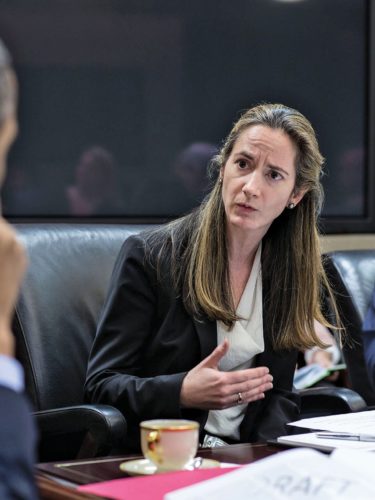
Rosa Brooks
Rosa Brooks is a professor at the Georgetown University Law Center, where she teaches courses on international law, failed states, atrocity law, and other subjects. She also serves as a Schwartz Senior Fellow at the New America Foundation. Brooks returned in July 2011 from a two year public service leave of absence, during which she served as Counselor to Under Secretary of Defense for Policy Michele Flournoy. During her time at the Defense Department, Brooks also founded the Office for Rule of Law and International Humanitarian Policy, and also led a major overhaul of the Defense Department's strategic communication and information operations efforts. In July 2011, she received the Secretary of Defense Medal for Outstanding Public Service. From 2005-2009, Brooks was a weekly op-ed columnist for the Los Angeles Times, and served as faculty director of GULC's Human Rights Institute. In 2006-2007, Brooks served as as Special Counsel to the President at the Open Society Institute in New York. From 2001-2006, she was an associate professor at the University of Virginia School of Law, where she taught human rights law, constitutional law, and criminal law. Brooks has also served as a senior advisor at the US Department of State, a consultant for Human Rights Watch, a fellow at the Carr Center at Harvard's Kennedy School of Government, a board member of Amnesty International USA, a Term Member of the Council on Foreign Relations, a lecturer at Yale Law School, a member of the Executive Council of the American Society of International Law, a member of the World Economic Forum's Global Agenda Council on Fragile States, the board of the National Security Network and the Steering Committee of the White Oak Foreign Policy Leaders Project. In addition to her popular writing, Brooks has written numerous scholarly articles on international law, failed states, post-conflict reconstruction and the rule of law, human rights, terrorism and the law of war. Her book, "Can Might Make Rights? The Rule of Law After Military Interventions," (with Jane Stromseth and David Wippman) was published in 2006 by Cambridge University Press. Her government and NGO work has involved field research in Iraq, Afghanistan, Indonesia, Israel, Palestine, Kosovo, China, Russia, Ghana, Kenya, Uganda, South Africa, and Sierra Leone, among other places. Brooks received her A.B. from Harvard in 1991 (history and literature), followed by a master's degree from Oxford in 1993 (social anthropology) and a law degree from Yale in 1996.
Barry Carter
In his earlier government service, Mr. Carter served as a senior counsel on the Senate Select Committee on Intelligence Activities. He was a member of Dr. Henry Kissinger's National Security Council staff from 1970-72, working on nuclear arms negotiations and other national security matters. While an Army officer, he was a program analyst in the Office of the Secretary of Defense. In the private sector, he is currently a member of the Advisory Council of Zurich's Credit and Political Risk group. From 1998 to 2007 he served on the board of directors of a U.S. international company that traded uranium products and other sensitive materials. He was a trial and appellate lawyer in private practice in California and Washington D.C. Since 2000, he has consulted in several cases involving international business and human rights. In academia, Mr. Carter, a native Californian, graduated Phi Beta Kappa from Stanford University, received a master's degree in economics and public policy from Princeton's Woodrow Wilson School of Public and International Affairs, and graduated from Yale Law School, where he was the Projects Editor of the Yale Law Journal. He served as Executive Director of the American Society of International Law during 1992-93. Prof. Carter's book on International Economic Sanctions: Improving the Haphazard U.S. Legal Regime (Cambridge Univ. Press: 1988) received the 1989 annual award from the American Society of International Law (ASIL) for the outstanding new book on international law subjects. He is the co-author of the widely used casebook on International Law (6th ed. 2011) and the editor of the accompanying Selected Documents (10th ed. 2011). He has also written chapters in books as well as publishing articles in the California Law Review, Yale Law Journal, Scientific American, Daedalus, Washington Post, Wall Street Journal and other periodicals. He is a member of the Council on Foreign Relations, the American Law Institute, ASIL, and the American Bar Association.
David Cole
After graduating from Yale Law School, Professor Cole served as a law clerk to Judge Arlin M. Adams of the United States Court of Appeals for the Third Circuit. Professor Cole then became a staff attorney for the Center for Constitutional Rights where he litigated a number of major First Amendment cases, including Texas v. Johnson, 491 U.S. 397 (1989), United States v. Eichman, 496 U.S. 928 (1990), which established that the First Amendment protects flag burning, and National Endowment for the Arts v. Finley, which challenged the constitutionality of content restrictions on federal art funding. He continues to litigate First Amendment and other constitutional issues as a volunteer staff attorney at the Center. He has published in a variety of areas, including civil rights, criminal justice, constitutional law and law and literature. He is the legal affairs correspondent for The Nation, a commentator on National Public Radio: All Things Considered, and the author of three books: Enemy Aliens: Double Standards and Constitutional Freedoms in the War on Terrorism (New Press, 2d ed. 2005); Terrorism and the Constitution: Sacrificing Civil Liberties for National Security (New Press, 3d ed. 2005) (with James X. Dempsey); and No Equal Justice: Race and Class in the American Criminal Justice System (New Press, 1999).
Viet Dinh
Viet D. Dinh A.B., J.D., Harvard. After law school, where he was a Class Marshal and an Olin Research Fellow in Law and Economics, Professor Dinh served as a law clerk to Judge Laurence H. Silberman of the U.S. Court of Appeals for the D.C. Circuit and to U.S. Supreme Court Justice Sandra Day O'Connor. He was Associate Special Counsel to the U.S. Senate Banking Committee for the Whitewater investigation and Special Counsel to U.S. Senator Pete V. Domenici for the impeachment trial of President Clinton. He also serves as counsel to the Special Master mediating a number of lawsuits by Holocaust victims against German and Austrian financial institutions. His representative writings include "Codetermination and Corporate Governance in a Multinational Business Enterprise" in the Journal of Corporation Law, "What is the Law in Law and Development?" in The Green Bag, and "Financial Sector Reform and Economic Development in Vietnam" in Law and Policy in International Business.
Laura Donohue
Laura Donohue is an Associate Professor of Law at Georgetown Law. She writes on the history of national security and counterterrorist law in the United States and United Kingdom. Her most recent book, The Cost of Counterterrorism: Power, Politics, and Liberty (Cambridge University Press, April 2008) analyzes the impact of American and British counterterrorist law on life, liberty, property, privacy, and free speech. Professor Donohue has held fellowships at Stanford Law School's Center for Constitutional Law, Stanford University's Center for International Security and Cooperation, and Harvard University's John F. Kennedy School of Government, where she was a Fellow in the International Security Program as well as the Executive Session for Domestic Preparedness. In 2001 the Carnegie Corporation named her to its Scholars Program, funding the project, Security and Freedom in the Face of Terrorism. She took up the award at Stanford, where she taught in the Departments of History and Political Science and directed a project for the United States Departments of Justice and State and, later, Homeland Security, on mass-casualty terrorist incidents. In 2008–09 she clerked for Judge John T. Noonan, Ninth Circuit Court of Appeals. She is a Life Member of the Council on Foreign Relations. Professor Donohue obtained her AB in Philosophy (with Honors) from Dartmouth College, her MA in Peace Studies (with Distinction) from the University of Ulster, Northern Ireland, her JD (with Distinction) from Stanford Law School, and her PhD in History from the University of Cambridge, England.
Neal Katyal
Before his appointment as Deputy Soliciter General on Jaunary 21, 2009, Katyal was a professor at Georgetown Law and the Director of the Center on National Security and the Law. In 2006, he prevailed in the US Supreme Court case of Hamdan v. Rumsfeld, challenging the policy of military trials at Guantanamo Bay Naval Station, Cuba. An expert in matters of constitutional law, particularly the role of the President and Congress in time of war and theories of constitutional interpretation, Katyal has embraced his theoretical work as the platform for practical consequences in the federal courts.
David A. Koplow
After graduating from Yale Law School in 1978, Professor Koplow served first as an attorney-advisor, then as special assistant to the Director of the U.S. Arms Control and Disarmament Agency. He has also served as secretary of the Lawyers Alliance for World Security and as a member of the Policy Board of Legal Counsel for the Elderly and the steering committee of Section 2 of the D.C. Bar. He has been at GULC since 1981. From 1997-99, while on leave from the Law Center, he served as Deputy General Counsel (International Affairs) at the Department of Defense. Professor Koplow teaches International Law I, and a seminar in the area of national security, arms control and non-proliferation. He also directs a clinic, the Center for Applied Legal Studies, which practices in the field of political asylum. He has written in the areas of international law, U.S. foreign affairs law, and arms control, especially regarding verification of compliance with arms control treaties.
Marty Lederman
Professor Lederman was Deputy Assistant Attorney General in the Department of Justice's Office of Legal Counsel from 2009 to 2010, and an Attorney Advisor in OLC from 1994-2002. From 1988 to 2004, he was an attorney at Bredhoff & Kaiser, where his practice consisted principally of federal litigation, including appeals, on behalf of labor unions, employees and pension funds. In 2008, with David Barron, he published a two-part article in the Harvard Law Review examining Congress's authority to regulate the Commander in Chief's conduct of war. Prior to rejoining the Department of Justice, he was a regular contributor to several blogs and web sites, including Balkinization, SCOTUSblog, Opinio Juris, and Slate, writing principally on issues relating to separation of powers, war powers, torture, detention, interrogation, international law, treaties, executive branch lawyering, statutory interpretation and the First Amendment. He served as law clerk to Chief Judge Jack B. Weinstein on the United States District Court for the Eastern District of New York, and to Judge Frank M. Coffin on the United States Court of Appeals for the First Circuit.
David Luban
David Luban is University Professor and Professor of Law and Philosophy at Georgetown Law, and the Acting Director of Georgetown's Center on National Security and the Law. His recent scholarship concerns international criminal law, just war theory, human rights, and the US torture debate. He is also an award-winning scholar of legal ethics. He has published more than 150 articles; his books have been translated into Chinese and Japanese. They include Lawyers and Justice (1988), Legal Modernism (1993), Legal Ethics and Human Dignity (2007) and, most recently, International and Transnational Criminal Law (2010) (with Julie O'Sullivan and David P. Stewart). Luban has held a Guggenheim Fellowship and Woodrow Wilson Fellowship. He has been visiting professor and Distinguished Senior Fellow in Legal Ethics at Yale Law School, and Leah Kaplan Visiting Professor of Human Rights at Stanford Law School. In spring 2011, he will be a fellow of the Institute for Advanced Studies at Hebrew University. Luban has written Slate.com, the Washington Post, and the Los Angeles Times; he is a member of the group legal blog Balkinization. He is a frequent speaker at universities in the United States, and has lectured in ten other countries. Luban served on the DC Bar's legal ethics committee, and chaired the Professional Responsibility Section of the Association of American Law Schools as well as the American Philosophical Association's committee on law and philosophy. In 2010 he participated in the Department of Defense's Cross-Domain Deterrence Initiative. His courses include: Legal Justice; International Criminal Law; International Human Rights; Just and Unjust Wars; Transnational Legal Theory; Advanced Legal Ethics.
Dakota Rudesill
Dakota Rudesill is a scholar and practitioner of legislation and national security law and policy, and serves as Interim Director of the Federal Legislation and Administrative Clinic (FLAC). Professor Rudesill has advised senior leaders in all three branches of the federal government. He worked for the U.S. Congress for nine years, principally as legislative assistant for national security to Senator Kent Conrad and the senior professional staff member for the U.S. Senate Budget Committee responsible for national defense and international affairs spending. In the executive branch, as a member of the Obama-Biden Presidential Transition Team, Professor Rudesill advised Dennis C. Blair, the President's nominee to be Director of National Intelligence, and Leon Panetta, the President's nominee to be CIA Director, as they prepared for confirmation by the U.S. Senate. Thereafter, he served for a year in the Policy, Plans, and Requirements directorate of the Office of the Director of National Intelligence (ODNI), during which he also served as ODNI representative to the Detention Policy Task Force established under Executive Order 13493 (Jan. 21, 2009). Previously, in the judicial branch, Professor Rudesill was a law clerk to James B. Loken, Chief Judge of the U.S. Court of Appeals for the Eighth Circuit.
Philip Schrag
Professor Schrag teaches Civil Procedure and directs the Center for Applied Legal Studies, in which students represent refugees from persecution who are seeking asylum in the United States. Before joining the Law Center faculty in 1981, he was assistant counsel to the NAACP Legal Defense Educational Fund, Consumer Advocate of the City of New York, a professor at Columbia University Law School, and Deputy General Counsel of the U.S. Arms Control and Disarmament Agency, from which he received a Meritorious Honor Award in 1981. He is also a prolific author, having written dozens of articles on consumer law, nuclear arms control, political asylum, and various other topics for both law journals and popular publications. He is the author, or co-author, of fourteen books, including Refugee Roulette: Disparities in Asylum Adjudication and Proposals for Reform (with Jaya Ramji-Nogales and Andrew I. Schoenholtz) (N.Y.U. Press 2009), Asylum Denied (with David Ngarurih Kenney) (Univ of California Press 2008) and the innovative professional responsibility textbook Ethical Problems in the Practice of Law (with Professor Lisa G. Lerman) (Aspen Publishers, 2d ed. 2008). He has been honored with the Association of American Law Schools' Deborah L. Rhode award for advancing public service opportunities in law schools through scholarship, service and leadership, Lexis/Nexis' Daniel Levy Memorial Award for Outstanding Achievement in Immigration Law, and the Outstanding Law School Faculty Award of Equal Justice Works, for leadership in nurturing a spirit of public service in legal education and beyond.
David P. Stewart
Professor Stewart joined the faculty as Visiting Professor of Law following his retirement from the U. S. Department of State, where he served as Assistant Legal Adviser for Private International Law. Previously he had been Assistant Legal Adviser for Diplomatic Law and Litigation, for African Affairs, for Human Rights and Refugees, for Law Enforcement and Intelligence, and for International Claims and Investment Disputes, as well as Special Assistant to the Legal Adviser. Before joining the government, he was in private practice with Donovan Leisure Newton & Irvine in commercial and antitrust litigation. He co-edited the multi-volume Digest of U.S. Practice in International Law for the years 1990-2003. He was Adjunct Professor for 25 years and received Georgetown's Charles Fahy award for distinguished adjunct faculty teaching in 2003-2004. In 2008 Prof. Stewart was elected to the Inter-American Juridical Committee, which advises the Organization of American States on juridical matters of an international nature and promotes the progressive development and the codification of international law. He is a member of the Board of Editors of the American Journal of International Law, vice-president of the American Branch of the International Law Association, and a member of the Executive Council of the ABA's Section of International Law. Professor Stewart directs the Global Law Scholars Program, co-directs the Center on Transnational Business and the Law, and teaches courses in public and private international law, foreign relations law, and international criminal law and civil litigation. With Professors Luban and O'Sullivan, he co-authored International and Transnational Criminal Law (Aspen 2009).
Jane Stromseth
Professor Stromseth teaches and writes in the fields of constitutional law, international law, human rights, international security, and post-conflict reconstruction. She is co-author of Can Might Make Rights? Building the Rule of Law After Military Interventions (2006); editor of Accountability for Atrocities: National and International Responses (2003); and author of The Origins of Flexible Response: The Debate Over NATO Strategy in the 1960s (1988). She has also written many articles on topics including constitutional war powers, humanitarian intervention, post-conflict justice, and law and the use of force. Professor Stromseth has served in government as Director for Multilateral and Humanitarian Affairs at the National Security Council and as an Attorney-Adviser in the Office of the Legal Adviser at the U.S. Department of State. Prior to joining the Law Center faculty in 1991, Professor Stromseth served as a law clerk to U.S. Supreme Court Justice Sandra Day O'Connor and to Judge Louis F. Oberdorfer of the U.S. District Court for the District of Columbia. Professor Stromseth is a member of the Council on Foreign Relations and serves on the Editorial Board of the American Journal of International Law. She received her doctorate in International Relations at Oxford, where she was a Rhodes Scholar, and her law degree at Yale, where she was a student director of the Lowenstein Human Rights Project.
Dean William M. Treanor
In 2010, Dean Treanor joined the Law Center from Fordham Law School, where he had been dean of the law school since 2002 and Paul Fuller Professor. He had been on the Fordham faculty since 1991. He has also been a visiting professor at the Sorbonne. From 1998-2001, Dean Treanor served as Deputy Assistant Attorney General in the Office of Legal Counsel, U.S. Department of Justice. From 1987-1990, he was associate counsel, Office of Independent Counsel, during the Iran/Contra investigation, and in 1990 he served as a special assistant U.S. attorney, Misdemeanor Trial Unit, Office of the U.S. Attorney for the District of Columbia. Dean Treanor was law clerk to the Honorable James L. Oakes, U.S. Court of Appeals for the Second Circuit, Brattleboro, Vermont. He has published widely, with a focus in constitutional law and legal history.
Carlos Manuel Vázquez
After graduating from law school, where he was Articles and Book Reviews Editor of the Columbia Law Review, Professor Vazquez served as a law clerk to the Honorable Stephen Reinhardt of the U.S. Court of Appeals for the Ninth Circuit. He then practiced law with Covington and Burling in Washington, DC, before joining the law school faculty as a visiting professor of law in 1990, and then as an associate professor in 1991. From 2000 to 2003, he was the United States member of the Inter-American Juridical Committee, the organ of the Organization of American States responsible for juridical matters and for promoting the progressive development and codification of international law in the Americas. Professor Vazquez has written and taught primarily in the areas of international law, constitutional law, and federal courts.