


When Small Nations Lead: The Pacific’s Climate Case to the World’s Highest Court
December 1, 2025 by Lana Aguon
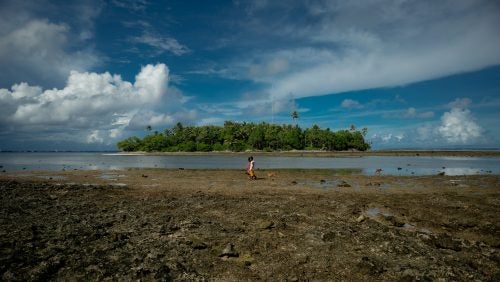
The Marshall Islands coping with the effects of climate change and rising sea levels. See below for image attribution.
A landmark ICJ advisory opinion, driven by Pacific leadership, defines states’ legal duties to address climate change and affirms the existential stakes for small island nations.
Across the Pacific, the climate crisis is not a distant threat – it is a daily reality. Rising seas swallow ancestral shorelines, saltwater intrusion destroys crops and freshwater sources, typhoons inundate homes, and weather events grow more intense each year.[1] These impacts threaten food systems shaped by generations of Indigenous knowledge and erode lands that serve as repositories of genealogy, culture, and spiritual identity.[2] In small island states such as Vanuatu, Fiji, Tuvalu, and the Marshall Islands, climate change is not merely environmental – it is existential, threatening the sovereignty and continuity of Indigenous lifeways.[3] Despite these climate-driven disasters, wealthy and high-emitting countries continue to weaken their climate commitments. 2025’s COP30, again, stalled on a fossil-fuel phaseout, and political rollbacks in major emitters, including the United States, have eroded environmental justice protections and regulatory safeguards.[4] Yet as global powers hesitated, Pacific nations pressed ahead, transforming this political inertia into one of the most significant legal achievements in climate governance – an achievement born not in global power centers, but in the islands most threatened by inaction.
Released in July 2025, the International Court of Justice (ICJ) – the world’s highest court – released its Advisory Opinion on the Obligations of States in Respect of Climate Change (AO), requested by Pacific Island nations and propelled by the persistence of Pacific youth. The AO affirms that states have binding obligations under international law to mitigate climate change, protect human rights threatened by its impacts, and support vulnerable nations.[5] For Pacific and Indigenous communities, the opinion validates that the struggle against climate change is fundamentally about cultural survival, territorial integrity, and the right to remain rooted in ancestral land.
The ICJ Opinion
The questions presented to the ICJ focused on two issues:
- States’ obligations under international law to protect the climate system and environment from human-caused greenhouse gas emissions.[6]
- The legal consequences when states breach those obligations – especially for small island states and for present and future generations affected by climate harm.[7]
Drawing from human rights law, the no-harm principle, customary international law, and the U.N. Convention on the Law of the Sea, the Court emphasizes that high-emitting states bear heightened responsibility.[8]
Key Findings of the Court:
- Climate action must be grounded in science.
- The ICJ affirms that the IPCC represents the “best available science.”[9]
- The 1.5°C limit is legally relevant and binding.
- All states must act – and cooperate in good faith – to limit warming to 1.5°C.[10] This includes ensuring that Nationally Determined Contributions (NDCs) and climate finance align with achieving this goal.
- States owe stringent due diligence.
- States must “use all the means at [their] disposal” to prevent harm to the climate system and to protect human rights.[11] This necessarily includes regulating fossil fuel production, consumption, licensing, and subsidies – the primary sources of greenhouse gas emissions. Failure to do so may constitute an internationally wrongful act.[12]
- NDCs must reflect the highest possible ambition – and must increase over time.
- States whose NDCs are insufficient breach their obligations.[13]
- Developed states owe financial support.
- Wealthy, high-emitting states must provide financial resources to assist developing states with both mitigation and adaptation.[14]
- Climate obligations exist beyond the UNFCCC and Paris Agreement.
- States also have binding duties under human rights law, the Law of the Sea, and customary international law.[15]
- All states – regardless of treaty membership – must prevent significant environmental harm.
- Even states not party to specific treaties must act with due diligence and cooperate to protect the climate system.[16]
- The right to a clean, healthy, and sustainable environment is foundational.
- It is a precondition for the enjoyment of all other human rights.[17]
- States that violate their obligations face legal consequences.
- Under the law of state responsibility, the ICJ confirms that violating climate obligations triggers:
- Duty of performance
- Cessation and guarantees of non-repetition (revoking harmful policies or licenses);[18]
- Duty to make reparation, including:
- Under the law of state responsibility, the ICJ confirms that violating climate obligations triggers:
This clarity empowers vulnerable nations to seek concrete commitments: phasing out fossil fuels, scaling up climate finance, and prioritizing adaptation support.
A Youth Movement That Reframed the Conversation
This historic achievement is inseparable from the leadership of Pacific and Indigenous youth. The ICJ advisory opinion originated with Pacific Island Students Fighting Climate Change (PISFCC), a youth-led network that refused to accept a future of forced migration.[22] They reframed climate change as a human rights crisis, mobilizing students across islands and diaspora communities, meeting with government leaders, and drafting legal arguments grounded in Indigenous worldviews and international law.[23]
Building on this momentum, Vanuatu, an island most at risk to climate change, advanced the initiative on the international stage.[24] Working closely with Pacific communities – and supported by Blue Ocean Law, led by Chamorro attorney Julian Aguon – their legal strategy was rooted in community needs, intergenerational responsibility, and Indigenous jurisprudence recognizing the inseparability of land, ocean, culture, and collective rights.[25]
For Pacific and Indigenous communities with a sacred and deep spiritual, cultural, and familial relationship with the land, the ICJ’s opinion affirms a long-held principle: harm to land constitutes harm to people. By converting lived experiences of loss and vulnerability into legally cognizable claims, the Court equips Pacific nations with a powerful tool for engaging high-emitting states and strengthens the broader pursuit of environmental justice.
A Path Forward Guided by Indigenous and Youth Leadership
In a world saturated with climate anxiety, the ICJ opinion stands as a rare source of hope. It demonstrates that youth and Indigenous leaders can reshape global legal structures through persistence, cultural grounding, and visionary thinking. Their leadership reminds the world that effective climate governance must center those with the most at stake – and those with the deepest knowledge of resilience, relationality, and responsibility. For the Pacific, this advisory opinion is not the end of the struggle – it is the legal foundation for the next chapter of climate justice. As the director of PISFCC, Vishal Prasad, declared after the landmark win: “The world’s smallest countries have made history…Young people around the world stepped up, not only as witnesses to injustice, but as architects of change.”[26] And if the world follows the lead of the smallest nations with the most to lose, a just and livable future remains possible.
Image attribution: Courtesy of the Asian Development Bank CC BY-NC-ND 2.0 DEED via Flickr. No changes were made to the image.
[1] P.D. Nunn et al., Traditional Knowledge for Climate Resilience in the Pacific Islands, 15 WIREs Climate Change e882 (2024), https://doi.org/10.1002/wcc.882.
[2] Id.
[3] Anna Elżbieta Kolendo, Beyond Climate Science: Cultural Loss in the Pacific Islands, Earth.Org (Mar. 20, 2023), https://earth.org/climate-change-pacific-islands/.
[4] Inayat Singh, COP30: Fossil-Fuels Transition Stalled as Brazil, Others Push Back, CBC (2025), https://www.cbc.ca/news/science/cop30-fossil-fuels-transition-brazil-climate-9.6990405.
[5] Lukas Schaugg, Natalie Jones & Jeffrey Qi, Historic International Court of Justice Opinion Confirms States’ Climate Obligations, International Institute for Sustainable Development (July 28, 2025), https://www.iisd.org/articles/deep-dive/icj-advisory-opinion-climate-change.
[6] Obligations of States in Respect of Climate Change (Request for Advisory Opinion), Advisory Opinion, 88, Int’l Ct. Justice (July 2025).
[7] Id.
[8] Climate Change Advisory Opinion, 174; 278.
[9] Id. at 244.
[10] Id.
[11] Id. at 281.
[12] Id. at 427.
[13] Id. at 234-49.
[14] Id. at 264-65.
[15] Id. at 171-73; 407-409.
[16] Id. at 315; 409.
[17] Id. at 393.
[18] Id. at 447-48.
[19] Id. at 451.
[20] Id. at 452-54.
[21] Id. at 455.
[22] See Martina Igini, “The Biggest Climate Case in History”: Behind the Campaign That Inspired the ICJ Advisory Opinion on Climate Change, Earth.Org (July 22, 2025), https://earth.org/the-biggest-climate-case-in-history-behind-the-campaign-that-inspired-the-icj-advisory-opinion-on-climate-change/.
[23] Id.
[24] Id.
[25] See Julian Aguon, Right Livelihood Laureate Profile, Right Livelihood Award (2025), https://rightlivelihood.org/the-change-makers/find-a-laureate/julian-aguon/.
[26] Jamie Tahana, “How Pacific Students Took Their Climate Fight to the World’s Highest Court. And Won.” RNZ News (Sept. 2025), https://www.rnz.co.nz/news/pacific/568334/how-pacific-students-took-their-climate-fight-to-the-world-s-highest-court-and-won.