


Between Celebration and Contamination: Rethinking Fireworks in a Climate-Conscious Era
January 20, 2026 by Charlie Kabelac
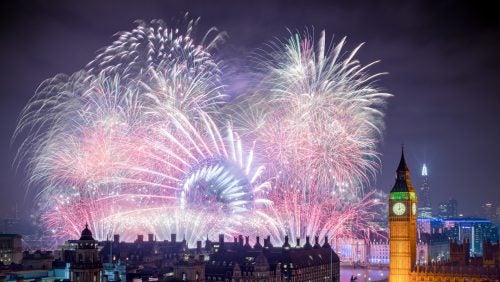
Fireworks look beautiful for just a few moments, while their effects on the environment persist. See below for image attribution.
Fireworks remain a popular form of celebration for holidays, festivals, or other occasions. Yet, mounting research on environmental pollution, animal disturbance, and health hazards raises questions about their justifiability, especially as more sustainable alternatives emerge.
Fireworks are a cornerstone of many cultural celebrations as they serve as a sign of joy and light.[1] This year, again, fireworks were a central part of New Year celebrations around the world. Many cities across the United States and Europe exhibited Air Quality Indexes of 100 and above, some reaching almost 200 shortly after the clock hit midnight.[2] For reference, scores above 100 are considered unhealthy for sensitive groups, whereas scores above 150 are considered unhealthy for the general public.[3] Overall firework usage in the United States rose consistently until 2022, then dropped in 2023, and increased again in 2024.[4] Over 90% of consumption occurs privately, as opposed to public displays.[5]
Despite fireworks’ cultural and traditional importance, their negative environmental impacts are extensively documented. The explosives heavily impact air quality, releasing high concentrations of pollutant gases such as SO2, NO, NO2, and CO.[6] The explosions also create large amounts of smoke that negatively impact human respiratory health.[7]
Moreover, they significantly increase the concentration of PM2.5, particles smaller than 2.5 micrometers that can penetrate into human and animal respiratory systems and bloodstreams.[8] A study of Chinese New Year fireworks in Shanghai measured more than a 10-fold increase of PM2.5 within a few hours of the opening ceremony, with fireworks contributing up to 90.5% of PM2.5 in Shanghai during the 2013 Festival.[9]
Fireworks further produce large amounts of waste that remain on soil, roads, parks, surface waters, and other outdoor areas for long periods of time after the initial explosions.[10] In addition to their fire hazard, this negatively impacts habitats for many animals, who are also heavily disturbed by the auditory and visual effects of fireworks.[11]
Firework bans around the world show promising results, though: A firecracker ban in New Delhi during the Diwali festival resulted in an average decrease of 18% in nanoparticles in the city.[12] A total ban on fireworks that will take effect this year in the Netherlands is predicted to save up to 9 million kg of paper and cardboard, 230 tons of plastic, avoid the dispersal of over 170,000 kg of barium, 87,000 kg of copper, and 55,000 kg of strontium, eliminate almost 5% of total annual fine dust emissions in the Netherlands, while directly saving over 600 tons of CO2 emissions from the combustion, global production, and transport of fireworks[13]. These studies show that environmental impacts in urban regions can be reduced significantly by the proper implementation of policy and participation from citizens.
Instead, communities can turn to light or drone shows as a substitute to celebrate special occasions.[14] For example, the French city of Nancy attracts many tourists over the summer with its stunning lights installation at Place Stanislas, its central square with beautiful 18th century urban architecture that was declared a UNESCO world heritage site in 1983.[15] And here in D.C., on New Year’s Eve, the Washington Monument lit up as part of a lights show dedicated to the upcoming 250-year celebrations across the country.[16]
Even if communities do not want to fully part from fireworks, there are more sustainable alternatives to the currently used pyrotechnics. A study from 2022 developed a different fabrication method for a free-standing polymer composite film firework made from magnesium boride, sodium nitrite, and poly.[17] This composite produces sparkle, color, and moderate sound while avoiding many traditional pyrotechnic ingredients such as charcoal, sulfur, metal powders, and paper, which are associated with higher emissions and waste.[18] Because of this formulation, the film firework significantly reduces odor, COₓ, and NOₓ emissions, and minimizes trash generated during burning.[19]
Therefore, we need to ask ourselves if fireworks are still a justifiable mode of celebration, considering the environmental effects on air quality and wildlife and the viable alternatives available.
Image: SIMarsden via Wikimedia Commons, CC BY-SA 4.0.
[1] See e.g., Kevin Salatino, Incendiary Art: The Representation of Fireworks in Early Modern Europe (1997); Alba Colombo, Jaime Altuna & Esther Oliver-Grasiot, Playing With Fire Collectively: Contemporary Cultural Rites as Devisers and Outcomes of Community Networks, 25 Event Mgmt. 57, 65 (2021).
[2] New Year’s Eve Fireworks and Air Quality, IQAir (Jan. 1, 2026), https://www.iqair.com/newsroom/new-year-s-eve-fireworks-and-air-quality.
[3] Air Quality Index Scale and Color Legend, World Air Quality Index Project, https://aqicn.org/scale/
(last visited Jan. 15, 2026).
[4] U.S. Fireworks Consumption Figures: 2000–2024, Am. Pyrotechnics Ass’n, https://www.americanpyro.com/assets/docs/FactsandFigures/2025/APA%20Facts%20and%20FiguresConsumption_2024.pdf (last visited Jan. 15, 2026).
[5] Id.
[6] Imre Salma et al., Firework Smoke: Impacts on Urban Air Quality and Deposition in the Human Respiratory System, 328 Env’t Pollution 121612 (2023).
[7] Id.
[8] Id.; Kanagaraj Rajagopal, Vignesh Mohan & Rajeev Kumar Mishra, Are Delhi Residents Exposed to Lesser Particle Number Concentration Due to the Firework Ban in the City?, 17 Air Quality, Atmosphere & Health 1617, 1624 (2024).
[9] Lan Yao et al., The Effects of Firework Regulation on Air Quality and Public Health During the Chinese Spring Festival From 2013 to 2017 in a Chinese Megacity, 126 Env’t Int’l 96, 104 (2019).
[10] Salma et al., supra note 6.
[11] Else Verbeek et al., Fireworks and Animals: A Review of Animal Welfare and Legislation, Swed. Ctr. for Animal Welfare & Swedish Univ. of Agric. Sci. (2025).
[12] Kanagaraj Rajagopal, Vignesh Mohan & Rajeev Kumar Mishra, supra note 8.
[13] The Dutch Fireworks Ban: What Are the Environmental Benefits?, Hedgehog (Dec. 22, 2025), https://www.hhc.earth/knowledge-base/articles/the-dutch-fireworks-ban-what-are-the-environmental-benefits.
[14] See e.g., Pavlo Fedykovych, Here Are the 8 Best Drone Shows Ever, Kitcast Blog (Oct. 27, 2024), https://blog.kitcast.tv/best-drone-shows-ever/.
[15] See Sound-and-Light Show in Place Stanislas, Nancy Tourisme, https://www.nancy-tourisme.fr/en/to-see-to-do/agenda-and-major-events/sound-and-light-show-in-place-stanislas/ (last visited Jan. 15, 2026); Sound and Light Shows for a Sparkling Summer in Eastern France!, Explore Grand Est: Le Mag, https://www.explore-grandest.com/en/magazine/les-spectacles-son-et-lumiere-pour-vivre-un-ete-etincelant-dans-le-grand-est‑4/ (last visited Jan. 15, 2026).
[16] Ida Domingo, Washington Monument to Glow With New Year’s Eve Projection Show, WJLA (Dec. 30, 2025), https://wjla.com/features/dmv-250/story/washington-monument-light-up-projections-new-years-eve-freedom-250-america-birthday-national-mall-dc-events-lighting-show-us-history-2026-anniversary-tourism-public-celebration-historical-landmark.
[17] Vijayakrishnan Jeyavani et al., MgB₂/NaNO₂–PVA Free-Standing Polymer Composite Film as a Green Firework: A Step Towards Environmental Sustainability, 45 Bull. of Material Sci. 175 (2022).
[18] Id.
[19] Id.