

Oil, Sovereignty, and Environmental Collapse: Environmental Law and U.S. Intervention in Venezuela
January 21, 2026 by Hope Pohlman
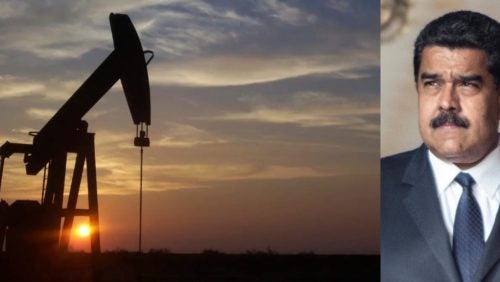
A pumpjack used to extract oil, similar to those operating in Venezuela, alongside an image of Nicolás Maduro, Venezuela’s deposed former President, currently in U.S. custody awaiting trial. See below for image attribution.
U.S. intervention in Venezuela raises urgent questions about sovereignty, international law, and the environmental costs of reviving heavy, carbon-intensive oil production.
On January 3, 2026, U.S. forces conducted a military operation in Venezuela, removing President Nicolás Maduro from power and transporting him to New York to face U.S. federal charges related to narcotics trafficking and terrorism.[1] Following the operation, President Trump stated at a news conference at Mar-a-Lago that the United States would “run the country until such time as we can do a safe, proper and judicious transition.”[2]
Explicitly included in this plan to “run” Venezuela was the assertion of control over the country’s vast oil reserves. Since January 3, President Trump has repeatedly stated that he intends to “get the oil flowing,”[3] that he “expect[s] the United States [will] be running Venezuela and extracting oil from its huge reserves for years,”[4] and that the US plans to take “30 million to 50 million barrels of oil” from Venezuela.[5] President Trump claims the oil rightfully belongs to the United States:
“Venezuela unilaterally seized and sold American oil, American assets and American platforms, costing us billions and billions of dollars… This constituted one of the largest thefts of American property in the history of our country.”[6]
Senior administration officials have reinforced this position. Trump’s Energy Secretary, Chris Wright, stated that the United States intended to maintain significant control over Venezuela’s oil industry, including overseeing the sale of the country’s oil production “indefinitely.” [7] Similarly, Secretary of State Marco Rubio stated that “[they] are in the midst right now and in fact about to execute on a deal to take all the oil” with Venezuela’s state-owned oil company, Petróleos de Venezuela (PDVSA).[8] PDVSA subsequently issued a statement confirming that negotiations were taking place.[9] Although it has barely been weeks since Maduro’s capture, the pace and scope of these developments raise a number of legal, political, and environmental questions.
Why Venezuela?
Venezuela has the world’s largest proven oil reserves, estimated at 303 billion barrels as of 2023, and more than five times the amount held by the United States.[10] These resources are controlled by PDVSA, Venezuela’s state-owned oil company. In the late 1990s, PDVSA regularly exported significant quantities of oil to the United States.[11] However, political instability, mismanagement within PDVSA, chronic underinvestment, and sanctions targeting Venezuela’s energy sector have led to a sharp decline in oil production and exports.[12]
The nature of Venezuela’s oil further contributes to its strategic importance: it is extra-heavy crude oil, highly viscous and dense, making it harder and more expensive to extract than conventional crude oil.[13] As a result, it typically sells at a discount compared to lighter oil.[14] Refining this oil also requires specialized techniques and infrastructure capabilities in which U.S. refineries, particularly those in Texas and Louisiana, have historically excelled.[15]
Beyond oil, Venezuela also possesses substantial natural gas reserves, as well as significant deposits of gold, coal, and iron.[16] Together, these natural resources make Venezuela particularly attractive to U.S. strategic and economic interests. Since the beginning of President Trump’s second term, the administration has increasingly focused on Venezuela, including conducting more than 30 strikes on vessels alleged to be transporting drugs from Venezuela[17] and seizing five oil tankers accused of circumventing U.S. sanctions.[18]
Why does Trump claim that this oil belongs to the US?
Prior to the 1970s, Venezuela’s oil industry was dominated by foreign companies. In 1976, President Carlos Andrés Pérez nationalized the sector, creating PDVSA and placing all oil production, refining, and exportation under state control. Foreign companies were thereafter required to contract with PDVSA to operate in Venezuela.[19] U.S. companies including Exxon, Chevron, and ConocoPhillips entered into such arrangements.[20]
In 1992, Hugo Chávez—a military officer—launched a failed coup before being elected president in 1998 on a socialist platform. Although some of Chávez’s policies expanded social services and reduced poverty, others contributed to the long-term decline of Venezuela’s oil industry.[21] In 2003, Chávez dismissed thousands of experienced PDVSA employees following an industry strike, severely undermining the company’s technical capacity.[22]
In 2007, Chávez expanded nationalization efforts by requiring foreign companies to transfer majority ownership of their oil ventures to PDVSA. Exxon and ConocoPhillips failed to reach agreements and subsequently had their Venezuelan assets seized. [23] Both companies (along with many others) pursued arbitration and obtained favorable rulings, but many awards went unpaid. As Luisa Palacios, adjunct senior research scholar at Columbia University’s Center on Global Energy Policy, explains “[t]he value of these liabilities is estimated at $20 to $30 billion or about 10% to 15% of the almost $200 billion in international debt obligations Venezuela owes.”[24]
Chávez also dismantled institutional constraints on executive power, including removing presidential term limits and exerting control over the judiciary.[25] These actions laid the groundwork for Nicolás Maduro’s consolidation of power after assuming office in 2013.[26] Following the collapse of global oil prices in 2014, Venezuela’s economy deteriorated rapidly. Maduro responded to growing unrest with repression, censorship, and electoral manipulation, securing reelection in 2018 in a contest widely condemned as undemocratic.[27]
The convergence of Venezuela’s vast oil reserves, unresolved debts to U.S. oil companies, and Maduro’s authoritarian rule ultimately culminated in the U.S. intervention and capture of Maduro in January 2026. Although the charges of narcotics trafficking and terrorism may not be baseless, their invocation also appears to function as a legal justification for U.S. involvement in a resource-rich state.
What are the potential environmental effects from U.S. involvement in Venezuelan oil production?
The United States’ increased role in Venezuela’s oil industry has sparked concern that ramped-up production, especially of heavy, carbon-intensive crude, will magnify environmental degradation[28]. Venezuelan oil is sulfur-rich and significantly more energy-intensive to extract and refine than lighter crude.[29] Years of underinvestment have also left Venezuela with deteriorating infrastructure, including aging pipelines, damaged wellheads, and poorly maintained refineries, increasing the risk of oil spills, methane leaks, and excessive gas flaring. Expanded production is also likely to accelerate deforestation and ecosystem damage in sensitive coastal, wetland, and rainforest regions.[30]
Heavy crude extraction often occurs in wetlands, slow-moving river systems, and coastal areas where contamination spreads easily and persists for long periods.[31] Sites such as Lake Maracaibo and protected coastal parks have already suffered long-term pollution that has devastated fisheries, coral reefs, and local livelihoods.[32] Experts note that even modest increases in output could generate carbon emissions comparable to those of entire countries, with far greater climate impacts once the oil is ultimately burned by consumers.[33]
While U.S. officials and some industry analysts argue that new investment could improve efficiency and environmental performance through modern technology, critics caution that rapid production increases tend to prioritize output over safeguards.[34] U.S. policy statements have focused largely on controlling oil revenues and infrastructure repairs, with little attention to environmental oversight or climate consequences.[35] As a result, Venezuela’s oil revival highlights a broader concern: geopolitical interventions and sanctions regimes can accelerate environmental degradation in already vulnerable states, while leaving questions of accountability, remediation, and long-term ecological cost largely unaddressed.
Image at left is dedicated to the public domain.
Image at right: Eneas De Troya via Wikimedia Commons, CC BY-SA 4.0.
[1] Kiki Intarasuwan, Emily Mae Czachor, Joe Walsh, & Melissa Quinn, Ousted Venezuelan President Maduro arraigned in U.S. court; Trump threatens other nations, CBS News (January 6, 2026, at 06:16 ET), https://www.cbsnews.com/live-updates/venezuela-trump-maduro-charges/.
[2] Alexandra Marquez, Tom Winter, Chloe Atkins & Daniella Silva, Maduro arrives in New York as Trump says U.S. will govern Venezuela until there’s a ‘proper transition’, NBC News, (January 3, 2026, at 12:01 EST), https://www.nbcnews.com/politics/white-house/trump-venezuela-nicolas-maduro-strikes-run-country-transition-military-rcna252044.
[3] Jennifer Jacobs, Joe Walsh, James LaPorta, & Tucker Reals, Trump says U.S. is “in charge” of Venezuela, Maduro jailed in New York after U.S. military operation, CBS News (January 5, 2026, at 04:37 ET), https://www.cbsnews.com/live-updates/venezuela-us-military-strikes-maduro-trump/.
[4] David E. SangerTyler PagerKatie Rogers & Zolan Kanno-Youngs, Trump Says U.S. Oversight of Venezuela Could Last for Years, The New York Times (January 8, 2026), https://www.nytimes.com/2026/01/08/us/politics/trump-interview-venezuela.html.
[5] Regina Garcia Cano, Aamer Madhani, & Megan Janetsky, Trump says US to get 30 million to 50 million barrels of oil from Venezuela at market price, AP News (January 6, 2026, at 20:28 EST), https://apnews.com/article/venezuela-trump-democrats-9d16138866bebdc2644eb009c6326066.
[6] Aimee Picchi, Trump says Venezuela stole American oil. Here’s what really happened, CBS News (January 9, 2026, at 23:13 EST), https://www.cbsnews.com/news/trump-venezuela-oil-assets-theft-explainer/.
[7] Rebecca F. Elliott and Robert Jimison, U.S. Sets Out Bare-Bones Plan to Control Venezuela’s Oil Sales, The New York Times (January 2, 2026), https://www.nytimes.com/2026/01/07/business/energy-environment/us-venezuela-oil-control.html.
[8] Id.
[9] Id.
[10] Hanna Duggal and Marium Ali, What resources does Venezuela have — apart from the world’s most oil?, Aljazeera (January 8, 2026), https://www.aljazeera.com/news/2026/1/8/what-resources-does-venezuela-have-apart-from-the-worlds-most.
[11] Johani Carolina Ponce, Five keys to understanding Venezuela’s oil history, Yale Climate Connections (January 9, 2026), https://yaleclimateconnections.org/2026/01/five-keys-to-understanding-venezuelas-oil-history/.
[12] Duggal, supra note 12.
[13] Jillian Ambrose, Dense, sticky and heavy: why Venezuelan crude oil appeals to US refineries, The Guardian (January 5, 2026, at 11:27 EST), https://www.theguardian.com/business/2026/jan/05/venezuelan-crude-oil-appeals-to-us-refineries.
[14] Id.
[15] Duggal, supra note 12.
[16] Id.
[17] US kills five in attack on alleged drug boats, search for survivors ongoing, Aljazeera (January 1, 2026), https://www.aljazeera.com/news/2026/1/1/us-kills-three-in-attack-on-alleged-drug-boats-searches-for-survivors#:~:text=That%20individual%20was%20not%20found,out%20covert%20operations%20in%20Venezuela.
[18] Konstantin Toropin, Aamer Madhani, & Michael Biesecker, US intercepts fifth sanctioned tanker as it exerts control over Venezuelan oil distribution, AP News (January 10, 2026, at 15:20 EST), https://apnews.com/article/sanctioned-oil-tanker-intercepted-c3b6e0cee49af87f78a22425f505249d.
[19] Ponce, supra note 13.
[20] Picchi, supra note 8.
[21] Ponce, supra note 13.
[22] Id.
[23] Picchi, supra note 8.
[24]Id.
[25] A Decade Under Chávez: Political Intolerance and Lost Opportunities for Advancing Human Rights in Venezuela, Human Rights Watch (September 18, 2008), https://www.hrw.org/report/2008/09/18/decade-under-chavez/political-intolerance-and-lost-opportunities-advancing-human.
[26] Ponce, supra note 13.
[27] Id.
[28]Steven Grattan, Why boosting production of Venezuela’s ‘very dense, very sloppy’ oil could harm the environment, AP News (January 9, 2026, 10:24 EST) https://apnews.com/article/venezuela-oil-pollution-0485a3d37f474bacb478e1d5160736fd.
[29] Laura Paddison, What happens to the planet if Trump gets his hands on all of Venezuela’s oil?, CNN Climate, (January 7, 2026), https://www.cnn.com/2026/01/07/climate/venezuela-oil-dirty-emissions-methane.
[30] Grattan, supra note 40.
[31] Lake Maracaibo Ecosystem, EBSCO Knowledge Advantage, https://www.ebsco.com/research-starters/science/lake-maracaibo-ecosystem.
[32] Id.
[33] Grattan, supra note 40.
[34] Id.
[35] Id.