

The Pending Fate of Climate Superfund Statutes
January 29, 2026 by Kristina McKean
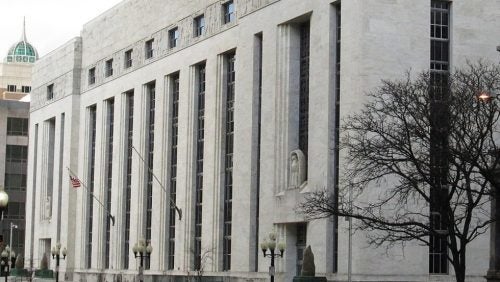
The James T. Foley United States Courthouse in the Northern District of New York, where West Virginia v. James is taking place. See below for image attribution.
Litigation challenging climate superfund statutes in New York and Vermont will continue to unfold in 2026, potentially providing insights to other states considering similar statutes.
Under pressure to adapt to the impacts of climate change and without sufficient funding, some states have turned to a familiar old principle: the polluter pays. Climate superfund statutes are innovative cost recovery statutes modeled off the Comprehensive Environmental Response, Compensation, and Liability Act (CERCLA) which seek to recover costs from fossil fuel polluters for use in state adaptation projects.[1] In 2024, Vermont and New York became the first two states in the country to pass climate superfund legislation.[2] In the spirit of CERCLA, the climate superfund laws impose a strict liability scheme, but cover greenhouse gas (GHG) emissions rather than hazardous substances.[3] The statutes define a covered period and indicate that entities “engaged in the trade or business of extracting fossil fuel or refining crude oil” that emitted more than 1 billion tons of GHG during the covered period are “responsible parties” liable to the state for cost recovery payments.[4] Liability will be determined by the entities’ proportional share of GHG contribution during the covered period.[5]
Though neither statute is scheduled to be implemented until 2028, both predictably face significant legal challenges.[6] The first lawsuit against Vermont’s statute, Chamber of Commerce of the United States of America v. Moore, was filed in December 2024 by the American Petroleum Institute and the U.S. Chamber of Commerce and argued claims of federal preclusion, federal preemption under the Clean Air Act, 14th amendment Due Process Clause violation, Commerce Clause violation, excessive fines, and Takings Clause violation.[7] A similar coalition of plaintiffs filed a lawsuit against New York in Chamber of Commerce of the United States of America v. James in February 2025, putting forth the same claims.[8] New York was also sued by a group of 22 states, led by West Virginia along with various industry groups in State of West Virginia v. James in February 2025.[9] This case was consolidated with Chamber of Commerce v. James following a motion by defendants.[10]
The states faced even more legal scrutiny over the two statutes when the second Trump administration took power and turned its focus to energy issues.[11] On April 8, 2025, the President issued Executive Order 14260 which specifically instructed the Attorney General to take action against the climate superfund statutes.[12] In quick order, the U.S. government filed nearly identical complaints against Vermont and New York regarding their respective statutes in May 2025, arguing Clean Air Act preemption, unconstitutional extraterritorial regulation, Interstate Commerce Clause violation, Foreign Commerce Clause violation, and Foreign Affairs preemption.[13]
Currently, all four cases brought against these climate superfund statutes remain undecided. Vermont has filed a Motion to Dismiss under Rule 12(b)(6), failure to state a claim in both Chamber of Commerce v. Moore and United States v. Vermont.[14] Meanwhile, plaintiffs have filed motions for summary judgement in both of these cases.[15] Turning to New York, in United States v. New York, only plaintiffs have been permitted to file a motion for summary judgment. Defendants must wait for the court’s response to this motion before filing their own motion for summary judgment.[16] In West Virginia v. James, both plaintiffs and defendants have filed motions for summary judgment and are awaiting decision.[17]
Despite the onslaught of legal challenges and amidst the retreat of federal funding from climate change and adaptation, other states continue to consider enacting their own climate superfund legislation.[18] In 2025, eleven other states introduced similar climate superfund bills to address rising adaptation costs.[19] Legislation in California, New Jersey, Massachusetts, Maine, and Hawaii is still pending, while bills in other states have thus failed to pass.[20] It remains to be seen how other states will act in response to litigation against Vermont and New York. States may be waiting for the outcome of these lawsuits s to adapt their statutes accordingly. After the first complaint was filed against New York in February 2025, the state immediately amended its statute, adding in a clause limiting liability to those entities with sufficient connection to the state and narrowing the covered industry to fossil fuel producers only.[21] Though it is currently unclear how the courts will decide these cases, progress on the litigation in 2026 may help inform other states as they consider how to draft and pass these innovative laws.
Image: Beyond My Ken via Wikimedia Commons (CC BY-SA 4.0).
[1] See Amanda G. Halter, Ashleigh K. Myers & Jillian Marullo, New York’s “Climate Superfund” Bill Becomes Law, Part of a Trend, Pillsbury Law (Jan. 6, 2025), https://www.pillsburylaw.com/en/news-and-insights/climate-superfund-new-york.html.
[2] Id.
[3] Id.
[4] Vt. Stat. Ann. tit. 10 § 596(22) (2025); NY. Env. Conserv. L. § 76-0101(20) (LexisNexis 2025)
[5] Vt. Stat. Ann. tit. 10 § 598(b) (2025); NY. Env. Conserv. L. § 76-0103(3) (LexisNexis 2025)
[6] See The State’s Opposition to the United States’ Motion for Summary Judgement at 3, United States v. New York (No. 1:25-cv-03656-PKC) (2025); Memorandum of Law in Support of Defendants’ Motion to Dismiss at 2, Chamber of Commerce v. Moore (No. 2:24-cv-01513) (2025); United States v. Vermont (No. 2:25-cv-00463) (2025).
[7] Complaint for Declaratory and Injunctive Relief, Chamber of Commerce v. Moore (No. 2:24-cv-01513) (2024).
[8] Complaint for Declaratory and Injunctive Relief, Chamber of Commerce v. James (No. 1:25-cv-01738) (2025).
[9] Amended Complaint for Declaratory and Injunctive Relief, West Virgina v. James (No. 1:25-cv-00168-BKS-DJS).
[10] Order on Letter Request, State of West Virginia v. James(2025) (No. 1:25-cv-00168)
[11] See Exec. Order No. 14260, 90 Fed. Reg. 15513 (Apr. 14, 2025).
[12] Id.
[13] Complaint for Declaratory and Injunctive Relief, United States v. New York (No. 1:25-cv-03656) (2025); Complaint for Declaratory and Injunctive Relief, United States v. Vermont (No. 2:25-cv-463) (2025).
[14] Memorandum of Law in Support of Defendants’ Motion to Dismiss at 21, Chamber of Commerce v. Moore (No. 2:24-cv-01513) (2025); United States v. Vermont (No. 2:25-cv-00463) (2025).
[15] Chamber of Commerce of the United States of America v. Moore (2:24-cv-01513), CourtListener (Jan. 16, 2026), https://www.courtlistener.com/docket/69506206/chamber-of-commerce-of-the-united-states-of-america-v-moore/#entry-102; United States of America v. State of Vermont (2:25-cv-00463), CourtListener (Jan. 16, 2026), https://www.courtlistener.com/docket/70031549/united-states-of-america-v-state-of-vermont/#entry-50.
[16] United States of America v. State Of New York (1:25-cv-03656), CourtListener (Nov. 20, 2025), https://www.courtlistener.com/docket/70033074/united-states-of-america-v-state-of-new-york/#entry-81.
[17] State of West Virginia v. James (1:25-cv-00168), CourtListener (Jan. 17, 2026), https://www.courtlistener.com/docket/69620305/state-of-west-virginia-v-james/?page=2#entry-230.
[18] See, e.g., Olivia Guarna & Amy Turner, 100 Days of Trump 2.0: The Inflation Reduction Act, Climate Law (Apr. 29, 2025), https://blogs.law.columbia.edu/climatechange/2025/04/29/100-days-of-trump-2-0-the-inflation-reduction-act/; Seth Brown, The urgency of flood mitigation: Who is going to pay for all of this? Stormwater Solutions (Sep. 3, 2025), https://www.stormwater.com/stormwater-management/flood-control/article/55304117/the-urgency-of-flood-mitigation-who-is-going-to-pay-for-all-of-this.
[19] Amanda Halter, Ashleigh Myers & Jilliam Marullo, Climate Superfund Map, Pillsbury Law (Nov. 25, 2025) https://www.pillsburylaw.com/en/news-and-insights/climate-superfund-map.html.
[20] Id.
[21] Amanda Halter, Ashleigh Myers & Jilliam Marullo, The Battle over Climate Superfund Laws: Legal Challenges in Vermont and New York, Pillsbury Law (Apr. 4, 2025) https://www.pillsburylaw.com/en/news-and-insights/climate-superfund-laws-vermont-new-york.html.