


Environmental Protection at Risk: Greenland, Indigenous Stewardship, and the Costs of U.S. Intervention
February 2, 2026 by Katie Brateanu
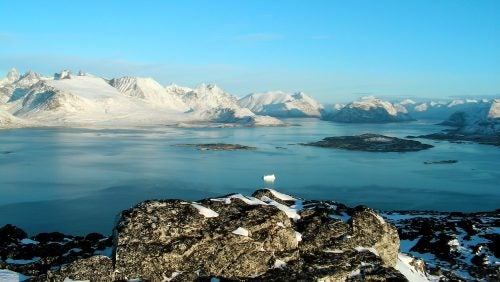
Ice caps in Nanortalik, Greenland. See below for image attribution.
Trump’s pursuit of Greenland threatens its environment, established protections, and Indigenous knowledge systems, revealing how geopolitics can sideline climate vulnerability and those who safeguard it.
The autonomous territory of Greenland is home to roughly 57,700 people,[1] 89 percent of whom are the Kalaallit Inuit.[2] Spanning approximately 2.16 million square kilometers, the world’s largest island, despite its misleading name, is largely covered by an ice sheet and remains sparsely populated.[3] Historically, questions over Greenland’s independence and territorial sovereignty have focused on its relationship with Denmark.[4] Today, a far more brooding fear has taken hold: the unwelcome intervention of Donald Trump and the United States.
Since his first term in 2019, Trump has expressed his desire to purchase and exert control over Greenland, citing concerns over Russian and Chinese military activity in the region.[5] In doing so, he has brushed aside the sentiments of Greenlanders who have consistently asserted their right to self-determination and independence.[6] Remarks from Washington have triggered widespread condemnation, reviving long-standing anxieties about being treated as a strategic asset rather than as a people.[7] Those fears have been compounded by Trump’s willingness to sidestep international norms and his growing military prowess, intensifying concerns that Greenland could become the next stage for geopolitical brinkmanship.[8]
Beyond the blatant disregard for Greenlandic autonomy, increased U.S. influence poses another serious threat: the erosion of environmental protections that sit at the core of Greenlandic cultural and political life. Although Greenland possesses some of the world’s richest reserves of natural resources,[9] it has historically resisted extractive development, instead favoring a policy of environmental protectionism and regulation.[10] Under Greenland’s Mineral Resources Act, for example, all major development projects must undergo an Environmental Impact Assessment (EIA), and in some instances, a Social Sustainability Assessment (SSA) prior to approval.[11] Crucially, the Act requires companies to implement mitigation measures to minimize environmental damage and assigns full liability for ecological harm through compensation requirements.[12]
This commitment to environmental protection is reflected in Greenland’s political landscape.
In 2021, the left-wing Inuit Ataqatigiit party won parliamentary elections on a platform centered on halting mining projects and strengthening environmental policies.[13] Following their election, the party enacted legislation banning mining that would release radioactivity into the environment, reflecting both the will of the Greenlandic public and the government’s understanding of its responsibility to protect its citizens from long-term environmental harm.[14]
Greenland’s environmental governance also emphasizes the role of Indigenous Knowledge (IK), particularly in the context of impact assessments and long-term stewardship. EIA guidelines for mineral exploitation require the consultation of traditional users, local hunters, and local fishermen.[15] While IK has yet to be formally included, there is increasing discussion around its broader application and need.[16] Groups like the Inuit Circumpolar Council (ICC), an international Indigenous Peoples’ organization and permanent member of the Arctic Council, have played a central role in advocating for the use of IK in environmental research and in the collection of information on ecosystem services.[17] These conversations remain ongoing, with many emphasizing the need for stronger and more consistent incorporation of IK in Greenland’s environmental policies.[18] Nonetheless, Greenland’s approach reflects broader Arctic systems in which Indigenous livelihoods are closely tied to the surrounding land, and where generations of observation and knowledge have produced sophisticated land management practices.[19]
It is precisely these ecosystems, belief systems, and protections that are at risk from an expanded U.S. presence. The very resources Greenlanders seek to protect have become a source of interest for Trump. Although the President has framed acquisition as a matter of national security, his own statements, claiming that a framework deal with NATO would include rights to rare-earth minerals, suggest a geopolitical motivation.[20] Even if national security were his sole justification, Trump’s dismissive stance on climate change threatens to undermine decades of Greenlandic environmental protectionism. Increased militarization and traffic to and from the island would likely accelerate ice sheet melting, further exacerbating environmental degradation while simultaneously making the territory more accessible for exploitation.[21] While Trump has reportedly stepped back from overt threats to seize the island, he now claims to be laying the groundwork for a future agreement, one that, by his own admission, would ensure that he “will have everything [he] wants.”[22]
The United States’ evolving attitudes towards Greenland reflect the broader geopolitics of the area. Global powers such as the United States, Russia, and China increasingly view the Arctic as a strategic frontier.[23] Climate change has only heightened its appeal. As warming northern waters become easier and less costly to navigate, new shipping lanes and commercial opportunities are emerging.[24] Russia has already begun developing a Northern Sea Route, deploying ice breakers to create routes for massive cargo vessels.[25] In this context, environmental degradation is no longer merely a consequence of geopolitical competition—it is one of its enablers.
The growing scramble for Greenland and the Arctic reveals a pattern whereby climate change and environmental vulnerability are increasingly treated as pathways to power rather than as crises demanding restraint. In these contests, the voices most consistently sidelined are those who have the greatest stake in environmental protection. Indigenous communities, whose identities are bound to the land, are most attuned to the ways of protecting the island, its resources, and, in turn, its people.[26] Centuries of living in one of the planet’s harshest environments have produced sophisticated systems of traditional knowledge for climate predictions and environmental stewardship.[27] Yet, what remains conspicuously absent from geopolitical discussions about Arctic acquisition is the Inuit peoples themselves. Greenland’s case thus illustrates a broader, harrowing reality: when the environment becomes a tool of geopolitical ambition, those who have worked hardest to protect it are often the first to be ignored.
Image: Jensbn via Wikimedia Commons (CC BY-SA 3.0).
[1] Central Intelligence Agency, Greenland, CIA World Factbook, https://www.cia.gov/the-world-factbook/countries/greenland/ (last updated Jan. 20, 2026).
[2] Katharina Buchholz, Where the World’s Indigenous People Live, Statista (Aug. 9, 2022), https://www.statista.com/chart/18981/countries-with-the-largest-share-of-indigenous-people/.
[3] Central Intelligence Agency, Greenland, supra note 1.
[4] Diana Roy, The Trump Administration’s Push for Greenland: What to Know, Council on Foreign Relations (Jan. 22, 2026), https://www.cfr.org/articles/greenlands-independence-what-would-mean-us-interests.
[5] Id.
[6] Gabriela Pomeroy et al., “We are not for sale”: Greenlanders Express Fear and Indignation as Trump Eyes Territory, British broadcasting co. (Jan. 7, 2026), https://www.bbc.com/news/articles/cvgx8w4pgk0o.
[7] Jane Zhang & Sarah Anderson, Trump called Greenland a ‘Piece of Ice.’ To Greenlanders, It’s So Much More., Bus. Insider (Jan. 22, 2026), https://www.businessinsider.com/greenlanders-respond-trumps-piece-of-ice-greenland-davos-comments-2026-1.
[8] Roy, supra note 4.
[9] Jonathan Paul, Greenland is Rich in Natural Resources – A Geologist Explains Why, The Conversation (Jan. 8, 2026), https://theconversation.com/greenland-is-rich-in-natural-resources-a-geologist-explains-why-273022.
[10] D A Mokhorov et al., Greenland Environmental Laws at the Present Stage, Iop Conf. Ser.: Earth EnV’TX Sci. 1, 1 (2020).
[11] Mineral Resources Act, Greenland Parliament Act No.7, pts. 15-16 (unofficial translation), available at https://govmin.gl/wp-content/uploads/2020/05/Unofficial-translation-of-unofficial-consolidation-of-the-Mineral-Resources-Act.pdf.
[12] Id. at pt. 14.
[13] Greenland profile, British Broadcasting Co. (Jan. 10, 2025), https://www.bbc.com/news/world-europe-18249474.
[14] Greenland: Arbitration Panel Rules for Government in Environmental Disputes, Climate Rights Int’l (Oct. 30, 2025), https://cri.org/greenland-arbitration-panel-rules-for-government-environmental-dispute/#:~:text=In%20response%20to%20these%20concerns,release%20radioactivity%20into%20the%20environment.
[15] Parnuna Petrina Egede Dahl, Indigenous Knowledge as a Resource in Environmental Assessments: In Relation to Extractive Industries in Greenland, Aalborg Univ. Open Publ’g (July 2024), https://www.researchgate.net/publication/388614665_Indigenous_knowledge_as_a_resource_in_environmental_assessments_in_relation_to_extractive_industries_in_Greenland.
[16] Id.
[17] Id.
[18] See id, discussing how IK is a valuable resource that should be better integrated into environmental assessments in Greenland; see also Parnuna Petrina Egede Dahl, Does Indigenous Knowledge Occur in and Influence Impact Assessment Reports? Exploring Consultation Remarks in Three Cases of Mining Projects in Greenland, 10 Arctic Rev. on L. & Pol. 165 (2019), discussing how IK can supplement and improve impact assessments in Greenland.
[19] Simone Weichenrieder, Leveraging Indigenous Knowledge for Effective Nature-Based Solutions in the Arctic, The Arctic Institute (Aug. 27, 2024), https://www.thearcticinstitute.org/leveraging-indigenous-knowledge-effective-nature-based-solutions-arctic/.
[20] Matt Egan, Trump Says Rare Earths Are Part of His Greenland deal. It’s “Completely Bonkers,” CNN Bus., https://www.cnn.com/2026/01/22/business/greenland-rare-earth-minerals-trump (last updated Jan. 22, 2026).
[21] Claire Brown, Climate Change Has Turned Greenland into a Target for Trump, N.Y. Times (Jan. 8, 2026) https://www.nytimes.com/2026/01/08/climate/trump-greenland-climate-change.html.
[22] Francesca Chambers, Trump Says U.S. Getting “Total Access” to Greenland, USA Today (Jan. 22, 2026) https://www.usatoday.com/story/news/world/2026/01/22/trump-us-military-access-greenland/88298857007/.
[23] Ivana Kottasová, The Great Race for the Arctic: Why Russia, China and the U.S. All Have It in Their Sights, CNN World, https://www.cnn.com/2026/01/21/world/arctic-race-security-trump-explainer (last updated Jan. 21, 2026).
[24] Brown, supra note 21.
[25] Id.
[26] Kujataa Greenland: Norse and Inuit Farming at the Edge of the Ice Cap, UNESCO (Sept. 30, 2025), https://www.unesco.org/en/articles/kujataa-greenland-norse-and-inuit-farming-edge-ice-cap.
[27] Maryam Salman, Ancient Wisdom, Modern Crisis: How Indigenous Knowledge Can Save the Planet, Medium (Sept. 1, 2024), https://medium.com/@maryam.salman70/ancient-wisdom-modern-crisis-how-indigenous-knowledge-can-save-the-planet-21b59f60da5a.