


Slowing Down to Save the Right Whale: Why Stronger Vessel Speed Rules Still Matter
March 23, 2026 by Esther Lang
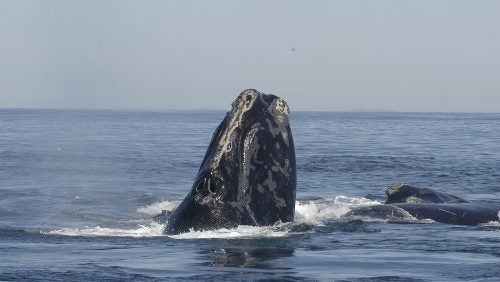
A North Atlantic right whale
North Atlantic right whales face extinction risks from ship strikes. Stronger vessel speed rules could reduce collisions and remain one of the most practical legal tools for protection.
In March 2026, federal lawmakers renewed attention to the rules designed to protect the endangered North Atlantic right whale from vessel collisions.[1] The North Atlantic right whale is one of the most endangered marine mammals in the world.[2] Scientists estimate that only about 380 individuals remain today, including approximately 70 reproductively active females.[3] Ship strikes and fishing gear entanglement are the main reasons for the population decline.[4] Among these threats, vessel collisions are one of the most directly preventable. U.S. environmental law already provides tools to reduce these risks. However, current vessel speed rules do not provide sufficient protection for the species.
Federal law requires the government to protect endangered species such as the North Atlantic right whale. The Endangered Species Act (ESA) requires federal agencies to ensure that their actions do not jeopardize the continued existence of listed species.[5] The Marine Mammal Protection Act (MMPA) also prohibits the “take” of marine mammals, [6] which includes killing or injuring them.[7]
One of the main regulatory tools is the vessel speed rule issued by the National Marine Fisheries Service (NMFS). The current rule limits ships longer than 65 feet to speeds of 10 knots or less in designated seasonal management areas along the U.S. East Coast.[8] These areas include waters near major ports where right whales are known to migrate or feed.[9] Slower vessel speeds give ship operators more time to detect whales and reduce the force of collisions when they occur.
Scientific studies show that vessel speed limits significantly reduce the risk of lethal whale strikes. A slower ship creates less impact force and gives whales more time to avoid the vessel.[10] Researchers have also found that the probability of a whale dying from a collision drops sharply when vessels travel below 10 knots.[11] As a result of these findings, speed restrictions have become one of the most widely accepted strategies for protecting large whales.
Despite these benefits, the current vessel speed rule has some limits. For example, many vessels that operate in whale habitats are not covered. The rule only applies to ships longer than 65 feet despite the fact that smaller vessels, including recreational boats and smaller commercial ships, still pose risks to whales.[12] In addition, the existing seasonal zones do not always match recent whale migration patterns. Climate change and changing food sources have altered where whales travel and feed.[13] As a result, whales may now appear more frequently outside traditional protected areas.
In 2021, NMFS released an assessment evaluating the effectiveness of the current regulation under 50 C.F.R. § 224.105.[14] The report noted that further action may be needed to reduce collision risks, including addressing vessel traffic from boats smaller than 65 feet and reconsidering the boundaries and timing of existing management areas.[15] In 2022, NMFS proposed applying speed limits to vessels 35 to 65 feet long, extending seasonal management areas, and allowing dynamic zones when whales are detected in real time.[16] However, the proposal was withdrawn in 2025.[17]
This action highlights a broader issue in environmental law. Regulations often require balancing economic activity with species protection.[18] However, the ESA sets a high standard for protecting endangered species. Courts have repeatedly stated that Congress intended the ESA to prioritize species survival when agencies make regulatory decisions.[19] When a population is already near collapse, delaying protective measures can have irreversible consequences.
Protecting the North Atlantic right whale requires action before the population declines further. Environmental law already provides the framework for stronger protections. Expanding vessel speed rules would be a practical step toward reducing preventable whale deaths. In a situation where every whale matters, slowing down may be one of the most effective ways to help the species survive.
[1] Press Release, House Comm. on Nat. Res., NOAA Seeks Input on North Atlantic Right Whale Vessel Speed Rule (Mar. 4, 2026).
[2] North Atlantic Right Whale, NOAA Fisheries, https://www.fisheries.noaa.gov/species/north-atlantic-right-whale (last visited Mar. 15, 2026).
[3] North Atlantic Right Whale Calving Season 2026, NOAA Fisheries,
https://www.fisheries.noaa.gov/national/endangered-species-conservation/north-atlantic-right-whale-calving-season-2026 (last visited Mar. 15, 2026).
[4] North Atlantic Right Whale, supra note 2.
[5] Endangered Species Act of 1973, 16 U.S.C. § 1536(a)(2) (2018).
[6] Marine Mammal Protection Act of 1972, 16 U.S.C. § 1372(a) (2018).
[7] Marine Mammal Protection Act of 1972, 16 U.S.C. § 1362(13) (2018).
[8] 50 C.F.R. § 224.105 (1999).
[9] See North Atlantic Right Whale Critical Habitat Map and GIS Data, NOAA Fisheries, https://www.fisheries.noaa.gov/resource/map/north-atlantic-right-whale-critical-habitat-map-and-gis-data (last visited Mar. 15, 2026).
[10] P. B. Conn & G. K. Silber, Vessel Speed Restrictions Reduce Risk of Collision-Related Mortality for North Atlantic Right Whales, 4 Ecosphere 1, 10-12 (2013).
[11] Angelia S.M. Vanderlaan & Christopher T. Taggart, Vessel Collisions with Whales: The Probability of Lethal Injury Based on Vessel Speed, 23 Marine Mammal Sci. 144, 150–52 (2007).
[12] Lance P. Garrison et al., Assessing the Risk of Vessel Strike Mortality in North Atlantic Right Whales Along the U.S. East Coast, NOAA Tech. Memo. NMFS-SEFSC-757, at 13-14 (2022).
[13] Erin L. Meyer-Gutbrod et al., Redefining North Atlantic Right Whale Habitat-Use Patterns Under Climate Change, Limnology & Oceanography, Nov. 2022, at 1, 1.
[14] NOAA Fisheries, Off. of Protected Res., North Atlantic Right Whale (Eubalaena glacialis) Vessel Speed Rule Assessment (2020).
[15] Id. at 36-38.
[16] North Atlantic Right Whale Vessel Strike Reduction Rule, 87 Fed. Reg. 46921 (proposed Aug. 1, 2022).
[17] North Atlantic Right Whale Vessel Strike Reduction Rule, 90 Fed. Reg. 4711 (Jan. 16, 2025) (withdrawing proposed rule).
[18] House Comm. on Nat. Res., supra note 1 (“the 2022 proposal would have jeopardize[d] 340,000 American jobs and nearly $84 billion in economic contributions”).
[19] Tenn. Valley Auth. v. Hill, 437 U.S. 153, 184 (1978).