

Methane Management or Moral Hazard? How California’s Biogas Incentives are Funding Factory Farming
March 31, 2026 by Khristina Holterman
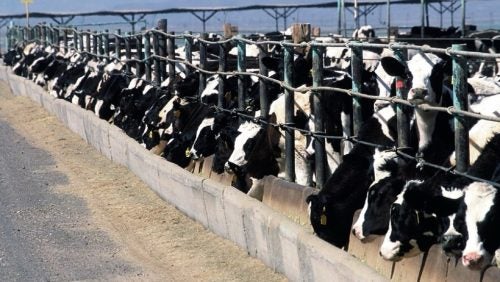
Confined cows feeding
California’s Low Carbon Fuel Standard perversely incentivizes industrial dairy farms to expand livestock production and increase methane emissions, regardless of manure digestion, via overvalued biogas credits.
California is the nation’s top dairy producer, supplying nearly twenty percent of all U.S. milk.[1][2] Approximately ninety percent of California’s dairy cows, about 1.7 million,[3] are raised on factory farms in the Central Valley, with an average herd size of about 2,300 animals kept in confined pens. These farms produce around 68.3 billion pounds of manure annually. For perspective, that is around 1.3 times the amount of waste produced annually by California’s human population.[4] This waste is then stored in “deep pits the size of football fields,” commonly referred to as open-air “lagoons,” where it sits uncovered, emitting methane and other harmful pollutants, leaking into groundwater, and raising public health and ecosystem concerns.[5]
Open-air lagoons are a major source of greenhouse gas emissions, contributing to anthropogenic climate change.[6] As the manure decomposes in the pits, it releases methane and nitrous oxide into the atmosphere.[7] Methane is the most potent greenhouse gas at over eighty times more potent than carbon dioxide on a twenty-year time scale, and nitrous oxide is almost 300 times more potent over a 100-year time scale.[8]
One waste management solution that has gained traction is converting livestock manure into energy via anaerobic digestion, a “renewable” alternative to open-air lagoons. California dairy producers have jumped at the opportunity to create biogas from its industrial farming operations and generate lucrative energy credits through California’s Low Carbon Fuel Standard (LCFS), which highly incentivizes the installation of anaerobic digesters on dairy farms. According to the Department of Energy, the LCFS program “requires a reduction in the carbon intensity of transportation fuels that are sold, supplied or offered for sale in the state through 2030.”[9] The LCFS assigns different values to fuel pathways based on a lifecycle assessment of carbon emissions.[10] California’s LCFS program has assigned negative carbon intensity scores to biogas produced from manure anaerobic digestion, and because of this low credit score, manure digester projects have generated more than a billion dollars’ worth of credits, which can then be sold to fossil fuel companies to offset their emissions.[11] Manure biogas accounts for about 1% of the energy used for transportation in California, yet it generates 21% of the credits in the LCFS program.[12] However, scholars have argued that the life cycle analyses of farms with digesters may overstate climate benefits due to incomplete accounting of upstream and downstream emissions.[13]
LCFS bases its credits on a fuel’s carbon intensity (CI). Carbon intensity “takes into account the GHG emissions associated with all of the steps of producing, transporting, and consuming a fuel—also known as a complete life cycle of that fuel.”[14] In accounting for the life cycle, the costs of rearing the livestock are not accounted for.[15] Thus, upstream and downstream emissions are not being accounted for, especially considering that most of cow-emitted methane is from belches.[16] Neglecting that fact and solely counting methane emitted from manure allows for the expansion of herds, which in turn means more belches and more unabated methane emissions, as anaerobic digesters only mitigate methane from manure. A proper accounting of the full fuel cycle would show biogas has a much higher lifecycle assessment than advertised and thus should be excluded from renewable energy incentives.
As LCFS credits for biogas are currently set up, they create a positive feedback loop — only larger dairies in California can afford to produce their own biogas due to federal equipment subsidies and are thus motivated to increase operations and herd size to continue reaping the benefits of the credits.[17] A major step is to address the overinflation of biogas credits in the LCFS market. Litigants and California lawmakers can interpret LCFS credit standards, specifically §95480 in the California Code of Regulations, more narrowly to argue that the purpose of LCFS credits, which is to “reduce the full fuel-cycle, carbon intensity of the transportation fuel pool used in California, pursuant to the California Global Warming Solutions Act of 2006,” is not being satisfied by anaerobic digesters capturing methane because the “full fuel-cycle” is not accounted for.[18] The language: “pursuant to the California Global Warming Solutions Act of 2006” points to a standard of emissions that would sharply reduce greenhouse gases and transition to a “sustainable, low-carbon future.”[19] As it currently stands, more than half of all methane emissions in California come from dairy and livestock through poor manure management and enteric fermentation, and neighbors to these farms in the Central Valley are disproportionately impacted by air and water pollution from the facilities.[20]
California’s Senate Bill 1383 is aiming to reduce methane emissions from organic waste in landfills, and the California Air Resources Board (CARB) is currently soliciting public comments to implement Dairy and Livestock provisions. While this would be a step in the right direction for methane management of dairy mega-farms, it is unlikely to deter LCFS over-crediting soon.[21] Alternative solutions for California include encouraging credit rewards for other forms of renewable energy, and on-farm solar panels, which may even motivate farms to lower herd sizes to make room for panels. If other forms of renewable energy were more valuable than biogas, factory farms would not have as much of an incentive to expand operations to produce more manure and more biogas. As it currently stands, manure-derived biogas benefits accrue solely to larger industrial farms and incentivize them to continue harmful farming practices, thereby perpetuating the production of more, rather than less, methane.
[1] Cal. Dep’t of Food & Agric., Livestock and Dairy Research, https://www.cdfa.ca.gov/oars/research/livestock_and_dairy_research/ (last visited Mar. 24, 2026).
[2] Daniel A. Sumner et al., Contributions of the California Dairy Industry to the California Economy 1 (Univ. of Cal., Davis Agric. Issues Ctr., Report for the Cal. Milk Advisory Bd. 2019), https://cail.ucdavis.edu/wp-content/uploads/2019/07/CMAB-Economic-Impact-Report_final.pdf.
[3] Astrid Elliot et al., Controlling H5N1 in California Dairies: Student Policy Practicum Findings, Stan. L. Sch. (Oct. 3, 2025), https://law.stanford.edu/2025/10/03/controlling-h5n1-in-california-dairies-student-policy-practicum-findings/.
[4] Food & Water Watch, Factory Farm Nation: California’s Mega-Dairy Problem (Sept., 2024), https://www.foodandwaterwatch.org/wp-content/uploads/2024/09/FSW_0924_FFMap_CA.pdf.
[5] Alex Blanchette, Living Waste and the Labor of Toxic Health on American Factory Farms, 33 Med. Anthropology Q. 94 (2019) https://anthrosource.onlinelibrary.wiley.com/doi/full/10.1111/maq.12491?saml_referrer=.
[6] Ben Lilliston, New EPA Data Confirms Role of Factory Farms in Rising Agricultural Emissions, Inst. For Agric. & Trade Policy (Mar. 3, 2022), https://www.iatp.org/new-epa-data-confirms-role-factory-farms-rising-agriculture-emissions.
[7] Cesspools of Shame: How Factory Farm Lagoons and Sprayfields Threaten Environmental and Public Health, Nat. Res. Def. Council (July 24, 2001), https://www.nrdc.org/resources/cesspools-shame-how-factory-farm-lagoons-and-sprayfields-threaten-environmental-and-public.
[8] Understanding Global Warming Potentials, U.S. Env’t Prot. Agency (Dec. 29, 2025), https://www.epa.gov/ghgemissions/understanding-global-warming-potentials.
[9] Alternative Fuels Data Center: Low Carbon Fuel Standard, U.S. Dep’t of Energy, https://afdc.energy.gov/laws/6308 (last visited Mar. 24, 2026).
[10] Cal. Code Regs. tit. 17, § 95488.3 (2024).
[11] K. Finderman et al., Risks of Crediting Carbon Offsets in Low Carbon Fuel Standards: Lessons Learned from Dairy Biomethane, 206 Energy Pol’y 114738 (2025), https://doi.org/10.1016/j.enpol.2025.114738
[12] Id.
[13] Randall S. Abate, Putting Lipstick on a Pig: Biogas, Methane Digesters, and the Greenwashing Playbook, 54 Env’t L. 545 (2024).
[14] Cal. Air Res. Bd., LCFS Basics, https://ww2.arb.ca.gov/resources/documents/lcfs-basics (last visited Mar. 24, 2026).
[15] Ruthie Lazenby, Rethinking Manure Biogas, Ctr. For Agric. & Food Sys. (Aug. 24, 2022), https://cafs.vermontlaw.edu/resource-library/rethinking-manure-biogas.
[16] Id.
[17]Dan Charles, How Dairy Farmers Are Cashing in on California’s Push for Cleaner Fuel, NPR (Feb. 10, 2022), https://www.npr.org/2022/02/10/1077235578/how-dairy-farmers-are-cashing-in-on-californias-push-for-cleaner-fuel.
[18] Cal. Code Regs. tit. 17, § 95480.
[19] Cal. Air Res. Bd., AB 32 Global Warming Solutions Act of 2006, https://ww2.arb.ca.gov/resources/fact-sheets/ab-32-global-warming-solutions-act-2006 (last visited Mar. 24, 2026).
[20] Ethan N. Elkind et al., Berkeley Law Center for Law, Energy & the Environment & Emmett Inst. on Climate Change & the Environment, UCLA Sch. of L., Ahead of the Herd: Policy Solutions to Accelerate Livestock Methane Emissions Reduction in California 7, 8, 32 (Sept. 2022), https://www.law.berkeley.edu/wp-content/uploads/2022/09/Ahead-of-the-Herd-September-2022.pdf
[21] Blanca Begert, California Explores First-Time Regulation on Dairy Methane Emissions, Inside Climate News (Feb. 6, 2026), https://insideclimatenews.org/news/06022026/california-dairy-methane-emissions-regulation/.