

After EPA’s Repeal of the Endangerment Finding: Climate Governance Without a Federal Floor
April 1, 2026 by Zhuoqiao Yin
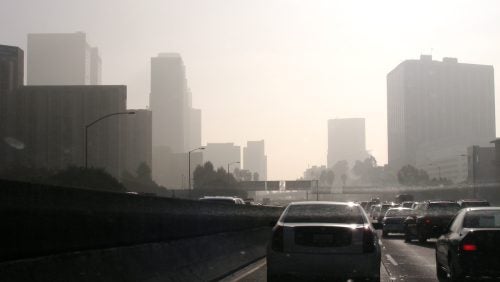
Cars in traffic and a grey haze in Pasadena, California. See below for image credit.
In February 2026, EPA repealed the 2009 Endangerment Finding and said that, without it, the agency lacks authority under Clean Air Act section 202(a) to regulate greenhouse-gas emissions from new motor vehicles. This article explains what the 2009 Endangerment Finding was, and why repealing it matters.
In 2007, the Supreme Court held in Massachusetts v. EPA that greenhouse gases count as “air pollutants” under the Clean Air Act.[1] Before Massachusetts, EPA had argued that it either (1) lacked authority to regulate greenhouse gases or (2) could decline to regulate them for broader policy reasons. The Court rejected both positions. It held that EPA could not avoid the issue by invoking general policy concerns; instead, the agency had to answer the question the statute actually asks: whether greenhouse gases from new motor vehicles endanger public health.[2] The 2009 Endangerment Finding effectively answered that question in the affirmative. It became the legal foundation for federal regulation of greenhouse gases from cars and trucks, and later for a broader federal climate regulatory regime.[3]
In February 2026, EPA reversed course. It withdrew that conclusion and argued that the finding 1) overstated the connection between U.S. vehicle emissions and global climate harms and 2) understated the uncertainty and possible benefits of higher CO2 levels.[4] These claims, however, were strongly contested. Resources for the Future said the National Academies’ 2025 review stood “in direct contrast” to EPA’s proposal,[5] and Harvard public-health experts continue to describe greenhouse gases as posing serious health risks.[6] Whatever the merits of EPA’s scientific reassessment, the repeal has significance beyond the scientific debate itself. The Endangerment Finding had long served as a legal foundation for federal climate regulation, so withdrawing it raises a distinct question: what happens then? The following sections examine the repeal’s legal consequences in two main respects: It fragments climate governance and may push more disputes into court.
The repeal’s first major consequence is fragmentation. It removes the federal floor, but not the need for climate governance. Regulatory responsibility shifts downward into states and local governments, producing a more fragmented and uneven climate-governance landscape.
This fragmentation operates in two directions. Vertically, it creates conflict across levels of government. Cities may try to fill the federal gap, but their power depends on state law. Local governments must act consistently with state law, and state law controls when it “expressly preempts,” “occupies an entire field,” or “conflicts with” local law.[7] Because these rules vary from state to state, local governments must constantly assess the scope of their authority and prepare for preemption challenges. That increases both uncertainty and planning costs.[8]
Fragmentation is also horizontal: States differ from one another in legal authority, institutional structure, and fiscal capacity.
First, legal asymmetry. States do not have equal authority to regulate emissions under federal law. In transportation, for instance, California has a special waiver path under the Clean Air Act, which allows it to obtain EPA approval to enforce its own vehicle-emissions standards. Other states may adopt California’s standards, but only if those standards are identical to California’s waived standards.[9] Therefore, even before states make policy choices, the law already gives them unequal room to move.
Second, institutional asymmetry. States do not govern climate change through a single institutional model. Some participate in carbon markets: The Regional Greenhouse Gas Initiative (RGGI) explains that each participating state has its own CO2 Budget Trading Program under its own law, and that together those state programs “compose a regional cap and market for allowances.”[10] Some adopt statewide emissions targets: The National Conference of State Legislatures (NCSL) reports that at least 16 states and Puerto Rico have enacted greenhouse-gas reduction requirements.[11] Others rely more on sector-specific tools, including renewable portfolio standards, utility regulation, and building rules.[12]
Third, capacity asymmetry. States also differ in the fiscal capacity available to support climate policy. NCSL reports that states are facing slowing revenue growth, increased spending pressures, and uncertainty created by possible federal funding cuts.[13] In that environment, states with stronger institutions and budgets are better positioned to design and implement climate policy, while others may lag.
A second potential legal consequence of the repeal is renewed nuisance litigation. In American Electric Power v. Connecticut, the Supreme Court held that the Clean Air Act displaced federal common-law nuisance suits over greenhouse-gas emissions because Congress had assigned that regulatory question to EPA.[14] But the Court did not decide whether state-law nuisance claims were preempted; it left that issue open.[15] That matters now. EPA’s 2026 repeal says the agency lacks authority under Clean Air Act § 202(a) to regulate greenhouse-gas emissions from new motor vehicles, and that retreat will give plaintiffs a stronger argument that courts should no longer assume federal regulation occupies the field.[16] This might shift climate disputes back into the courts, especially through state-law suits.
Image: “Aab Pasadena Highway Los Angeles” by Aliazimi via Wikimedia Commons (CC BY-SA 4.0).
[1] Massachusetts v. EPA, 549 U.S. 497, 528–35 (2007).
[2] Id. at 532–35.
[3] Endangerment and Cause or Contribute Findings for Greenhouse Gases Under Section 202(a) of the Clean Air Act, 74 Fed. Reg. 66,496, 66,497 (Dec. 15, 2009).
[4] Rescission of the Greenhouse Gas Endangerment Finding and Motor Vehicle Greenhouse Gas Emission Standards Under the Clean Air Act, 91 Fed. Reg. at 7,692–93, 7,702.
[5] Joshua Linn et al., Comment on the Reconsideration of 2009 Endangerment Finding and Greenhouse Gas Vehicle Standards, Res. for the Future (Sept. 22, 2025), https://www.rff.org/publications/testimony-and-public-comments/comment-on-the-reconsideration-of-2009-endangerment-finding-and-greenhouse-gas-vehicle-standards/.
[6] Why the Endangerment Finding Mattered So Much for Health and the Climate, Harv. T.H. Chan Sch. of Pub. Health (Feb. 24, 2026), https://hsph.harvard.edu/news/why-the-endangerment-finding-mattered-so-much-for-health-and-the-climate/.
[7] Vincent M. Nolette et al., Navigating State Law in Local Climate Action 1, 5–7 (Sabin Ctr. for Climate Change L. 2026), https://scholarship.law.columbia.edu/sabin_climate_change/266/.
[8] Id.
[9] Vehicle Emissions California Waivers and Authorizations, U.S. Env’t Prot. Agency, https://www.epa.gov/state-and-local-transportation/vehicle-emissions-california-waivers-and-authorizations(explaining that California may seek a waiver of federal preemption and that other states may adopt California’s motor vehicle emission standards under Clean Air Act section 177 only if those standards are identical to California’s waived standards) (last visited Mar. 18, 2026).
[10] State Statutes & Regulations, Reg’l Greenhouse Gas Initiative, https://www.rggi.org/program-overview-and-design/state-regulations (“Through statutes or regulations based on the RGGI Model Rule, each state has established individual CO₂ Budget Trading Programs based upon its own statutory or regulatory authority. Together, these compose a regional cap and market for allowances.”) (last visited Mar. 18, 2026); see also Elements of RGGI, Reg’l Greenhouse Gas Initiative, https://www.rggi.org/program-overview-and-design/elements (last visited Mar. 18, 2026).
[11] Greenhouse Gas Emissions Reduction Targets and Market-Based Policies, Nat’l Conf. of State Legislatures, https://www.ncsl.org/energy/greenhouse-gas-emissions-reduction-targets-and-market-based-policies (last visited Mar. 18, 2026).
[12] State Renewable Portfolio Standards and Goals, Nat’l Conf. of State Legislatures, https://www.ncsl.org/energy/state-renewable-portfolio-standards-and-goals (last visited Mar. 18, 2026); 2024 Legislative Energy Trends, Nat’l Conf. of State Legislatures (Mar. 7, 2025), https://www.ncsl.org/energy/2024-legislative-energy-trends.
[13] Erica MacKellar, The State of State Budgets Is Stable for Now, Nat’l Conf. of State Legislatures (May 6, 2025), https://www.ncsl.org/resources/details/the-state-of-state-budgets-is-stable-for-now.
[14] Am. Elec. Power Co. v. Connecticut, 564 U.S. 410, 424–29 (2011).
[15] Id. at 429.
[16] Rescission of the Greenhouse Gas Endangerment Finding and Motor Vehicle Greenhouse Gas Emission Standards Under the Clean Air Act, 91 Fed. Reg. at 7,702.