


Data Centers May Be Skyrocketing… Literally
January 20, 2026 by Jackson Neme
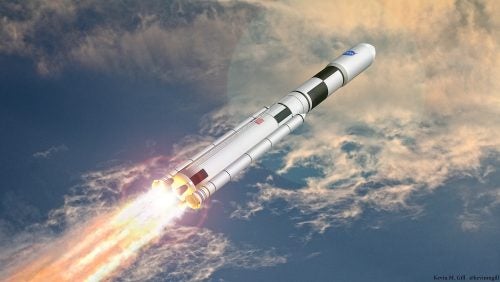
A photo of a rocket launching, originally uploaded to flickr by Kevin Gill.
AI Data Centers may soon be moving to space, but that move may have significant environmental and consumer impacts without environmental impact assessments and regulations.
With the rise of artificial intelligence, data centers are growing rapidly,[1] requiring massive amounts of energy to support the training and processing of large AI workloads. AI is projected to increase its share of the data center market substantially, accounting for approximately 50% by 2030,[2] representing a 175% increase in data center power consumption.[3] The skyrocketing energy needs of data centers has been linked to skyrocketing energy bills for consumers,[4] while data center and business energy prices have not seen the same impact.[5] Because data centers rely on the same grid as residential customers, increased data center demand, even non-proximate demand, puts additional pressure on consumers.[6] In addition, new data centers require significant new energy infrastructure investment, causing more outages,[7] increased construction, and making it harder to meet certain clean energy targets.[8] One proposed solution to the resource-intensive needs of new data centers put forth by Elon Musk and Jeff Bezos is to deploy data centers in space.[9]
Deploying data centers on satellites, the thinking goes, would cut down on “Earthly headaches” such as the intense power required to run the data centers, instead relying on solar energy without any weather or atmospheric conditions reducing efficiency.[10] Given the solar power available in space, it may ultimately be cost-efficient to run AI in space,[11] especially given the lack of environmental regulations and neighbors that would be harmed.[12] Operating data centers in space will come with numerous engineering challenges, such as managing chip temperatures and protecting them from radiation,[13] cooling the data centers, and significant maintenance challenges.[14]
The question remains, however, even if data centers could be moved into space, what effect it would have on consumers. On the one hand, data centers in space would reduce significant land, water, and grid impacts that current data centers impose. Rather than a new AI Hyperscale data center using more energy than 100,000 homes on the same grid as those residential customers.[15] One new Meta data center in Wyoming, for instance, is expected to need more energy than all the homes in Wyoming combined.[16] Relying on a separate grid means that consumer energy prices would theoretically be unaffected by space data centers.
These are not the only potential consumer benefits. Data centers can consume as much water as a city of 50,000 and use up hundreds of acres of land.[17] Not only does this put an enormous strain on many local communities, but these projects often end up harming vulnerable communities, and implicating numerous environmental justice concerns.[18] Theoretically, data centers in space would take the burden off of those communities.
However, while the move may solve some of the concerns about data centers, it may exacerbate and create others. As data centers move into a region, the grid often needs substantial investments in both generation and infrastructure to power the new customers. These significant investments are risky. Because of the life of the infrastructure required to serve the new load, current consumers can be on the hook for paying for the investment.[19] While this investment can cause the rising energy prices already discussed, it can be especially dangerous if the energy utilities make the investment and then data centers leave the region, as existing customers would have to foot the entire bill. This is why many energy tariffs (rates) for data centers require a longer contract length.[20] However, those regulatory protections can only do so much: data centers moving out will likely force more costs onto other customers on the grid.
While building new data centers in space may address certain terrestrial concerns, launching the satellites and materials needed is both costly and comes with potential environmental dangers. Space launches come with distinct environmental impacts, including the ecological footprint and greenhouse gas emissions that vary greatly depending on the type and orbit of the launch.[21] In addition to the soot released by satellite launches equivalent to 7 million diesel dump trucks circling the earth, satellites pose a risk of collisions, especially as increasing numbers of satellites are sent into orbit.[22] If data centers are sent into space, additional collisions could create a chain, leading to infrastructure destruction and a cloud of space debris.
While neither emissions nor collisions are insurmountable challenges, both are exacerbated by the lack of environmental regulations governing space launches. There has been minimal environmental impact assessment on satellite launches despite recommendations from the Government Accountability Office (GAO) for policy changes.[23] Instead, President Trump recently signed an executive order that directs the Transportation Department to eliminate or expedite environmental reviews for launch and reentry licenses and permits, establishing or using categorical exclusions under National Environmental Policy Act (NEPA).[24]
Rather than exempting them, given the massive scale of data centers and their energy and resource usage, environmental assessments should be critical before any large-scale launches. While certain policymakers are suggesting even further action to reduce environmental regulations that allegedly slow economic expansion into space,[25] there are currently very few roadblocks. Governments ought to seriously consider what regulations should apply to space launches, and encourage environmental assessments, especially if companies begin the significant undertaking of launching data centers into space.
[1] “Bring Your Own Power” Becomes Reality For Data Centers, Facility Exec. (Jan. 7, 2026), https://facilityexecutive.com/bring-your-own-power-becomes-reality-for-data-centers.
[2] Id.
[3] Is There Enough Data Center Capacity for AI, Goldman Sachs (Dec. 11, 2025), https://www.goldmansachs.com/insights/articles/is-there-enough-data-center-capacity-for-ai.
[4] Josh Saul et al., How AI Data Centers are Sending Power Bills Soaring, Bloomberg (Sept. 29, 2025), https://www.bloomberg.com/graphics/2025-ai-data-centers-electricity-prices/?embedded-checkout=true.
[5] Karin Kirk, Home electricity bills are skyrocketing. For data centers, not so much, Yale Climate Connections (Sept. 29, 2025), https://yaleclimateconnections.org/2026/01/home-electricity-bills-are-skyrocketing-for-data-centers-not-so-much/.
[6] Saul et al., supra note 4.
[7] Marc Levy, U.S. electric grids under pressure from energy hungry data centers are changing strategy, AP News (Sept. 13, 2025), https://apnews.com/article/big-tech-data-centers-electricity-energy-power-texas-pennsylvania-46b42f141d0301d4c59314cc90e3eab5.
[8] Data Centers Are Making It Hard for Utilities to Deliver on Climate Goals, Inst. for Energy Rsch. (Dec. 17, 2025), https://www.instituteforenergyresearch.org/the-grid/data-centers-are-making-it-hard-for-utilities-to-deliver-on-climate-goals/.
[9] Micah Maidenberg & Becky Peterson, Bezos and Musk Race to Bring Data Centers to Space; Space companies backed by tech billionaires hope to move AI data centers off Earth, Wall Street J. (Dec. 10, 2025)
[10] Id.
[11] Id.
[12] Eli Tan & Ryan Mac, Even the Sky May Not Be the Limit for AI Data Centers, N.Y. Times (Dec. 10, 2025) https://www.nytimes.com/2026/01/01/technology/space-data-centers-ai.html.
[13] Maidenberg & Peterson, supra note 9.
[14] Why Putting AI Data Centers in Space Probably Doesn’t Make Much Sense, Chaotropy (Oct. 4, 2025) https://www.chaotropy.com/why-jeff-bezos-is-probably-wrong-predicting-ai-data-centers-in-space/.
[15] John Gorey, Data Drain: The Land and Water Impacts of the AI Boom, Lincoln Inst. of Land Policy (Oct. 17, 2025), https://www.lincolninst.edu/publications/land-lines-magazine/articles/land-water-impacts-data-centers/.
[16] Id.
[17] Id.
[18] Russell Contreras, AI Boom Fuels “Environmental Justice” Fears in Communities of Color, Axios (Dec. 8, 2025) https://www.axios.com/2025/12/08/ai-civil-rights-black-latino-water-electricity.
[19] Mandy Deroche and Jacob Elkin, New Report Examines Electricity Contracts for Data Centers and other Mega-load or Large-load Facilities, Earthjustice (Feb. 4, 2025)
[20] Id.
[21] Ficawoyi Donou-Adonsou, Space launches and the environment: As the earth orbit level matters, what can be done?, 46 J. Pol’y Modeling 369, 383-34 (2024).
[22] Lucas Gutterman, What Are the Environmental Impacts of Satellites?, pirg.org (Aug. 22, 2024) https://pirg.org/edfund/articles/are-satellites-bad-for-the-environment/.
[23] U.S Gov’t Accountability Off., GAO-23-105005, Satellite Licensing: FCC Should Reexamine its Environmental Review Process for Large Constellations of Satellites (2022).
[24] Exec. Order No. 14335, Enabling Competition in the Commercial Space Industry, 90 Fed. Reg. 40219.
[25] Ellis Scherer, Policy Reforms to Launch U.S. Space Innovation, Info. Tech. and Innovation Found. (Jan. 5, 2026), https://itif.org/publications/2026/01/05/policy-reforms-to-launch-us-space-innovation/.