

Detention in the Everglades: NEPA, Federal Funding, and Alligator Alcatraz
January 14, 2026 by Maggie Zendehrouh
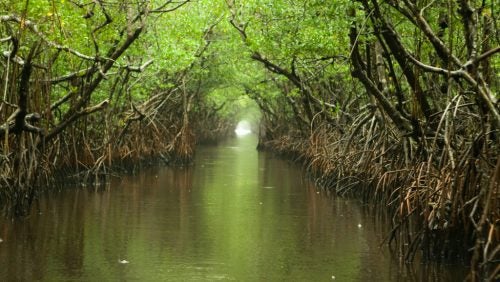
Mangroves in the Florida Everglades
'Alligator Alcatraz' — How a Florida detention center in the Everglades may sidestep NEPA, risking irreversible harm to a fragile ecosystem and public water supply.
The South Florida Detention Center, dubbed “Alligator Alcatraz,” may ultimately stand as one of the Trump Administration’s most environmentally consequential anti-immigration initiatives. The detention facility is located in the heart of Florida’s Everglades in Big Cypress National Preserve, a biologically rich wetland ecosystem federally recognized as sacred to several of Florida’s indigenous communities, like the Miccosukee and Seminole tribes.[1] Florida Governor Ron Desantis has openly explained that the remote and biologically diverse wetland location was intended as a deterrent against escape, akin to the infamous island prison, Alcatraz.[2]
While the moral and humanitarian concerns raised by such a detention strategy are substantial, the ecological implications of Alligator Alcatraz may prove equally significant. Notably, the facility may be functioning in defiance of the National Environmental Policy Act (NEPA). NEPA requires federal agencies to consider the environmental impact of major federal actions that could significantly affect the human environment.[3] Conservation groups across South Florida argue that the construction and operation of the detention center proceeded without adequate consideration of such environmental consequences, particularly given the vulnerability of the surrounding wetlands.[4] Allowing projects to move forward without proper environmental review could set a “dangerous precedent.”[5]
Florida officials and the Trump Administration emphasize that the state is operating the facility,[6] thus NEPA scrutiny would not apply. However, federal immigration detainees are housed in the facility,[7] and Department of Homeland Security Secretary Kristi Noem has acknowledged that much of the facility’s funding will come from the Federal Emergency Management Agency (FEMA), best known for hurricane and disaster relief.[8] The federal funding of the South Florida Detention Center and the above operational factors raise questions about whether the project constitutes a federal action subject to NEPA.
The Everglades are home to thirty-six native Florida species federally listed as endangered or threatened, including Florida panthers, West Indian manatees, Florida bonneted bats, and American alligators.[9] The detention center sits atop the abandoned Everglades Jetport, a failed project that caused much strife among environmental groups in the late 1960s.[10] Hydrologist Luna B. Leopold published a report concluding that the jetport would “inexorably destroy the South Florida ecosystem and thus the Everglades National Park.”[11] These concerns extend to the current detention facility. Governor Desantis has argued that the facility poses no environmental risk because it was built on an existing airstrip.[12] Yet, reports indicate that at least twenty acres of new asphalt have been laid in the facility,[13] which can alter natural water flow, increase water runoff, and facilitate the spread of chemical pollutants.[14] These changes can reduce available habitat and cause fish kills.[15]
The consequences extend beyond wildlife. The Everglades serve as the primary source of drinking water for more than 7 million Floridians.[16] Pollution or hydrological disruption in Big Cypress therefore has direct human implications. Hydrologist Christopher McVoy worries that if the detention population grows, the facility may outgrow its current footprint, and surrounding wetlands may be drained for expansion.[17] Even absent physical expansion, the daily operations of the detention facility potentially pose risks. Artificial lighting, noise, increased human presence, and physical barriers such as fences and barbed wire are likely to displace wildlife from the area.[18] Ironically, a detention center marketed as relying on the Everglades’ wildlife as a deterrent may itself harm the very ecosystem it invokes. Alligator Alcatraz thus reflects a familiar pattern in environmental law: when projects are pushed forward without thorough review, the ecological damage can be difficult to reverse.
[1] See Kaylyn Zipp, ‘Alligator Alcatraz’ Could Threaten Fragile Ecosystem, The Wildlife Society (Aug. 5, 2025), https://wildlife.org/alligator-alcatraz-could-threaten-fragile-ecosystem/.
[2] See David Fischer, Environmental Concerns Could Halt Construction at ‘Alligator Alcatraz’ Detention Center, PBS News (Aug. 13, 2025), https://www.pbs.org/newshour/politics/environmental-concerns-could-halt-construction-at-alligator-alcatraz-detention-center.
[3] Maggie Baker, Protecting the Human Environment: Using NEPA to Challenge Immigration Detention, 55 ENV’T L. 371, 380 (2025).
[4] Fischer, supra note 2.
[5] The Everglades detention center’s threat to wildlife, water, and Big Cypress, Conservancy of Southwest Florida (Aug. 27, 2025), https://conservancy.org/the-everglades-detention-centers-threat-to-wildlife-water-and-big-cypress/.
[6] Fischer, supra note 2.
[7] See David Fischer, Judge Orders Temporary Halt to Construction at Florida’s ‘Alligator Alcatraz’ Detention Center, Associated Press (Aug. 7, 2025), https://apnews.com/article/florida-detention-alligator-alcatraz-08aac166ad5fa5dfbd33a00f6be2b979.
[8] See Associated Press, What to Know About ‘Alligator Alcatraz,’ Florida’s Immigration Detention Site in the Everglades, The National Herald(June 25, 2025), https://www.thenationalherald.com/what-to-know-about-alligator-alcatraz-floridas-immigration-detention-site-in-the-everglades/.
[9] See Threatened and Endangered Species – Everglades National Park, National Park Service (Dec. 17, 2025), https://www.nps.gov/ever/learn/nature/techecklist.htm.
[10] The Everglades detention center’s threat to wildlife, water, and Big Cypress, supra, note 5.
[11] Id.
[12] See Hiroko Tabuchi, The ‘Alligator Alcatraz’ Site Once Changed History. Now, It’s Testing the Law Again., N.Y. Times (Aug. 22, 2025), https://www.nytimes.com/2025/08/08/climate/alligator-alcatraz-everglades-airport.html.
[13] See “Alligator Alcatraz” Status Update: 127 Days of America’s Worst Idea, Friends of the Everglades (Nov. 6, 2025), https://www.everglades.org/alligator-alcatraz-status-update-127-days-of-americas-worst-idea/.
[14] Fischer, supra note 2.
[15] See David Fischer, Federal Judge Hears Closing Arguments in ‘Alligator Alcatraz’ Case Regarding Environmental Impact, NBC 6 (Aug. 13, 2025), https://www.nbcmiami.com/news/local/judge-to-hear-arguments-on-halting-alligator-alcatraz-construction-over-environmental-concerns/3676755/.
[16] See Geology and Hydrology of Everglades National Park, U.S. Geological Survey (last visited Jan. 6, 2025), https://www.usgs.gov/geology-and-ecology-of-national-parks/geology-and-hydrology-everglades-national-park.
[17] Tabuchi, supra note 12.
[18] Zipp, supra note 1.