

Disability Disregarded: A Call to Action for Disability-Inclusive Climate Commitments
February 18, 2026 by Lyla Masterson
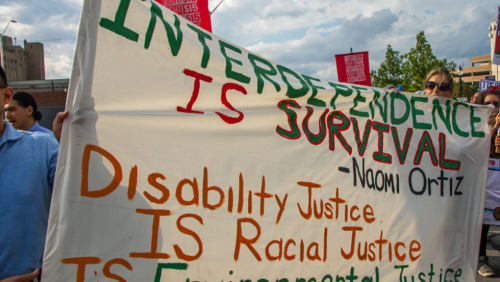
Banner that reads: “Interdependence is Survival-Naomi Ortiz” and below reads “Disability Justice IS Racial Justice IS Environmental Justice.” See below for image link
This article explores the disproportionate impact of climate crises on the disabled community and calls for leaders in the legal profession to build a disability-inclusive environmental justice framework.
Climate change disproportionately affects communities facing intersectional discrimination on the basis of disability, race, gender, class, and other social categories.[1] When addressing this disparate impact, climate policies often lump the disabled population within the broad category of “vulnerable groups,” continuing a long history of treating the disabled community as an afterthought.[2] Ultimately, the disabled community makes up the largest minority group within the United States, which highlights the immense importance of adopting climate plans that incorporate and place disability-rights-specific measures as a priority.[3]
The Impacts of Climate Change on Persons with Disabilities
The disabled community is more likely to be affected by climate change and climate disasters due to social exclusion, economic inequality, and an overall stigma that leads to increased exposure to climate hazards, which threatens their rights to access clean water, food, and mobility.[4] During climate disasters, emergency warnings and other important messaging, such as boil water notices, are not designed with accessibility in mind, especially for individuals with visual or hearing impairments, creating difficulties in planning for extreme weather events.[5] Climate change disrupts social protection systems and essential health-care services, which results in higher rates of mortality for disabled persons who lack access to emergency support.[6]
Beyond natural disasters, cumulative climate impacts exacerbate health and health care inequities faced by the disabled community.[7] During periods of extreme heat, disabled individuals have a greater likelihood of requiring emergency systems and access to transportation, but are unlikely to receive adequate support based on socioeconomic status and stigma.[8] Similarly, changes in water and air temperatures, heavier rains, flooding, and rising sea levels carry disease-ridden organisms into drinking water, which can intensify or initiate disabling conditions like gastrointestinal illnesses.[9] Climate change stressors from food and water insecurity to climate events can exacerbate or create mental health issues.[10]
While this list is non-exhaustive of all the ways in which the disabled population feels the effects of climate change, it serves as a call to action to meaningfully include the disabled community in climate initiatives.
Disability-Inclusive Climate Justice Framework
Despite being disproportionately affected by climate change, the disabled community is systematically disregarded in climate negotiations, commitments, and policies.[11] A disability-inclusive climate justice framework involves active, meaningful participation of disabled voices in decision-making, placing more resources into research on disability-inclusive climate solutions, investing into more training and education for the disabled community to effectively respond to environmental changes, and most pertinently, participation from the legal profession.[12] While climate action involves the collaboration of many professional fields, the law is at the center of it all.
Particularly, lawyers are uniquely situated to amplify disabled voices by advocating for their inclusion in community planning processes, pursuing strategic climate litigation brought by people with disabilities to increase climate commitments, and facilitating the development of disability-inclusive policies.[13] The participation of lawyers in uplifting disability rights in climate action can occur on the local level, by urging cities to outline provisions to mitigate disability-specific climate vulnerabilities.[14] On a national scale, lawyers can champion disability-inclusive policies to make up for the gaps in current regulations.[15]
As climate-related disasters increase, so does the need to prioritize the disabled population in local, national, and international climate measures. Ultimately, lawyers need to be at the forefront of pushing forward a disability-inclusive climate justice agenda.
Image: Becker1999 from Grove City, OH, CC BY 2.0 <https://creativecommons.org/licenses/by/2.0>, via Wikimedia Commons, https://commons.wikimedia.org/wiki/File:Make_Detroit_the_Engine_of_the_Green_New_Deal!_IMG_200s_(3)_(48434557342).jpg
[1] See Penelope J S Stein, et al., Advancing Disability-Inclusive Climate Research and Action, Climate Justice, and Climate-Resilient Development, 8 The Lancet Planetary health e242, e242 (2024), https://www.thelancet.com/journals/lanplh/article/PIIS2542-5196(24)00024-X/fulltext.
[2] See Rachel Reed, People with Disabilities Must be Included in Climate Planning and Responses, Say Harvard Researchers, harv. l. today (Apr. 5, 2024), https://hls.harvard.edu/today/people-with-disabilities-must-be-included-in-climate-planning-and-responses-say-harvard-researchers/.
[3] See Judith Heumann & John Wodatch, We’re 20 Percent of America, and We’re Still Invisible, n.y. times (July 26, 2020), https://www.nytimes.com/2020/07/26/opinion/Americans-with-disabilities-act.html; Off. of the U.N. High Comm’r for Hum. Rts., Analytical Study on the Promotion and Protection of the Rights of Persons with Disabilities in the Context of Climate Change, U.N. Doc. A/HRC/44/30 (2020) [hereinafter U.N. Doc. A/HRC/44/30]; see also Brendan Hyatt, Disability-Inclusive Climate Action Planning in the United States, env’t l. ins.: vibrant env’t blog (Aug. 18, 2021) https://www.eli.org/vibrant-environment-blog/disability-inclusive-local-climate-action-planning-united-states.
[4] See Stein, supra note 1 at e242; U.N. Doc. A/HRC/44/30, supra note 3.
[5] Climate Change and the Health of People with Disabilities, Env’t Prot. Agency (2023) [hereinafter EPA Climate Change and Health of Disabled Persons Report], https://web.archive.org/web/20260104004522/www.epa.gov/climateimpacts/climate-change-and-health-people-disabilities (archived Jan. 4, 2026); Hyatt, supra note 3 (explaining that individuals with hearing and visual impairments were unable to access information about Hurricane Katrina and adequately prepare for it).
[6] See U.N. Doc. A/HRC/44/30, supra note 3 at 4; Stein, supra note 1 at e242; see also Reed, supra note 2.
[7] U.N. Doc. A/HRC/44/30, supra note 3 at 4.
[8] EPA Climate Change and Health of Disabled Persons Report, supra note 5; Stein, supra note 1 at e242; see also Rachel Reed, Disability in a Time of Climate Disaster, harv. l. today (Jan. 19, 2023), https://www.environment.harvard.edu/news/disability-time-climate-disaster (highlighting that individuals with “psychosocial disabilities” have triple the rate of mortality in heatwaves).
[9] EPA Climate Change and Health of Disabled Persons Report, supra note 5.
[10] See Stein, supra note 1 at e245; EPA Climate Change and Health of Disabled Persons Report, supra note 5.
[11] See Reed, supra note 2; Hyatt, supra note 3.
[12]See Stein, supra note 1 at e250-52; U.N. Env’t Programme, How Climate Change Disproportionately Impacts Those with Disabilities (Dec. 9, 2019), https://www.unep.org/news-and-stories/story/how-climate-change-disproportionately-impacts-those-disabilities; U.N. Doc. A/HRC/44/30, supra note 3 at 11-13.
[13] ABA House of Delegates, Resolution 110, at 4 (adopted Feb. 2015), https://www.americanbar.org/content/dam/aba/directories/policy/midyear-2015/2015-midyear-110.pdf; Reed, supra note 8.
[14] Hyatt, supra note 3 (noting that as of 2021, only eleven of the twenty-five largest cities in the United States discuss disability and of those eleven, only half include disability-inclusive provisions).
[15] See e.g., ABA House of Delegates, supra note 13 at 5-6 (explaining a current gap in policy in that the Americans with Disabilities Act (ADA) does not directly mention disasters nor emergency preparedness but has implications that local governments need to prioritize accessibility to response programs; however, there is still a failure to follow or anticipate how the ADA may be implicated).