

End Confinement and Plant Trees: Animal Agriculture Regulation and the Climate Crisis
January 23, 2026 by Elisabeth Buscemi
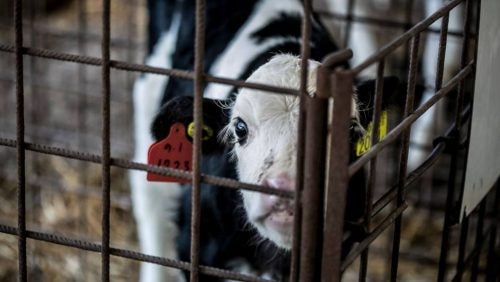
Baby cow staring through cage bars. See below for image link.
H.R. 4673 is scientifically unsound and keeps focus away from substantive discussions on how to make animal agriculture more environmentally sustainable.
H.R. 4673, the “Save Our Bacon Act,” is a step in the wrong direction not only for animal agriculture but also in the fight to curtail the climate crisis. Introduced to the House Committee on Agriculture in July 2025,[1] H.R. 4673 seeks to preempt existing state laws that regulate humane animal agriculture in interstate commerce, such as Massachusetts’ Question 3 and California’s Proposition 12.[2] This Act would nullify the voices of citizens in states who have passed humane animal agriculture bills and would also curtail the United States’ progress toward environmentally-sustainable animal agriculture.
Humane animal agriculture refers to when farmers make environmental, nutritional, behavioral, and health changes to their business practices that prioritize the physical and psychological well-being of the animals they raise.[3] A few of the changes include providing animals space to move freely, providing clean water, and allowing herding animals stay in their groups, among others.[4] Beyond improving conditions for animals, meat-eating individuals would also benefit from such changes, as the meat from less-stressed animals is higher quality and less likely to be at risk for bacterial infection.[5]
Massachusetts’ Question 3 and California’s Proposition 12 incorporate humane agricultural practices by creating legal penalties for the “confinement in a cruel manner” of certain farm animals.[6] Proponents of H.R. 4673, like Congressman Glenn Thompson (R-PA), argue that these state standards are “arbitrary and unscientific housing” requirements for farmed animals that place “burdens” on interstate commerce.[7] However, beyond being scientifically incorrect,[8] such claims, as well as H.R. 4673 itself, will only entrench the American regulatory system in behaviors that exacerbate the climate crisis.
According to the Food and Agriculture Organization of the United Nations, approximately 12% of global greenhouse gas emissions come from farmed animals.[9] The United States bears substantial responsibility, ranking as one of the largest global producers of beef and chicken, and as the third largest producer of pork.[10] Given its outsized role in animal agricultural, the United States has an obligation to do what it can to minimize the greenhouse gas output from its animal agriculture.
One way to minimize the country’s greenhouse gas emissions is to prohibit tightly-packed animal confinement, like that seen in factory farms, which is proven to exacerbate greenhouse gas emissions from animal agriculture.[11] Another method is to encourage regenerative animal agriculture, which would go beyond the current regulatory provisions in Massachusetts and California to promote humane animal agriculture. Regenerative agriculture is a land management form that encourages people to view agricultural systems as a dynamic, interconnected web rather than a direct supply chain.[12]
Regenerative agriculture is rooted in some indigenous communities’ practices of working with the land, and has proven successful for centuries.[13] Specific practices include intentional rotational grazing, which involves moving farmed animals between pastures to allow regrowth, agroforestry, which adds trees and other greenery into animal pastures, and the creation of conservation buffers, which incorporates planting greenery along a field or pasture’s edge to act as a habitat for beneficial organisms and protect against the elements like wind.[14]
Restorative animal agriculture, given its emphasis on utilizing natural growth like trees in the process of raising farmed animals, would help limit the ecologically-damaging effects of animal agriculture. One way animal agriculture contributes to greenhouse gas emissions is through methane produced by ruminant animals like cows.[15] However, trees can absorb methane from the atmosphere,[16] so planting trees near farm animals can lower the total methane emissions produced by animal agriculture.
The United States needs federal policies and regulations that encourage this restorative animal agriculture rather than statutes such as H.R. 4673, which undermines state-level humane animal agriculture regulatory provisions and worsens the climate crisis. If legislators continue to debate whether it is scientifically sound to keep animals in confinement, then they will never get around to the next step in the conversation: how to make animal agriculture more environmentally sustainable.
Image Link: Roee Shpernick, CC BY-SA 4.0 <https://creativecommons.org/licenses/by-sa/4.0>, via Wikimedia Commons.
[1] Save Our Bacon Act, H.R. 4673, 119th Cong. (2025).
[2] Brooks McCormick Jr Animal Law & Policy Program, Harvard Law School, Legislative Analysis of H.R. 4673: The “Save Our Bacon Act,” 3 (2025), https://animal.law.harvard.edu/wp-content/uploads/Legislative-Analysis-of-HR4673.pdf (last visited Jan. 21, 2026).
[3] What Does Humane Farming Really Mean?, Food Animal Concerns Trust, https://www.foodanimalconcernstrust.org/blog/what-does-humane-farming-really-mean (last visited Jan. 21, 2026).
[4] Id.
[5] Apolo A. Carrasco-Garcia et al., Effect of Stress During Slaughter on Carcass Characteristics and Meat Quality in Tropical Beef Cattle, 33 Asian-Australian J. of Animal Sci. 1656, 1657 (2020).
[6] 2021 Mass. Acts ch.108; Cal. Health & Safety Code § 25990–25994 (2018).
[7] An Examination of the Implications of Proposition 12: Hearing Before the Subcommittee on Agriculture in the House of Representatives, 119th Cong. 1 (2025) (statement of Hon. Glenn Thompson, Member, H. Comm. On Agriculture).
[8] Carrasco-Garcia, supra note 5, at 1656 (discussing the increased stress farmed animals suffer in confined spaces).
[9] Food & Agric. Org. of the. U.N., Global Emissions from Livestock in 2015, FAO GLEAM 3 dashboard, https://foodandagricultureorganization.shinyapps.io/GLEAMV3_Public/ (follow link to main page of dashboard; then select emission from the side bar and keep area as “world” and GWP100 set as “AR6”) (last visited Jan. 21, 2026).
[10] For beef production sorted by country, see USDA FAS, https://www.fas.usda.gov/data/production?commodity=almonds (click the drop down menu from commodity and type beef; then press enter) (last visited Jan. 21, 2026). For chicken meat production sorted by country, see USDA FAS, https://www.fas.usda.gov/data/production?commodity=almonds (click the drop down menu from commodity and type chicken meat; then press enter) (last visited Jan. 21, 2026). For pork production sorted by country, see USDA FAS, https://www.fas.usda.gov/data/production?commodity=almonds (click the drop down menu from commodity and type pork; then press enter) (last visited Jan. 21, 2026).
[11] See Anne Schechinger, Animal Feeding Operations Harm the Environment, Climate and Public Health, Env’t Working Grp. (Mar. 19, 2024), https://www.ewg.org/research/animal-feeding-operations-harm-environment-climate-and-public-health.
[12] Regenerative Agriculture 101, Nat. Res. Def. Council (Nov. 29, 2021), https://www.nrdc.org/stories/regenerative-agriculture-101.
[13] Id.
[14] Id.
[15] See Keith A. Johnson, Methane Emission from Cattle, 73 J. of Animal Sci. 2483, 2483 (1995).
[16] Vincent Gauci et al., Global Atmospheric Methane Uptake by Upland Tree Woody Surfaces, 631 Nature 796, 796 (2024).