

Fences Down, Grazing Up, and Cows That Don’t Read Permits
September 29, 2026 by Jonathan Winn
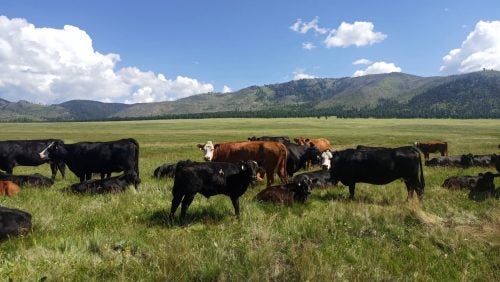
Trespass cattle grazing within the Valles Caldera Nature Preserve in July 2022. Courtesy: WildEarth Guardians
The USDA wants more cattle and lighter enforcement on drought-stressed national forests. A family cabin and the Valles Caldera show what unenforced grazing limits cost.
Growing up, I spent my summers exploring the Santa Fe National Forest, where my grandparents had a cabin. As the sun came up, my grandfather and I would head out for adventures: we’d look for the biggest tree in the forest or break out flashlights to search abandoned copper mines. In the evenings, we’d pack into his beat-up Bronco with my grandma to follow dirt roads and overgrown logging paths looking for wildlife. Deer and elk were a treat. Turkeys and grouse, common. Rabbits and squirrels abounded. But the animal we saw most wasn’t wild at all. Around every corner, along every stream, in every meadow, cows waddled, lowed, and left their leavings. Everywhere in the forest, I learned to look down and watch my feet. Not to keep from tripping, but to avoid stepping in a cow pie.
The U.S. Forest Service permits those cows, but with limits,[1] and for good reason: cattle damage national forests. They trample streambanks, foul water, and strip the grasses that hold the soil.[2] In the Southwest, a hotter, drier climate is putting those same ecosystems under even more stress.[3]
Yet in June, the USDA directed the Forest Service to expand grazing on national forests, restoring at least 500,000 head months over the next two years.[4] A head month refers to one animal grazing and using the range for one month.[5]The USDA framed the move as a supportive measure for ranchers.[6] In the current dry season, ranchers short on grass asked for more; the USDA responded by telling forest managers to open unallocated forage to temporary grazing “to the maximum extent possible.”[7] Helping ranchers through a drought is a fair goal. The trouble is what comes with it. The directive also tells agency staff to tread lightly on enforcement: offer help first, consider a good-faith rancher’s point of view, and, before acting against a permittee, ask not whether the action is permissible, but whether it is reasonable and prudent.[8] A grazing permit is a bargain. Ranchers feed their cattle on public land for $1.69 per head month, less than a tenth of the average rate on private land in the West.[9] In exchange, ranchers accept limits on how, when, and where their cattle can graze.[10] Enforcement then is necessary to keep that bargain for both the neighbors and the land.
Our cabin sits inside the forest on one of more than 100 private plots that share a fence. But in a national forest, a fence is only as good as the last tree that fell on it. We could either spend our time on repairs or accept that there would always be holes for the cattle to wander through. We chose adventuring. Most mornings as we left, we’d wave to the cows. And when we returned, we’d find “gifts” on our back porch. When we called the Forest Service, the rancher would come gather up the cattle, tell us to fix the fence, and a few days later, the cows would be back through a new hole. And it was always our fault.[11] Eventually, we gave up calling. Two decades later, I still go to the cabin. And so do the cows.
Our problem is not isolated. A 2016 federal audit found that the Forest Service dealt with most stray cattle the way it handled ours, with a phone call, and usually kept no record, so no one knew how often it happened.[12] Formal penalties were the exception.[13]
The Valles Caldera National Preserve is almost entirely surrounded by the Santa Fe National Forest. Grazing is largely off-limits within the preserve, and two endangered species make it their home.[14] Like ours, the preserve’s barbed-wire fence can’t keep the cows out. Falling trees have crushed it, people have cut it, and new gaps open every season.[15] In 2021 alone, the Park Service logged at least 1,026 trespass cattle.[16] When conservation groups threatened to sue, the Forest Service said the trespass wasn’t its problem. It permits grazing right up to the preserve’s fence, but “[u]nauthorized or otherwise illegal activities,” like cattle crossing it, “are not part of the Forest Service’s proposed action.”[17]
The cattle don’t spread out once they’re in. They go where the water is. In the Caldera, that means the streams and wet meadows where the endangered New Mexico meadow jumping mouse lives. The mouse hibernates for most of the year and spends its few waking months in the tall grass along the water.[18] Those months are the heart of grazing season.[19] Cattle eat that grass and trample the banks where it grows.[20]
A dry year makes all of it worse. When the grass runs short, cattle crowd the last green places and the last open water: the streams and meadows the mouse needs, and private land like ours, with a lake.[21] An unmaintainable fence won’t stop them. The USDA’s directive looks at the same dry season and answers with more cattle and more patience for ranchers whose herds stray.
Meanwhile, the endangered species reviews that govern grazing along the Caldera’s border are being rewritten. This summer, the conservation groups suing the Forest Service found new versions for some of the allotments, never before disclosed, in the administrative record the government turned over in the case.[22] According to the groups, the new reviews conclude that grazing poses no significant threat to the listed species, trade firm limits for standards that are almost impossible to enforce, and loosen the monitoring that would catch violations.[23]
Our lake and the Caldera are small pieces of a bigger problem. More than a century ago, the federal government created grazing permits to end the free-for-all of the open range, when anyone’s cattle could graze anywhere, and the land paid the price.[24] Permits, fees, and limits were supposed to turn ruined commons into managed ones. But a limit nobody enforces is just a suggestion, and dry years leave less room for suggestions. That leaves a hard question: whether the grazing program can be fixed, or whether a hotter, drier West has outgrown it. Either answer will be hard on ranchers, many of them family operations. But until someone answers it, the cost falls on the forest, the Caldera, and the neighbors with fences no one can keep standing.
Image: Cyndi Tuell via: WildEarth Gaurdians
[1] 36 C.F.R. § 222.3(a) (2025); see 16 U.S.C. § 551.
[2] A.J. Belsky, A. Matzke & S. Uselman, Survey of Livestock Influences on Stream and Riparian Ecosystems in the Western United States, 54 J. Soil & Water Conservation 419, 419 (1999); see also Michelle Krall & Philip Roni, Effects of Livestock Exclusion on Stream Habitat and Aquatic Biota: A Review and Recommendations for Implementation and Monitoring, 43 N. Am. J. Fisheries Mgmt. 476, 476 (2023).
[3] Dave D. White et al., Chapter 28: Southwest, in Fifth National Climate Assessment 28-1, 28-9, 28-10, 28-27 to 28-28 (Allison R. Crimmins et al. eds., U.S. Glob. Change Rsch. Program 2023), https://toolkit.climate.gov/sites/default/files/2025-07/NCA5_Ch28_Southwest.pdf[https://perma.cc/YLQ5-Z9VZ]; Robert L. Beschta et al., Adapting to Climate Change on Western Public Lands: Addressing the Ecological Effects of Domestic, Wild, and Feral Ungulates, 51 Env’t Mgmt. 474, 474 (2013).
[4] Memorandum from Michael Boren, Under Sec’y for Nat. Res. & Env’t, U.S. Dep’t of Agric., to Tom Schultz, Chief, U.S. Forest Serv., Line Officer Implementation of the Advancing Grazing on Forest Service and BLM Lands Memorandum of Understanding and the USDA–DOI Grazing Action Plan 2 (June 12, 2026), https://www.usda.gov/sites/default/files/documents/forest-service-grazing-memo.pdf [https://perma.cc/3VLK-BN2P] [hereinafter Grazing Memo] (directing the Forest Service to “restore at least 500,000 HMs across the National Forest System over the next two years”). The memorandum follows a two-page cover letter from Secretary of Agriculture Brooke L. Rollins and is paginated separately.
[5] 36 C.F.R. § 222.50(c) (2025).
[6] Grazing Memo, supra note 4, at 1.
[7] Id. at 2; Meredith Muth & Elise Osenga, Drought Status Update for the Intermountain West, Drought.gov (Aug. 20, 2026), https://www.drought.gov/drought-status-updates/drought-status-update-intermountain-west-2026-08-20 [https://perma.cc/25DG-ZCM4] (reporting that “nearly 95% of the region (Arizona, Colorado, New Mexico, Utah, and Wyoming) is experiencing some type of drought” and that producers say “little to no feed is available for livestock”). The drought authority among the provisions the memo cites permits temporary grazing “in the event of drought or other emergency of National or Regional scope where such use would not result in permanent resource damage.” 36 C.F.R. § 222.3(c)(2)(i)(E) (2025).
[8] Grazing Memo, supra note 4, at 5.
[9] Nat’l Agric. Stat. Serv., U.S. Dep’t of Agric., Agricultural Prices 36 (Jan. 30, 2026), https://esmis.nal.usda.gov/sites/default/release-files/795747/agpr0126.pdf [https://perma.cc/HY67-WW42] (reporting a 2025 average private lease rate of $28.30 per head per month in the 16 western states); see 36 C.F.R. § 222.51(a) (2025) (charging the Forest Service fee by the head month and applying it in the same 16 states); Press Release, Bureau of Land Mgmt., BLM, USDA Forest Service Announce 2026 Grazing Fees (Feb. 5, 2026), https://www.blm.gov/press-release/blm-usda-forest-service-announce-2026-grazing-fees [https://perma.cc/S3D3-AQLW].
[10] Carol Hardy Vincent et al., Cong. Rsch. Serv., R48806, Livestock Grazing on Lands Managed by the Bureau of Land Management and the Forest Service: Frequently Asked Questions 12 n.94 (Jan. 22, 2026) [hereinafter CRS R48806]; see 36 C.F.R. § 222.4(a)(8) (2025).
[11] Under New Mexico law, it more or less was. A landowner without a legal fence generally cannot recover for damage by livestock lawfully at large unless the trespass was willful. Vanderford v. Wagner, 174 P. 426, 427 (N.M. 1918) (defining willful trespass as driving the animals onto the land, or turning them loose elsewhere knowing they would necessarily enter it and intending that they do); Bd. of Cnty. Comm’rs v. Benavidez, 2013-NMCA-015, ¶ 6, 292 P.3d 482, 483; see N.M. Stat. Ann. § 77-16-1 (West, Westlaw through 2026 2d Reg. Sess. of the 57th Leg.) (requiring owners of lands or crops “that would be injured by trespassing animals” to fence them); Stewart v. Oberholtzer, 258 P.2d 369, 370–71 (N.M. 1953) (holding that the fence statute bars a landowner without a legal fence from using force to drive off livestock “unless the trespass is willful”). Without an intact fence, then, the permit’s limits are a neighbor’s main protection.
[12] U.S. Gov’t Accountability Off., GAO-16-559, Unauthorized Grazing: Actions Needed to Improve Tracking and Deterrence Efforts 12, 14 (July 2016) [hereinafter GAO-16-559] (reporting that the frequency and extent of unauthorized grazing are “largely unknown because according to agency officials the agencies prefer to handle most incidents informally and do not record them,” and that the agencies’ databases omit incidents “informally resolved with telephone calls or by visits from the agency program staff”).
[13] Id. at 23-24 The Forest Service has since implemented all three of GAO’s recommendations to it, including a 2019 memorandum directing regional foresters to record and bill all incidents of excess grazing and a February 28, 2022, interim directive to FSH 2209.13 basing penalties on commercial forage value. Unauthorized Grazing: Actions Needed to Improve Tracking and Deterrence Efforts, U.S. Gov’t Accountability Off., https://www.gao.gov/products/gao-16-559 [https://perma.cc/SW8M-7PV2] (last visited Sept. 24, 2026) (reporting the status of each recommendation). The agency also adopted a final rule allowing fee waivers for “unforeseen or uncontrollable circumstances.” Assessing Fees for Excess and Unauthorized Grazing, 87 Fed. Reg. 35,097, 35,097 (June 9, 2022) (codified at 36 C.F.R. § 222.50(h)).
[14] Petition for Review of Agency Action ¶¶ 56–57 & n.1, WildEarth Guardians v. U.S. Forest Serv., No. 1:24-cv-00557-LF-KRS (D.N.M. June 4, 2024), ECF No. 1 [hereinafter Pet.]; see 16 U.S.C. § 698v-11(b)(6)(B) The preserve is a unit of the National Park System, not part of the Santa Fe National Forest. 16 U.S.C. § 698v-11(b)(1), (c)(2).
[15] Pet., supra note 13, ¶¶ 64–65.
[16] Id. ¶¶ 64, 73.
[17] Id. ¶¶ 120–122 (quoting the Forest Service’s response to the groups’ February 2024 notice of intent to sue); see WildEarth Guardians, 2025 WL 2430383, at *3. But see 50 C.F.R. § 402.02 (2018) (defining “effects of the action” to include “indirect effects,” which “are caused by the proposed action and are later in time, but still are reasonably certain to occur”). A federal court reinstated that definition in 2026 after vacating the 2019 and 2024 versions. Ctr. for Biological Diversity v. Burgum, No. 24-cv-04651 (N.D. Cal. Mar. 30, 2026).
[18] Endangered and Threatened Wildlife and Plants; Determination of Endangered Status for the New Mexico Meadow Jumping Mouse Throughout Its Range, 79 Fed. Reg. 33,119, 33,120–21 (June 10, 2014) (codified at 50 C.F.R. § 17.11(h)).
[19] Pet., supra note 13, ¶¶ 54, 65, 67; see also 79 Fed. Reg. at 33,124, 33, 129.
[20] See id.
[21] See C.L. Roever et al., Cattle Grazing in Semiarid Forestlands: Habitat Selection During Periods of Drought, 93 J. Animal Sci. 3212, 3212 (2015); GAO-16-559, supra note 11, at 15.
[22] WildEarth Guardians v. U.S. Forest Serv., No. 1:24-cv-00557-LF-KRS, 2026 WL 2572774, at *1 (D.N.M. Aug. 31, 2026).
[23] Press Release, WildEarth Guardians et al., Forest Service Quietly Rewrites Protections for Imperiled Species, Hides New Biological Documents from Public (July 21, 2026), https://wildearthguardians.org/press-releases/forest-service-quietly-rewrites-protections-for-imperiled-species/ [https://perma.cc/VV9A-6MVV].
[24] Robert D. Baker et al., Timeless Heritage: A History of the Forest Service in the Southwest ch. 11 (U.S. Forest Serv. FS-409, 1988), https://npshistory.com/publications/usfs/region/3/history/chap11.htm [https://perma.cc/G29U-V48J; see also Taylor Grazing Act, ch. 865, 48 Stat. 1269, 1269 (1934) (codified as amended at 43 U.S.C. §§ 315–315r).