

First the Agencies, Now the Judiciary: Attempts to Weaken the Private Enforcement Arm of the Regulatory State
March 10, 2026 by Nadia Hussein
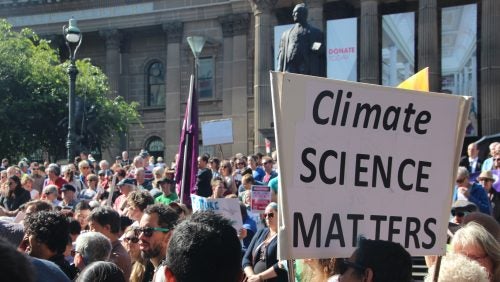
A large crowd gathered for a public demonstration, where a prominent sign reads "CLIMATE SCIENCE MATTERS," highlighting the advocacy for scientific integrity in environmental policy.
The Federal Judicial Center's removal of climate science guidance marks a strategic, deregulatory move to undermine mechanisms for private enforcement in climate change and environmental justice litigation.
FJC Removes Guidance for Judges on Climate Science
In February 2026, the Federal Judicial Center (FJC), an agency that provides guidance to judges on how to handle certain cases and controversies, quietly deleted drafted guidance on climate science.[1] This guidance, detailed in the Reference Manual on Scientific Evidence, includes a wide range of scientific research and evidentiary standards that serve as precedent in climate tort litigation.[2]
Although the FJC framed the deletion as a response to procedural concerns raised by twenty-seven Republican State Attorneys General[3], it represents a profound attempt to align the judiciary with a broader deregulatory agenda.[4] This action not only removes useful reference material but also dismantles the evidentiary infrastructure critical to private rights of action and complex environmental litigation.[5]
Background: The Broader Agenda for Environmental Deregulation
The second Trump administration and the Supreme Court have made multiple successful attempts to weaken the administrative prong of the American environmental regulatory framework. For example, in Loper Bright v. Raimondo[6], the Supreme Court overturned Chevron deference, which had required courts to defer to agencies’ reasonable interpretations of ambiguous statutes. More recently, EPA rescinded the 2009 Endangerment Finding[7], which established that greenhouse gases (GHGs) harm public health and welfare, bringing GHGs firmly within the crosshairs for EPA regulation.[8] This finding has since served as a hallmark of federal climate policy, allowing the government to directly regulate GHGs under the Clean Air Act. Its rescission by the second Trump administration’s EPA is another blow to the administrative state’s power and recognition of climate change as an issue of public law.
Attacking the Last Bastion for Environmental Justice: The Private Right of Action
Environmental regulation in the U.S. consists of two prongs: public law, enforced by administrative agencies, and private enforcement through litigation.[9] The two prongs have historically been interdependent, indicated by how mechanisms for private enforcement are often baked into administrative law and regulations.[10] Some of the most impactful environmental statutes include provisions for citizen suits and private rights of action to pave a way for private litigation as a buttressing force for enforcement in spots where administrative law is particularly weak.[11] Bringing attention to this relationship is markedly pertinent now, as the administrative state is increasingly in flux.
Against the backdrop of increased deregulation by the Trump administration, this recent and unusual deletion by the FJC stands out. As public law protections for climate change and environmental justice diminish, private litigation becomes the primary means of enforcement. Though the FJC’s guidance is not binding on courts, it has provided judges with reliable standards for evaluating climate science in climate torts.[12] The viability of environmental torts depends on a judge’s ability to navigate this “evidentiary gap” in proving causation between general climate science and concrete local harms suffered by specific plaintiffs in particular jurisdictions. This requires judges to understand how experts use statistical and scientific methods to bridge the gap between worldwide climate phenomena and localized damage. Without centralized judicial guidance on these climate science standards, the judiciary may struggle to evaluate complex scientific evidence consistently. While judges have access to precedent from other jurisdictions and may rely on established evidentiary standards, the absence of a federal reference manual eliminates a valuable resource designed specifically to explain climate science to the judiciary. Litigants in climate cases now face greater uncertainty about how different courts may approach scientific evidence, potentially making some forums more receptive to their claims than others. This variation, combined with the reduced clarity on what evidence courts should accept, may place private plaintiffs at a disadvantage if judges are less equipped to assess the scientific foundations of climate-related claims.
The FJC’s recent action may not seem as monumental as Loper Bright or the recission of the endangerment finding. However, the attention and pressure it received from Republicans is indicative of a substantial movement toward deregulation in all forms, including private enforcement.[13] Not only has this deregulatory agenda drastically weakened and captured federal agencies, but this also hints at an attempt to influence the judiciary’s actions in the private litigation realm.[14] For advocates of environmental justice and climate action, this development is incredibly concerning, as it may weaken available enforcement tools.
[1] Karen Zraick, Climate Change Is Erased From a Manual for Federal Judges, N.Y. Times (Feb. 10, 2026), https://www.nytimes.com/2026/02/10/climate/judge-manual-climate-change-chapter.html.
[2] Federal Judicial Center, Reference Manual on Scientific Evidence, Fourth Edition (2025), available at https://perma.cc/LP53-X28W (including omitted chapter).
[3] Letter from John B. McCuskey, Att’y Gen. of W. Va., et al., to Hon. Robin L. Rosenberg, Dir., Fed. Jud. Ctr. (Jan. 29, 2026), https://perma.cc/4A8D-W622.
[4] Press Release, The White House, President Trump Delivers Biggest Regulatory Relief in History (Feb. 13, 2026), https://perma.cc/3VP4-BPJQ.
[5] Abrahm Lustgarten, Federal Judicial Center Pulls Climate Change Chapter From Official Manual for U.S. Judges, ProPublica (Feb. 10,2026), https://www.propublica.org/article/federal-judicial-center-climate-change-republican-pressure.
[6] Loper Bright Enters. v. Raimondo, 603 U.S. 369 (2024).
[7] Rescission of the Greenhouse Gas Endangerment Finding and Motor Vehicle Greenhouse Gas Emission Standards Under the Clean Air Act, 91 Fed. Reg. 12,345 (proposed Feb. 18, 2026) (to be codified at 40 C.F.R. pts. 85, 86).
[8] Endangerment and Cause or Contribute Findings for Greenhouse Gases Under Section 202(a) of the Clean Air Act, 74 Fed. Reg. 66,496 (Dec. 15, 2009) (codified at 40 C.F.R. ch. 1).
[9] See J. Maria Glover, The Structural Role of Private Enforcement Mechanisms in Public Law, 53 Wm. & Mary L. Rᴇᴠ. 1137 (2013); see also William B. Rubenstein, Class Actions in the Administrative State: Kalven and Rosenfield Revisited, 80 U. Chi. L. Rᴇᴠ. 577 (2013).
[10] Id at 1148.
[11] See e.g., 42 U.S.C. § 7604 (Clean Air Act citizen suit); 33 U.S.C. § 1365 (Clean Water Act citizen suit); 16 U.S.C. § 1540 (Endangered Species Act citizen suit); 42 U.S.C. § 6972 (RCRA citizen suit).
[12] Supra note 3.
[13] Id.
[14] See generally Dillon et al., The Environmental Protection Agency in the Early Trump Administration: Prelude to Regulatory Capture, 108 Am. J. Pub. Health (Apr. 2018) (available online at https://perma.cc/P9AY-72BB/).