

From Massachusetts to Major Questions: Can the EPA Dismantle Its Own Climate Authority?
February 24, 2026 by Christiana Boehme
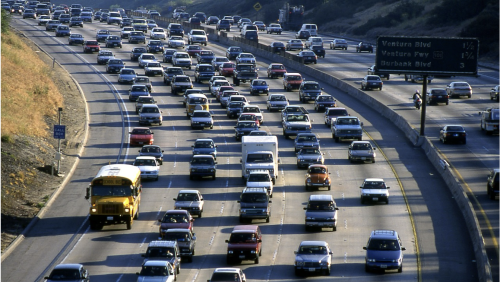
Heavy traffic fills a multi-lane highway, with cars, trucks, and a school bus illustrating dense motor vehicle congestion and emissions.
The Environmental Protection Agency's repeal of the 2009 Greenhouse Endangerment Finding substantially curtails greenhouse gas regulation, implicating previous decisions and the Major Questions Doctrine.
On February 12, 2026, the U.S. Environmental Protection Agency (“EPA”) finalized its decision to repeal the 2009 Greenhouse Endangerment Finding,[1] the scientific determination that has anchored federal regulation of greenhouse gas (“GHG”) emissions under the Clean Air Act for over fifteen years.[2] The agency also finalized the repeal of “all subsequent GHG emission standards” governing motor vehicles and engines that relied on that finding.[3] Six days later, a coalition of environmental and public health organizations petitioned for review in the U.S. Court of Appeals for the D.C. Circuit, setting the stage for a high-stakes legal challenge,[4] which will likely find its way to the Supreme Court.[5]
Section 202(a)(1) of the Clean Air Act (“CAA”) requires the EPA Administrator to prescribe “standards applicable to the emission of any air pollutant from any class . . . [of] new motor vehicles . . . which in his judgment cause, or contribute to, air pollution which may reasonably be anticipated to endanger public health or welfare.”[6] The landmark case, Massachusetts v. EPA, 549 U.S. 497 (2007), held that GHGs fall within the CAA’s broad definition of “air pollutant” and that the EPA therefore possesses the authority to regulate them.[7] The Court further explained that the EPA may avoid regulating GHGs only if it determines that they do not contribute to climate change or provides a “reasonable explanation” for declining to make this determination.[8] The Court also made clear that if the EPA were to “make[] a finding of endangerment, the [CAA] requires the agency to regulate” the pollutant.[9] Notably, the Court refused to clarify whether the EPA was required to make an endangerment finding, or whether policy concerns can inform the agency’s actions if it does.[10]
In 2009, the EPA issued its “Endangerment and Cause or Contribute Findings for Greenhouse Gases Under Section 202(a) of the Clean Air Act,” commonly known as the Endangerment Finding, which concluded that certain GHGs, including carbon dioxide, constitute “air pollution” and endanger the public health and welfare of “both current and future generations.”[11] Relying on this determination, the EPA promulgated numerous GHG regulations including vehicle and power plant emissions standards.[12] In 2015, the EPA issued the Clean Power Plan, which sought to shift electricity generation away from coal-fired plants toward cleaner sources.[13] Although challenges were pending, the Supreme Court stayed the Plan in 2016.[14] It was later repealed, and in 2021, the Biden EPA chose not to revive it. [15] Nevertheless, the Supreme Court held in West Virginia v. EPA, 597 U.S. 697 (2022), that the Clean Power Plan exceeded the EPA’s statutory authority under what the Court described as the “major questions doctrine,” which posits that agencies may not act on a matter of “vast economic and political significance” without very explicit authorization from Congress.[16]
So, what, according to the EPA, has changed since 2009? As a threshold matter, the EPA “does not rely on or evaluate the science to justify its repeal” of the finding.[17] Instead, the agency grounds its decision in legal reasoning.[18] First, it contends that the Endangerment Finding rested on a “profound misreading” of Massachusetts,[19] and furthermore, that questions concerning the Nation’s response to climate change are committed to Congress, and that Congress did not resolve those questions when it enacted CAA Section 202(a)(1).[20] Second, the EPA asserts that GHG regulations promulgated pursuant to the finding have had “no material impact” on climate change or its associated harms.[21] Third, it argues that GHG regulations fall outside the type of localized air pollution concerns Congress contemplated in enacting Section 202(a)(1).[22] Lastly, the EPA maintains that continuing such regulations would be unreasonable given their asserted “futility” and “immense burdens” on regulated parties and the economy.[23]
Considerable uncertainty surrounds the ultimate fate of the rescission, and in particular, whether the Court will extend its recent administrative law jurisprudence to this context. There is a meaningful possibility that the Court could apply the major questions doctrine as it did in West Virginia.[24] If so, the Court could conclude that broad regulation of GHGs falls outside the scope of authority Congress conferred in CAA Section 202(a)(1), leading to a holding that would substantially narrow, if not unsettle, the practical reach of Massachusetts. Crucially, none of the five Justices who formed the narrow majority in Massachusetts remain on the Court.[25] By contrast, three of the four dissenting Justices continue to serve on the Court,[26] and the remaining Justices, each nominated by President Trump, joined the majority in West Virginia.[27] Ultimately, the trajectory of federal climate regulation now turns on how the Court reconciles its foundational holding in Massachusetts with its more recent embrace of the major questions doctrine. Whether the EPA’s authority is reaffirmed or significantly constrained, the coming litigation will likely define the scope of administrative power over climate policy for years to come.
[1] Rescission of the Greenhouse Gas Endangerment Finding and Motor Vehicle Greenhouse Gas Emission Standards Under the Clean Air Act, 91 Fed. Reg. 7686 (Feb. 18, 2026).
[2] Philip B. Duffy, et al., Strengthened Scientific Support for the Endangerment Finding for Atmospheric Greenhouse Gases, 363 Science 597 (2019).
[3] Recission of the Greenhouse Gas Endangerment Finding, supra note 1, at 7729.
[4] Sharyn Stein, EPA Sued Over Illegal Repeal of Climate Protections, Env’t Def. Fund (Feb. 18, 2026), https://www.edf.org/media/epa-sued-over-illegal-repeal-climate-protections.
[5] Carrie Jenks & Sara Dewey, The Legal Reasoning Behind the Endangerment Rescission, The Salata Inst. for Climate and Sustainability at Harvard Univ. (Feb. 17, 2026), https://salatainstitute.harvard.edu/the-legal-reasoning-behind-the-endangerment-rescission/.
[6] 42 U.S.C. § 7521(a)(1).
[7] Massachusetts v. EPA, 549 U.S. 497, 500-01 (2007).
[8] Id. at 501.
[9] Id. at 533.
[10] Id. at 534-35.
[11] Endangerment and Cause or Contribute Findings for Greenhouse Gases Under Section 202(a) of the Clean Air Act, 74 Fed. Reg. 66496, 66498-99 (Dec. 15, 2009) (to be codified at 40 C.F.R. ch. 1).
[12] Sarah Brown, EPA Repeals Legal Basis for Regulating Greenhouse Gases. What it Means for the US — and the World, World Res. Inst. (Feb. 19, 2026), https://www.wri.org/insights/endangerment-finding-repeal-explained.
[13] Michael B. Gerrard, Trump EPA’s Proposed Revocation of Greenhouse Gas Endangerment Finding Raises Tangle of Legal Issues, N.Y.L.J., Sept. 2025, at 3.
[14] Bob Sussman, The Supreme Court’s Clean Power Plan Missteps, Brookings Inst. (Feb. 12, 2016), https://www.brookings.edu/articles/the-supreme-courts-clean-power-plan-missteps/.
[15] Trump Executive Order to Dismantle Clean Power Plan, Int’l Carbon Action P’ship (Mar. 29, 2017), https://icapcarbonaction.com/en/news/trump-executive-order-dismantle-clean-power-plan; Gerrard, supra note 13, at 3.
[16] West Virginia v. EPA, 597 U.S. 697, 700 (2022).
[17] Jenks & Dewey, supra note 5.
[18] Recission of the Greenhouse Gas Endangerment Finding, supra note 1, at 7686.
[19] Id. at 7689.
[20] Id. at 7690.
[21] Id. at 7732.
[22] Id. at 7733.
[23] Id. at 7688.
[24] Gerrard, supra note 13, at 5.
[25] Massachusetts v. Environmental Protection Agency, Oyez, https://www.oyez.org/cases/2006/05-1120 [https://perma.cc/ZYU9-UREE] (last visited Feb. 19, 2026). Justices Stevens, Kennedy, Souter, Breyer, and Ginsburg have all either retired from the bench or passed away. See Justice John Paul Stevens, John Paul Stevens Found., https://jpstevensfoundation.org/justice-john-paul-stevens/ (last visited Feb. 19, 2026); Amy Howe, Anthony Kennedy, Swing Justice, Announces Retirement, SCOTUSBlog (June 27, 2018), https://www.scotusblog.com/2018/06/anthony-kennedy-swing-justice-announces-retirement/; Amy Howe, David Souter, Retired Supreme Court Justice, Dies At 85, SCOTUSBlog (May 9, 2025), https://www.scotusblog.com/2025/05/david-souter-retired-supreme-court-justice-dies-at-85/; Justice Stephen Breyer, JUSTIA, https://supreme.justia.com/justices/stephen-breyer/ (last visited Feb. 19, 2026); Nina Totenberg, Justice Ruth Bader Ginsburg, Champion Of Gender Equality, Dies At 87, NPR (Sept. 18, 2020), https://www.npr.org/2020/09/18/100306972/justice-ruth-bader-ginsburg-champion-of-gender-equality-dies-at-87.
[26] 9 Questions About EPA’s Rescission of the 2009 Endangerment Finding, Baker Botts: Thought Leadership (Feb. 13, 2026), https://www.bakerbotts.com/thought-leadership/publications/2026/february/9-questions-about-epas-rescission-of-the-2009-endangerment-finding.
[27] Current Members, Supreme Court of the United States, https://www.supremecourt.gov/about/biographies.aspx (last visited Feb. 19, 2026); West Virginia v. Environmental Protection Agency, SCOTUSBlog, https://www.scotusblog.com/cases/case-files/west-virginia-v-environmental-protection-agency/#:~:text=Judgment:%20Reversed%20and%20remanded%2C%206,Justices%20Breyer%20and%20Sotomayor%20joined (last visited Feb. 19, 2026).