


How DOE’s Changing Relationship with FERC Implicates the Major Questions Doctrine
February 6, 2026 by Hannah Kinsey
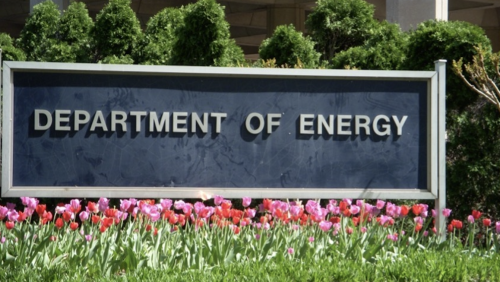
Entrance to the Department of Energy.
Recent actions by the Trump administration’s Department of Energy (DOE) are disrupting its relationship with the Federal Energy Regulatory Commission (FERC), the independent agency housed within it.
The Federal Energy Regulatory Commission (FERC) is an independent agency within the Department of Energy (DOE) that, unlike DOE, is designed to be insulated from political pressures. It has five commissioners who each serve staggered five-year terms, with no more than three commissioners from the same political party.[1] Commissioners are not subject to the supervision or direction of any officer, employee, or agent of any other part of DOE.[2] Only courts, not the President or Congress, have authority to review FERC cases.[3]
Agency independence, in theory, should enable nonpartisan, expertise-driven decision-making, helping FERC better achieve its mandate to ensure reliable, safe, secure, and economically efficient energy for American consumers. Recently, the Trump administration’s DOE has attempted to direct FERC’s activities through an obscure provision of the DOE’s enabling statute, raising concerns about FERC’s independence. The provision at issue, Section 403 of the DOE Organization Act (hereinafter Section 403), authorizes DOE to “propose rules, regulations and statements of policy of general applicability with respect to any function within the jurisdiction of [FERC],”[4] and to impose “reasonable time limits” for FERC to act on those proposals.[5] FERC must then “take final action” on the proposal: either by refusing to promulgate a final rule or policy, finalizing the rule or policy as proposed, or promulgating it with modifications.[6]
During President Trump’s first administration, Energy Secretary Perry used Section 403 to direct FERC to provide guaranteed payments in wholesale energy markets to coal and nuclear power plants.[7] In August and October of 2025, Energy Secretary Wright invoked Section 403 twice more, asking FERC to undertake additional actions aligned with the administration’s energy agenda.[8] Notably, such actions would indirectly support fossil fuel industries.
The Trump administration’s use of Section 403 implicates the major questions doctrine, which prohibits federal agencies from deciding issues of major national significance without clear congressional authorization.[9] Here, the major questions doctrine limits DOE’s ability to reinterpret its settled relationship with FERC using a statutory provision traditionally limited in scope.
Section 403’s legislative history and historical practice demonstrate that Congress designed it for a unique purpose: as an emergency measure for DOE during times of energy crisis. That purpose was shaped directly by the 1973 Arab oil embargo, the first energy crisis in American history,[10] which galvanized Congress to centralize energy powers that had been fragmented across three different agencies.[11] Some members of Congress favored granting broad powers to DOE to allow the Executive to swiftly manage the nation’s energy resources in the event of future crises.[12] Yet there was lingering distrust from the Watergate scandal, and many congressmen feared delegating too much power to the Executive.[13] Thus, Congress created FERC to handle licensing and regulation while DOE set policy.[14] Section 403 was a product of compromise in Congress, granting DOE a formal mechanism to participate in FERC’s activities beyond the traditional means available to agencies.[15]
Section 403 was used twice in its first 40 years: both times as part of extensive strategies by DOE to solve the country’s energy crises. In 1979, DOE invoked Section 403 to tackle another massive oil shortage, the very event that led to the DOE’s own creation.[16] In 1985, DOE invoked Section 403 as part of an overhaul of energy regulation—addressing major market distortions that FERC had been unable to resolve for three years.[17] Section 403 then remained unused for more than three decades as acute energy crises faded from public consciousness.
Frequently invoking Section 403, particularly if in response to fabricated “emergencies,”[18] prevents FERC from pursuing its own agenda and supplants it with DOE’s. Responding to Section 403 proposals requires FERC to divert its limited resources to collecting comments and evaluating DOE’s proposals— a process that often takes months. These practical realities overstep the limits Congress intended with the DOE Organization Act. Through Section 403, DOE is “claim[ing] to discover in a long-extant statute an unheralded power,” such power representing a “transformative expansion” in DOE’s regulatory authority.[19] Using Section 403 as a mechanism for routine policy interference risks FERC’s independence and places American energy security on the line.
[1] 42 U.S.C. § 7171(b)(1).
[2] 42 U.S.C. § 7171(d).
[3] 42 U.S.C. § 7171(i).
[4] 42 U.S.C. § 7173(a).
[5] 42 U.S.C. § 7173(d).
[6] Id.
[7] 82 Fed. Reg. 46940-41 (Oct. 10, 2017).
[8] See Sec’y of Energy, Sec’y of Energy’s Direction that the FERC Initiate Rulemaking Proc. and Proposal to Rescind the Draft Updated Certificate Pol’y Statement Pursuant to the Sec’y’s Auth. Under Section 403 of the Dept. of Energy Organization Act (Aug. 29, 2025) at 2, https://www.energy.gov/sites/default/files/2025-10/08-29-2025%20-%20FERC%20403%20Certificate%20Policy%20Statement%20-%20signed%20by%20S1%20Wright.pdf; Sec’y of Energy, Sec’y of Energy’s Direction that the Fed. Energy Regul. Comm’n Initiate Rulemaking Proc. and Proposal Regarding the Interconnection of Large Loads Pursuant to the Sec’ys Authority Under Section 403 of the Dep’t of Energy Org. Act (Oct. 23, 2025), https://www.energy.gov/sites/default/files/2025-10/403%20Large%20Loads%20Letter.pdf.
[9] E.g., Kate R. Bowers, The Major Questions Doctrine, Congress.Gov (Nov. 2, 2022), https://www.congress.gov/crs-product/IF12077.
[10] October, 1973: The First Energy Crisis, U.S. Department of Energy, https://www.energy.gov/management/october-1973-first-energy-crisis(last visited Jan. 26, 2025).
[11] Clark Byse, The Department of Energy Organization Act: Structure and Procedure, 30 Admin. L. Rev. 193, 193 (1978).
[12] See Sharon Jacobs, The Statutory Separation of Powers, 129 Yale L.J. 378, 382 (2019).
[13] See id.
[14] See Edward J. Grenier, Jr, & Robert W. Clark III, The Relationship Between DOE and FERC: Innovative Government or Inevitable Headache?, Energy L.J., Dec. 31, 1979, at 325.
[15] See Grenier, Jr. & Robert W. Clark III, supra note 15 at 337.
[16] See 44 Fed. Reg. 17644 (March 22, 1979); Philip K. Verleger Jr., The U.S. Petroleum Crisis of 1979, 2 Brookings Papers on Economic Activity 463, 463 (1979).
[17] See Charles H. Shoneman & Gerard R. McConnell, FERC Order No. 451: Freedom (Almost) for Old Gas, 7 Energy L.J. 299, 303 (1986).
[18] See Sharon Jacobs & Ari Peskoe, Energy Emergencies vs. Manufactured Crises: The Limits of Federal Authority to Disrupt Power Markets 3 (Univ. of Colo. ed., 2019)
[19] West Virginia v. EPA, 597 U.S. 697, 724 (2022).