


Is the Inflation Reduction Act “Just?”: Applying the IRA to the Energy Justice Framework
March 31, 2026 by Oliver Wilder
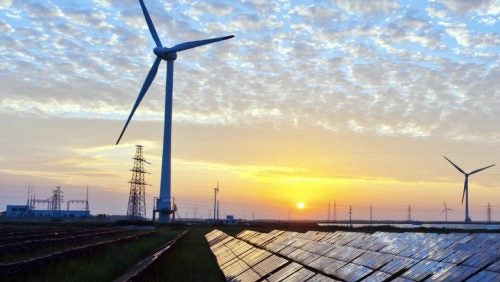
Solar cell panels, wind turbines, and electricity pylons at sunset.
While the Inflation Reduction Act marks a monumental shift in U.S. climate policy, a cleaner energy economy is not inherently a more “just” one. Applying the energy justice framework to the Act’s tax incentives and funding models reveals a landmark policy that serves as a critical checkpoint, rather than the finish line, for true equity.
Climate change legislation and, by proxy, clean energy policy have reached new heights since the United States passed the Inflation Reduction Act (IRA) on August 16, 2022, under the Biden Administration.[1] The Act provides hundreds of billions of dollars for a range of issues, including $400 billion for energy and climate, and offers numerous financial incentives and tax credits.[2] While the Act marks a major step toward decarbonization and incentivizes U.S. markets to build clean energy systems, it is important to be wary of the energy transition’s allure and to consider the more nuanced questions involved in such a monumental shift to the energy economy.
Legal scholars Shelley Welton and Joel Eisen argue that “the rapid transition to clean energy is fraught with potential inequities.”[3] They raise fundamental questions for “clean energy justice,” such as: Who should pay for the energy transition? Will the new green economy be fairer than the fossil fuel economy it replaces? Who decides which resources will power our future?[4] Welton and Eisen recognize that, while clean energy offers significant benefits for the global climate and air quality, a cleaner energy economy is not inherently a more “just” one.[5]
An important question thus becomes: What inequities exist in current clean energy systems, especially within the IRA? For example, tax credits aimed at households rather than businesses have mostly benefited higher-income Americans. [6] Severin Borenstein and Lucas Davis found that since 2006, U.S. households received over $18 billion in federal income tax credits for certain home renovations, such as installing solar panels and buying hybrid and electric vehicles. They find that the bottom three income quintiles receive only about 10% of these credits, with an even greater disparity in electric vehicle programs, with the top income quintile receiving 90% of all credits.[7] Within the framework of clean energy justice, this represents an obvious distributional issue. However, the IRA is unique in taking direct measures to address such inequities inherent in tax credits.
The IRA’s Low-Income Communities Bonus Credit Program provides up to a 10-20% boost to the Investment Tax Credit for qualified solar or wind facilities in low-income communities.[8] The program aims to expand clean energy facilities in low-income communities and benefit those who have faced health or economic disadvantages.[9] Data shows that this intention has been successful. From August 2022 to September 2023, around 75% of actual investment in clean energy technologies went to congressional districts with below-average income and educational attainment.[10] This paints a pretty picture, but not necessarily the whole one. Other studies show the top 25% highest-earning households received 66% of tax credits, totaling $5.5 billion, while the lowest-earning 25% received just $32 million.[11] Thus, while the IRA has taken affirmative efforts to remedy inequity in tax credit programs, it does not completely depart from that structure. However, the IRA has taken a step in the right direction toward greater clean energy justice by focusing investment and job growth in low-income communities.
The clean energy justice framework is also concerned with procedural inequity, i.e., who makes the decisions.[12] Here, the IRA addresses the symptom rather than the root cause. For example, to address the reality that low-income Americans experience the greatest environmental and climate impacts, Biden issued Executive Order 14008, which included the Justice40 initiative.[13] This initiative requires 40% of federal climate investments to benefit disadvantaged and overburdened communities.[14] However, while addressing the distributional concern, it overlooks the source of the distributional disparity: who creates and enforces clean energy systems. For example, the IRA, primarily focused on tax credits, is enforced by federal agencies such as the IRS and the Treasury.[15]
Another central concern Welton and Eisen raise is that clean energy transitions are often funded through electricity bills.[16] This means that as more affluent customers are better equipped to lower their bills through clean energy investments, a class divide could emerge over who funds the transition.[17] The IRA changes this model by funding the transition through tax increases on large corporations rather than on middle- and lower-income households.[18] While some costs may still be absorbed by consumers, the IRA’s unique funding structure attempts to reduce inequities by shifting the burden of clean energy development away from average Americans and onto the corporate sector.[19]
In conclusion, the IRA represents a major win for the clean energy transition and has had a more positive impact on lower-income communities than past clean energy policies. It reduces reliance on regressive funding systems and emphasizes investments in lower-income communities. However, as Welton and Eisen’s framework makes clear, achieving a “just” transition requires more. The enforcement structure and disparity in tax credit benefits showcase that the IRA is merely a checkpoint, not the finish line.
[1] Inflation Reduction Act of 2022, Pub. L. No. 117-169, 136 Stat. 1818 (2022).
[2] Buchalter, Inflation Reduction Act Incentives for Energy Sector, Insights (Aug. 18, 2022), https://www.buchalter.com/insights/inflation-reduction-act-incentives-for-energy-sector/ [https://perma.cc/LU4Y-4AD3].
[3] Shelley Welton & Joel Eisen, Clean Energy Justice: Charting an Emerging Agenda, 43 Harv. Envtl. L. Rev. 307, 308 (2019).
[4] Id.
[5] Id. at 309
[6] Severin Borenstein & Lucas Davis, The Distributional Effects of U.S. Clean Energy Tax Credits (Energy Inst. at Haas, Working Paper No. 262R, 2015).
[7] Id.
[8] 26 C.F.R. § 1.48(e)-1 (2023).
[9] Press Release, U.S. Dep’t of Treasury, FACT SHEET: How the Inflation Reduction Act’s Tax Incentives Are Ensuring All Americans Benefit from the Growth of the Clean Energy Economy (Oct. 20, 2023), https://home.treasury.gov/news/press-releases/jy1830.
[10] Jasia Smith & Jamie Friedman, Underserved Communities Are Benefiting From the Inflation Reduction Act’s Investments in Clean Energy and Technology, Ctr. for Am. Progress (Mar. 12, 2024), https://www.americanprogress.org/article/underserved-communities-are-benefiting-from-inflation-reduction-acts-investments-in-clean-energy-and-technology/.
[11] Thomas Frank, Wealthier Homeowners Nab Billions in Tax Credits for Energy Efficiency, Politico (Aug. 28, 2024), https://www.politico.com/news/2024/08/28/biden-energy-tax-credits-homeowners-00174019.
[12] Welton & Eisen, supra note 3.
[13] Courtney Lindwall, What Is the Justice40 Initiative? NRDC (Dec. 4, 2023), https://www.nrdc.org/stories/what-justice40-initiative.
[14] Id.
[15] Supra note 1.
[16] Welton & Eisen, supra note 3, at 310.
[17] Id.
[18] Ramsey Solutions, What Is the Inflation Reduction Act and How Does It Affect Me? (Jan. 5, 2024), https://www.ramseysolutions.com/taxes/inflation-reduction-act [https://perma.cc/5AUU-U849].
[19] Id.