


Rough Seas for Climate Resiliency Efforts: Hawai‘i’s “Green Fee” on Cruise Ships Faces Opposition
February 2, 2026 by Chess Cawley
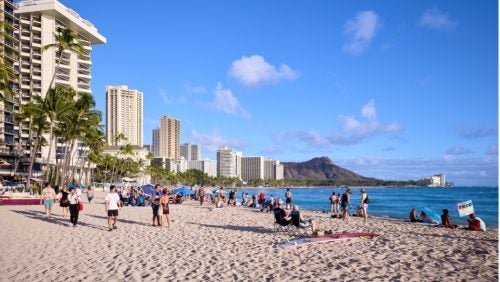
Photo of ‘Oahu, Hawai‘i’s Waikīkī Beach. See below for image link.
The Ninth Circuit recently blocked Hawai‘i’s cruise ship Green Fee, delaying necessary climate resilience funding, while weighing constitutional challenges to the nation’s first climate impact fee.
On December 31, 2025, the Court of Appeals for the Ninth Circuit issued an injunction blocking Hawai‘i from imposing a “Green Fee” on cruise ship passengers, effectively limiting climate resiliency efforts across the island chain while the appeal is pending.[1]
Passed in May of 2025, Act 96 created the nation’s first climate impact fee, or “Green Fee,” to help build climate resiliency in Hawai‘i.[2] The Act enables the state to increase the transient accommodations tax (TAT) rate on lodging, such as hotel rooms or vacation rentals, by 0.75% starting in 2026 and to impose the TAT on cruise ships using the state’s ports.[3] The Green Fee is designed to generate about $100 million annually,[4] which the state uses to fund climate initiatives in three main areas.[5] First, it supports environmental stewardship, including initiatives to safeguard Hawai‘i’s land and ocean ecosystems, and conserve biodiversity.[6] Second, the Green Fee advances climate and hazard resiliency efforts, strengthening infrastructure and lessening risks of natural disasters such as wildfires and floods.[7] Third, it supports sustainable tourism initiatives including improvements to local beaches and parks.[8]
The Green Fee plays a crucial role in proactively protecting the island chain by building resiliency, given Hawai‘i’s vulnerability to climate change. For example, in 2023, Maui faced “one of the deadliest U.S. wildfires in at least the past 100 years,” caused by high winds and extremely dry weather.[9] The wildfires claimed more than 100 lives, destroyed over 2,200 structures and caused an estimated $5.5 billion in losses.[10] Additionally, the island chain continues to face a severe threat of rising sea levels. Since 1970, Hawai‘i has already suffered about 5 inches of sea-level rise.[11] The short-term effects of this sea-level rise include increased coastal flooding, with 66,000 people at risk today.[12] Other threats such as ocean warming and acidification caused by climate change also pose significant dangers to local ecosystems across Hawai‘i.[13]
Despite the need for greater climate change mitigation and adaptation initiatives, the Green Fee faced opposition from frequent users of Hawai‘i’s ports and Cruise Lines International Association, who challenged the constitutionality of the tax on cruise ships.[14] They argue that the Green Fee violates the Tonnage Clause of the U.S. Constitution, which prohibits states from charging “for the privilege of entering, trading, or lying in a port.”[15] They also allege violations of the First Amendment and the Rivers and Harbors Appropriation Act of 1884.[16] The U.S. Government filed a motion to intervene as a plaintiff in this case before the United States District Court for the District of Hawai‘i.[17] The district court declined to block the Green Fee from taking effect and Plaintiffs appealed.[18] On December 31, 2025, the Ninth Circuit granted the motions for injunctive relief, halting the enforcement of the Green Fee’s cruise ship tax pending the resolution of the appeal.[19] This ruling does not affect the Green Fee’s application to hotels and other lodging through the TAT increase.
Overall, the Green Fee represents advances in Hawai‘i’s strong efforts to fund climate resiliency and sustainable tourism through targeted revenue from visitors. Although legal challenges have temporarily stopped the state from being able to use the Green Fee to tax cruise ships, it underscores Hawai‘i’s commitment to proactively protecting its communities, ecosystems, and infrastructure from the growing impacts of climate change.
Image: Frank Schulenburg, CC BY-SA 4.0 , via Wikimedia Commons; https://commons.wikimedia.org/wiki/File:Waikiki_Beach_(2024)-L1004709.jpg
[1] HNN Staff, Lawsuit Blocks Hawaii Cruise Ship Tax, Hotel Fees Take Effect, Hawaii News Now (Jan. 1, 2026), https://www.hawaiinewsnow.com/2026/01/02/lawsuit-blocks-hawaii-cruise-ship-tax-hotel-fees-take-effect/.
[2] Press Release, Office of the Governor, Governor Green Signs Historic Senate Bill 1396 Codifying a Green Fee to Mitigate Climate Impacts in Hawai‘i, (May 27, 2025), https://governor.hawaii.gov/newsroom/office-of-the-governor-news-release-gov-green-signs-historic-senate-bill-1396-codifying-a-green-fee-to-mitigate-climate-impacts-in-hawaii/.
[3] Act 96, 2025 Sess. Laws of Haw., https://www.capitol.hawaii.gov/sessions/session2025/bills/GM1196_.PDF.
[4] Press release, supra note 2.
[5] Green Fee Advisory Council, https://greenfeehawaii.org (last visited Jan. 22, 2026).
[6] Id.
[7] Id.
[8] Id.
[9] United States Environmental Protection Agency, Maui Wildfires (Nov. 18, 2025), https://www.epa.gov/maui-wildfires.
[10] United States Fire Administration, Preliminary After-Action Report: 2023 Maui Wildfire (Feb. 8, 2024), https://www.usfa.fema.gov/blog/preliminary-after-action-report-2023-maui-wildfire/.
[11] State of Hawai‘i Climate Commission, Rising Sea Level, State of Hawai‘i Climate Change Portal, https://climate.hawaii.gov/hi-facts/sea-level-rise/.
[12] Id.
[13] United States Environmental Protection Agency, What Climate Change Means for Hawai‘i (Aug. 2016), https://19january2017snapshot.epa.gov/sites/production/files/2016-09/documents/climate-change-hi.pdf.
[14] Cruise Lines Int’l Ass’n, Inc. v. Suganuma, No. 1:25-cv-00367 (D. Haw. Aug. 27, 2025) (complaint filed).
[15] Polar Tankers, Inc. v. City of Valdez, 557 U.S. 1, 8 (2009) (quoting Clyde Mallory Lines v. Alabama ex rel. State Docks Comm’n, 296 U.S. 261, 265–66 (1935)); see U.S. Const. art. I, § 10, cl. 3.
[16] Cruise Lines Int’l, No. 1:25-cv-00367 (D. Haw. Aug. 27, 2025) (complaint filed).
[17] Cruise Lines Int’l, No. 1:25-cv-00367 (D. Haw. Dec. 4, 2025) (Doc. 90) (order granting United States of America’s Motion to Intervene).
[18] Cruise Lines Int’l, No. 1:25-cv-00367 (D. Haw. Dec. 23, 2025) (Doc. 103) (order granting in part and denying in part motion to dismiss, and denying motions for preliminary injunction).
[19] Cruise Lines Int’l, No. 25-8057 (9th Cir. Dec. 31, 2025) (order granting preliminary injunction).