

The Two Speeds of NEPA Review at Burgum’s DOI
February 14, 2026 by Giulia Gerard
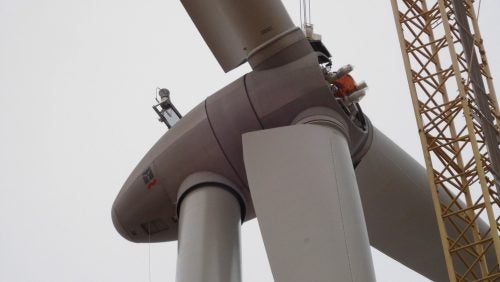
A wind turbine under construction
The Trump Administration is making good on its promise to expedite environmental permitting—unless you’re building wind or solar.
Nearly a year after the issuance of the executive order “Unleashing American Energy,”[1] the Trump Administration is making good on its promise to “expedite and simplify” the permitting review process—but not all energy producers have benefited equally.
On January 8, 2026, the Council for Environmental Quality (CEQ), the body that oversees federal environmental reviews under NEPA, finalized an interim rule that had been in effect since February 25, 2025.[2] The rule, entitled “Removal of National Environmental Policy Act Implementing Regulations,” rescinds longstanding procedural guidance issued by the CEQ that agencies were required to follow when evaluating the environmental impacts of their actions.[3] Now free to follow less stringent procedures, rules eliminating perceived administrative burdens in their environmental review processes.[4]
The Department of the Interior (DOI) and its various bureaus have been no exception. In July, DOI issued new rules relaxing its NEPA review procedures.[5] Acting under DOI’s new rules, the Bureau of Land Management (BLM) has stopped subjecting certain draft Environmental Impact Statements (EISs) to public notice-and-comment, bucking a standard practice for 46 years.[6] The subjects of expedited review have included leases for a mining project in Elko County, Nevada,[7] and for an oil extraction project in Alaska’s Cook Inlet.[8] Although the procedural shortcut is likely to hasten review, it also removes a key opportunity for the public to voice their opinions before the final EIS is published.
But not all BLM projects have been the subject of fast-pass procedures. In keeping with the Administration’s general distaste for renewables, many of the wind and solar developments pending BLM’s approval have been suspended in administrative purgatory.[9] Some approvals, such as a right-of-way grant to the Jackalope Wind project, have been stalled in NEPA review since March 2024.[10] The culprits of the delay appear to be a memo, requiring that all permitting decisions concerning wind and solar developments be submitted to the DOI’s Office of the Executive Secretariat and Regulatory Affairs for review,[11] and a secretarial order, signed by Burgum, directing Interior agencies to disfavor wind and solar permits because of low-density energy capacity.[12] The additional layers of scrutiny give Burgum’s office exceptional power to halt permits indefinitely or deny them altogether.
Unsurprisingly, the accelerating and decelerating pace of permit reviews has prompted litigation by major environmental groups.[13] In December, the Center for Biological Diversity and Sierra Club brought suit against BLM and DOI, seeking an injunction against the DOI rule that exempted draft EISs from public comment.[14] In their complaint, environmental plaintiffs argue that the rule was arbitrary and capricious, and contrary to law under the Administrative Procedure Act (APA).[15] NEPA, they argue, requires a meaningful opportunity for public comment during the review process, a requirement that would be frustrated by withholding draft EISs.[16] While the environmental groups’ arguments have strong precedent in the history of NEPA implementation, they face an uphill battle in light of the Supreme Court’s recent ruling in Seven County Infrastructure Coalition v. Eagle County, Colorado. [17] In the landmark 8-0 decision, the Court held that agencies are afforded “substantial discretion” in crafting their procedural requirements for EISs because of the “predictive and scientific judgments” involved in assessing the relevant impacts.[18] Thus, any increased haste in permit approvals may be difficult to challenge as a violation of NEPA.
However, a different challenge to DOI and BLM’s actions by another coalition of environmental groups may prove more fruitful. Also in December 2025, RENEW Northeast brought suit against BLM and DOI, alleging that the agencies had acted arbitrarily and capriciously under the APA by disfavoring wind and solar projects.[19] As evidence of the DOI’s anti-renewable bias, they cite the July 15 memorandum and the August 1 secretarial order, arguing that both offer pretextual reasoning that demonstrates animus towards wind and solar development, and thus lack a reasoned basis sufficient to satisfy hard-look review.[20] Despite raising many of the same claims as the DOI rule litigation, these plaintiffs may have the advantage of basing their most salient arguments outside NEPA’s text, avoiding the doctrinal problems posed by Seven Counties. Furthermore, other litigation premised on similar claims challenging delays in wind development have succeeded in the District of Massachusetts, suggesting an effective path forward.[21]
Although a challenge to the DOI’s favoritism could succeed in the courts, accelerated NEPA procedures may be here to stay. Efforts to codify the holding of Seven Counties and to remove many of NEPA’s most stringent procedural hurdles have already passed the House in the form of the SPEED Act.[22] Although some Senate Democrats have protested the act because of the Executive’s prejudice towards renewables, many seem otherwise sympathetic to the Act’s deregulatory aims.[23] As of writing this piece, the Senate Committee on Energy and Natural Resources has not yet scheduled hearings on the SPEED Act.[24]
[1] Exec. Order No. 14,154, 90 Fed. Reg. 8353 (2025).
[2] Removal of National Environmental Policy Act Implementing Regulations, 91 Fed. Reg. 618 (2026).
[3] See id. at 619.
[4] See id. at n.3.
[5] National Environmental Policy Act Implementing Regulations, 90 Fed. Reg. 29498 (2025)
[6] Hannah Northey, ‘Test Case’ for NEPA: Fast-Tracked Mine Reviews Fuel Outcry, E&E News by Politico (Oct. 21, 2025), https://www.eenews.net/articles/test-case-for-nepa-fast-tracked-mine-reviews-fuel-outcry/.
[7] Id.
[8] Yereth Rosen, No Public Comment or Hearings on Environmental Review of Oil Leasing in Alaska’s Cook Inlet, Alaska Beacon (Sept. 19, 2025), https://alaskabeacon.com/2025/09/18/no-public-comment-or-hearings-on-environmental-review-of-oil-leasing-in-alaskas-cook-inlet/.
[9] Brad Plumer & Rebecca F. Elliott, Trump Administration Is Delaying Hundreds of Wind and Solar Projects, N.Y. Times (Feb. 4, 2026), https://www.nytimes.com/2026/02/04/climate/wind-solar-projects.html.
[10] Jackalope Wind Project, BLM National NEPA Register, https://eplanning.blm.gov/Project-Home/?id=0bba6ce4-a7f2-f011-8406-001dd8008d46 (last visited Feb. 8, 2026).
[11] U.S. Dep’t of the Interior Departmental Review Procedures for Decisions, Actions, Consultations, and Other Undertakings Related to Wind and Solar Energy Facilities (July 15, 2025), http://www.doi.gov//media/document/departmental-review-procedures-decisions-actions-consultations-and-other.
[12] U.S. Dep’t of the Interior, SO 3438: Managing Federal Energy Resources and Protecting the Environment (Aug. 1, 2025), http://www.doi.gov//document-library/secretary-order/so-3438-managing-federal-energy-resources-and-protecting.
[13] Environmental Groups Challenge Interior Department’s New NEPA Procedures, Paul Hastings (Jan. 14, 2026) https://www.paulhastings.com/insights/phast-track-legal-insights-on-environment-energy-and-infrastructure/environmental-groups-challenge-interior-departments-new-nepa-procedures (last visited Feb. 3, 2026).
[14] Complaint at 1, 31-33, Center for Biological Diversity v. U.S. Dep’t of the Interior, No. 3:25-cv-10793 (N.D. Cal. Dec 18, 2025).
[15] Id. at 32.
[16] See id. at 32-33.
[17] Seven County Infrastructure Coalition v. Eagle County, Colorado, 605 U.S. 168 (2025).
[18] Id. at 181.
[19] Complaint at 49-50, 52-55, Renew Northeast v. U.S. Dep’t of the Interior, No. 1:25-cv-13961 (D. Mass. Dec. 23, 2025).
[20] See Id. at 4-5, 49-50, 52-55.
[21] See New York v. Trump, 2025 WL 3514301, *13-17 (D. Mass. 2025).
[22] H.R. 4776, 119th Cong. (2025).
[23] See Jael Holzman, Exclusive: Key Senate Democrats Oppose Permitting Bill, Heatmap News (Dec. 9, 2025), https://heatmap.news/politics/schatz-whitehouse-heinrich-speed-act.
[24] Public Lands, Forests, and Mining Subcommittee to Receive Testimony on Pending Legislation, U.S. Senate Committee on Energy and Natural Resources (Feb. 12, 2026), https://www.energy.senate.gov/hearings/2026/2/public-lands-forests-and-mining-subcommittee-to-receive-testimony-on-pending-legislation.