

The Water Wagers: When Water Becomes Foreseeably Dry
April 14, 2026 by Renata Valquier Chavez
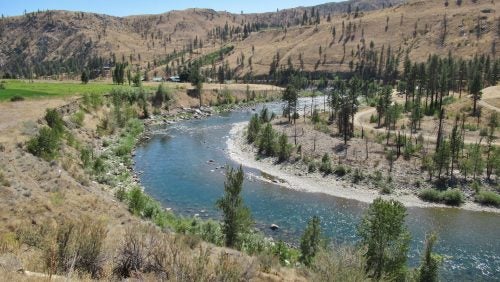
The Methow River in Washington's Okanogan County, within the Columbia River Basin targeted by Crown Columbia Water Resources LLC's area-wide water permit application. See below for image attribution.
Climate change's most consequential harms are slow, structural, and often invisible, exemplified by the growing commodification of water in the American West. While private law offers limited remedies, meaningful solutions require legislative reform.
Climate change has long been famed as a story of impending catastrophe. Economist R. Edward Park, in Slow Burn, argues that this framing misses the most consequential dimension of the problem: the pervasive, largely invisible costs that accumulate quietly across billions of lives.[1] These “slow burn” harms—gradual, chronic, and unequally distributed—rarely make headlines but may in aggregate prove more damaging than any single disaster.[2] The commodification of water costs are structural and slow-moving; its burdens fall on communities least able to absorb them; and the legal system can only partially hold accountable those who profit from manufactured scarcity.
The American West is suffering from two crises that are rapidly converging. The first is ecological: the Colorado River is carrying roughly 20 percent less water than it did on average in the previous century— the product of the worst drought in 1,500 years and the compounding effects of climate change. [3] The second is institutional: private financial investors, backed by Wall Street capital, are quietly acquiring water rights across the region at a pace and scale that existing legal frameworks are not designed to handle.
Together, these crises raise an important question: what role can private law play to intercept the commodification of water, or is it a problem fundamentally for legislators and regulators?
Scholars argue that the private law of torts, property, and contracts will inevitably be pressed into service as climate adaptation disputes multiply, and that courts should adopt what they call a “foreseeability of nonstationarity” principle.[4] This is a presumption that unprecedented climate extremes are foreseeable, not exceptional, and that private actors’ legal obligations should expand accordingly. Applied to investor water acquisitions, this framework illuminates both legal pressure points and the structural limits of private law as a response to an issue of public resource governance.
The scale of private investment in Western water rights has grown dramatically in the last decade. In Arizona, for example, most of the water rights serving a small farming community on the Colorado River were quietly acquired by a subsidiary of the financial conglomerate MassMutual.[5] Those rights were subsequently sold to a fast-growing Phoenix suburb located 175 miles away.[6] Water Asset Management, a Manhattan-based hedge fund, has become one of the largest landholders in Colorado’s Grand Valley, acquiring agricultural properties and their associated water rights.[7] In Washington state, Crown Columbia Water Resources, LLC, backed substantially by retired Goldman Sachs partners, applied for an unprecedented area-wide water permit that would allow it to acquire water rights anywhere across the entire Columbia River Basin under a single authorization.[8] Crown Columbia’s application for 49.9 cubic feet per second (cfs)[9] is carefully calibrated to stay just below the 50 cfs threshold that would trigger environmental review under Washington’s State Environmental Policy Act.[10] This illustrates how investors can work within the letter of existing law while circumventing its spirit.
These cases share a common exploitation of legal ambiguity. Western water law’s prior appropriation doctrine (first in time, first in right) was designed for farmers and municipalities with identified uses, not for financial intermediaries whose business models depend on holding rights in anticipation of future scarcity.
A recent law review article by Jim Rossi and J.B. Ruhl offers a reframing of private law’s foreseeability principle for the climate era. Traditionally, foreseeability has been tied to the assumption that natural systems fluctuate within stable upper and lower bounds, allowing past experience to predict future conditions.[11] They argue that climate change has killed stationarity.[12] Unprecedented extremes are now the new normal, and courts should presume that private actors operating within climate-vulnerable systems understand this.[13] The implications for duties, defenses, and damages is significant because an investor who profits explicitly from anticipated water scarcity cannot easily claim that scarcity-driven harms to others were unforeseeable.
When applied to investor water acquisitions, however, the foreseeability of nonstationarity runs into a fundamental problem. The harm it addresses is not primarily tortious. The communities of Arizona, the farmers of the Grand Valley, and the rural counties of Washington’s Columbia Basin are not injured because investors have been negligent. They are injured because investors have legally acquired rights through authorized transactions, operating within regulatory frameworks that permit water banking and rights transfers, and holding property that existing law recognizes as theirs to hold.
Private law is a bilateral, backward-looking remedial system.[14] It compensates identified victims for identified wrongs. It is poorly suited to regulating the structural conditions under which a scarce public resource is being systematically captured before the harm fully materializes. The investor water rush reveals that private law’s adaptation to a changed climate will arrive too late for who controls a public resource, but it provides a mechanism for holding profiteers partially accountable.
Park’s insight applies here with particular force. Because we are never “too late” to intervene in a slow burn, and because the intensity of the damage is so heavily shaped by human choices and institutional design, the more consequential question is not whether to act, but through what means. The answer, this analysis suggests, lies in legislative reform of water allocation systems, stronger public trust doctrine, and interstate compacts that treat scarcity as a structural condition rather than a series of individual disputes.
Image: “Methow River” by Jasperdo, licensed under CC BY-NC_ND 2.0.
[1] See generally Robert Jisung Park, Slow Burn: The Hidden Costs of a Warming World (Princeton Univ. Press eds. 2024).
[2] Id.
[3] The Colorado River, Env’t & Energy Study Inst. (Feb. 19, 2025), https://www.eesi.org/briefings/view/021925rivers.
[4] Jim Rossi and J. B. Ruhl, Adapting Private Law for Climate Change Adaptation, 76 Vanderbilt L. Rev. 827, 828 (2023), https://scholarship.law.vanderbilt.edu/vlr/vol76/iss3/1.
[5] Ben Ryder Howe, Wall Street Eyes Billions in the Colorado’s Water, N.Y. Times (Jan. 3, 2021), https://www.nytimes.com/2021/01/03/business/colorado-river-water-rights.html.
[6] Id.
[7] Wall Street Wants Our Water, Great Basin Water Network (Jan. 9. 2021), https://greatbasinwater.org/wall-street-wants-our-water.
[8] Evan Bush, Wall Street Spends Millions to Buy Up Washington State Water, Seattle Times (Nov. 1, 2019), https://www.seattletimes.com/seattle-news/environment/wall-street-spends-millions-to-buy-up-washington-state-water/.
[9] In hydrologic terms, Cubic Feet per Second is the flow rate or discharge equal to one cubic foot (of water, usually) per second. This rate is equivalent to approximately 7.48 gallons per second. See Nat’l Weather Serv., Glossary, https://forecast.weather.gov/glossary.php?word=CFS.
[10] Ann McCreary, Water Bank Would Lock Up Columbia Basin, Methow Valley News (Mar. 3, 2021), https://methowvalleynews.com/2021/03/03/water-bank-would-lock-up-columbia-basin/.
[11] Rossi & Ruhl, supra note 4, at 827.
[12] Id.
[13] Id.
[14] Id. at 841.