

When Climate Change Meets Immigration Law: The Legal Gap for Climate-Displaced People
January 20, 2026 by Hatem Hassan
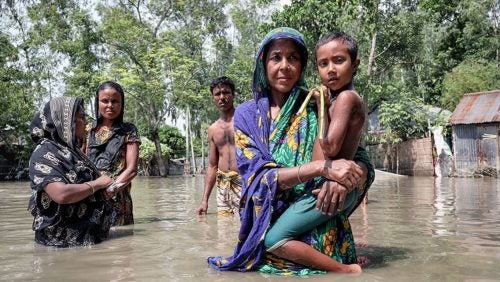
People wading through floodwaters illustrate human vulnerability to climate impacts.
Climate change is displacing millions, but U.S. environmental and immigration laws fail to protect climate migrants—revealing a growing legal gap with urgent human consequences.
Climate change is reshaping lived environments worldwide, forcing families to relocate due to extreme weather, sea-level rise, drought, and flooding. Yet U.S. law remains ill-equipped to protect those displaced by these climate-related harms. Although climate-induced displacement lies at the intersection of environmental and immigration law, neither framework recognizes or provides durable protection for climate migrants or climate refugees. This legal gap leaves a growing population in limbo and highlights the urgent need for targeted legislative and policy reform.
“Climate migration” refers to the movement of a person or groups of people, who are forced or choose to leave their homes, temporarily or permanently, largely because of sudden- or slow-onset changes in their regional environment due to the climate crisis.[1] While precise estimates vary, international agencies project that by 2050 climate change could force more than 216 million people to migrate within their own countries across six major world regions.[2] These estimates highlight the scale of challenges policymakers face, including identifying migration “hotspots,” financing large-scale urban expansion and resettlement, preventing the collapse of rural livelihoods, and ensuring that receiving cities can provide housing, water, jobs, and basic services to rapidly growing displaced populations.[3]
In the United States, the existing legal protections for displaced people primarily stem from two areas: the refugee and asylum system under immigration law and temporary humanitarian programs. Under the Immigration and Nationality Act (INA), a “refugee” is someone who is unable to return home due to a well-founded fear of persecution based on race, religion, nationality, membership in a particular social group, or political opinion.[4] Environmental degradation, even when severe, does not meet this criteria, so people displaced by climate events do not qualify as refugees under U.S. law. Efforts to expand “particular social group” arguments in climate cases have met resistance, and courts have upheld narrow interpretations that exclude climate threats alone from qualifying as persecution.[5]
Due to this gap, climate-displaced people currently may only access Temporary Protected Status (TPS) or similar humanitarian programs in narrow circumstances. TPS allows the Department of Homeland Security to grant temporary residency and work authorization to nationals of countries experiencing ongoing armed conflict, environmental disaster, or other extraordinary conditions.[6] Although TPS can offer short-term protection for those fleeing events such as hurricanes or droughts, it does not provide a pathway to permanent legal status or address the long-term needs of climate migrants.
Recognizing this deficiency, scholars and advocacy groups have proposed new legal pathways for climate-displaced persons. One notable example is the Climate Displaced Persons Act (CDPA), a bill reintroduced in Congress, which would add a definition of “climate-displaced persons” to INA and establish a framework for their admission into the United States, providing durable legal status and resettlement support.[7] The CDPA reflects growing recognition and consensus that climate displacement demands legal recognition beyond what current refugee law or temporary humanitarian relief offer.
Internationally, the United Nations High Commissioner for Refugees (UNHCR) acknowledges that people displaced by climate change often fall outside the 1951 Refugee Convention’s definition of a refugee.[8] However, climate pressures frequently intersect with conflict, human rights violations, and governance failures that can trigger protection needs under existing instruments.[9] These international perspectives highlight the legal complexity of climate migration and emphasize that neither domestic nor global legal systems currently offer a clear, comprehensive safety net for climate-displaced people.
The consequences of legal invisibility are significant. Climate-displaced individuals may face uncertain legal status, limited access to work authorization, and barriers to securing housing and social services. Meanwhile, communities within the United States experiencing internal climate displacement—such as tribal communities in Louisiana and Alaska grappling with rising seas—must rely on a patchwork of agency programs that emphasize adaptation planning rather than statutory protections. This fragmented approach leaves displaced individuals and communities without consistent support, enforceable rights, or long-term security, forcing them to navigate displacement through temporary or discretionary measures rather than durable legal protections.[10]
To close the gap between climate realities and outdated legal frameworks, several reforms are gaining traction among policymakers and advocates. First, Congress could enact legislation such as the Climate Displaced Persons Act to create a distinct classification for climate-displaced persons with clear criteria for admission, protection, and resettlement.[11]Such legislation could offer a humanitarian pathway that complements asylum and TPS programs without requiring climate harm to be redefined as persecution under the INA.[12] Second, the executive branch could improve the use of existing tools, by issuing TPS designations more frequently for climate disasters and integrating climate displacement considerations into broader immigration policy.[13] Third, Congress and federal agencies implementing environmental statutes could explicitly recognize displacement as a key metric in federal adaptation and resilience planning, linking climate policy to human rights outcomes.
Climate change is no longer a distant threat; it is already reshaping where and how people live today. But the law has yet to catch up with this reality. Bridging the divide between environmental harms and legal protection for displaced people requires legislative action, policy innovation, and a reframing of how legal systems address human mobility in the context of climate change.
[1] Climate Migrants, Climate Reality Project, https://www.climaterealityproject.org/climate-migrants (last visited Jan. 14, 2026).
[2] Viviane Clement et al., Groundswell Part II: Acting on Internal Climate Migration 80, World Bank (2021), https://documents1.worldbank.org/curated/en/837771631204427139/pdf/Groundswell-Part-II-Acting-on-Internal-Climate-Migration.pdf.
[3] Viviane Clement et al., Groundswell Part II: Acting on Internal Climate Migration xvii, xxiv–xxv, World Bank (2021) (warning that climate migration “hotspots” will emerge as early as the next decade and intensify by 2050; noting that receiving areas are often ill-prepared to absorb migrants or provide basic services; and emphasizing the need for proactive spatial and development planning to manage pressures on both sending and receiving areas).
[4] 8 U.S.C. § 1101(a)(42).
[5] Isaiah A. Gonzales & Siu Tip Lam, Unseen and Unprotected: The Ongoing Struggle of Climate Refugees in the United States, Vermont J. Env’t. L. (Dec. 2024), https://vjel.vermontlaw.edu/top-ten/2025-top-ten/2024/12/unseen-and-unprotected-the-ongoing-struggle-of-climate-refugees-in-the-united-states/.
[6] See Erol Yayboke, et al., A New Framework for U.S. Leadership on Climate Migration, Ctr. for Strategic & Int’l Stud. (Oct. 23, 2020), https://www.csis.org/analysis/new-framework-us-leadership-climate-migration (describing TPS and humanitarian parole options under current law).
[7] Climate Displaced Persons Act, H.R. 6455, 118th Cong. (2023) (proposing legal framework for climate-displaced persons’ protection).
[8] Climate Change and Displacement: The Myths and the Facts, UN High Comm’r for Refugees (Nov. 15, 2023), https://www.unhcr.org/news/stories/climate-change-and-displacement-myths-and-facts.
[9] Law and Policy for Protection and Climate Action, UN High Comm’r for Refugees, https://www.unhcr.org/us/law-and-policy-protection-and-climate-action (last visited Jan. 11, 2026) (explaining international refugee law limitations and climate displacement).
[10] See, e.g., Karla Mari McKanders, Climate Migration, A.B.A. (Oct. 30, 2024), https://www.americanbar.org/groups/crsj/resources/human-rights/2024-october/climate-migration/ (noting lack of U.S. legal protection for climate-displaced individuals and defining asylum criteria under the INA).
[11] See Climate Displaced Persons Act, S. 3340, 118th Cong. (2023).
[12] H.R. 6455, 118th Cong. (2023).
[13] See U.S. Opportunities to Address Climate Displacement, Amnesty Int’l (Aug. 2021), https://www.amnestyusa.org/wp-content/uploads/2021/08/Climate-Report-August-2021-Final-4.pdf?utm (explaining that TPS “can be granted based on the environmental disaster and extraordinary conditions grounds,” making it a potentially useful protective tool for climate-displaced people); See Erol Yayboke et al., A New Framework for U.S. Leadership on Climate Migration, Ctr. For Strategic & Int’l Stud. 10-12 (Oct. 23, 2020), https://www.csis.org/analysis/new-framework-us-leadership-climate-migration.