Georgetown Law home page Continuing Legal Education A-Z index Directories Search Student Services Admissions & Financial Aid Academic Programs About Georgetown Law Alumni Workshops & Institutes Library Faculty & Administration About this site Site map

CAROLA

(Center for the Advancement of the Rule of Law in the Americas)

ruler


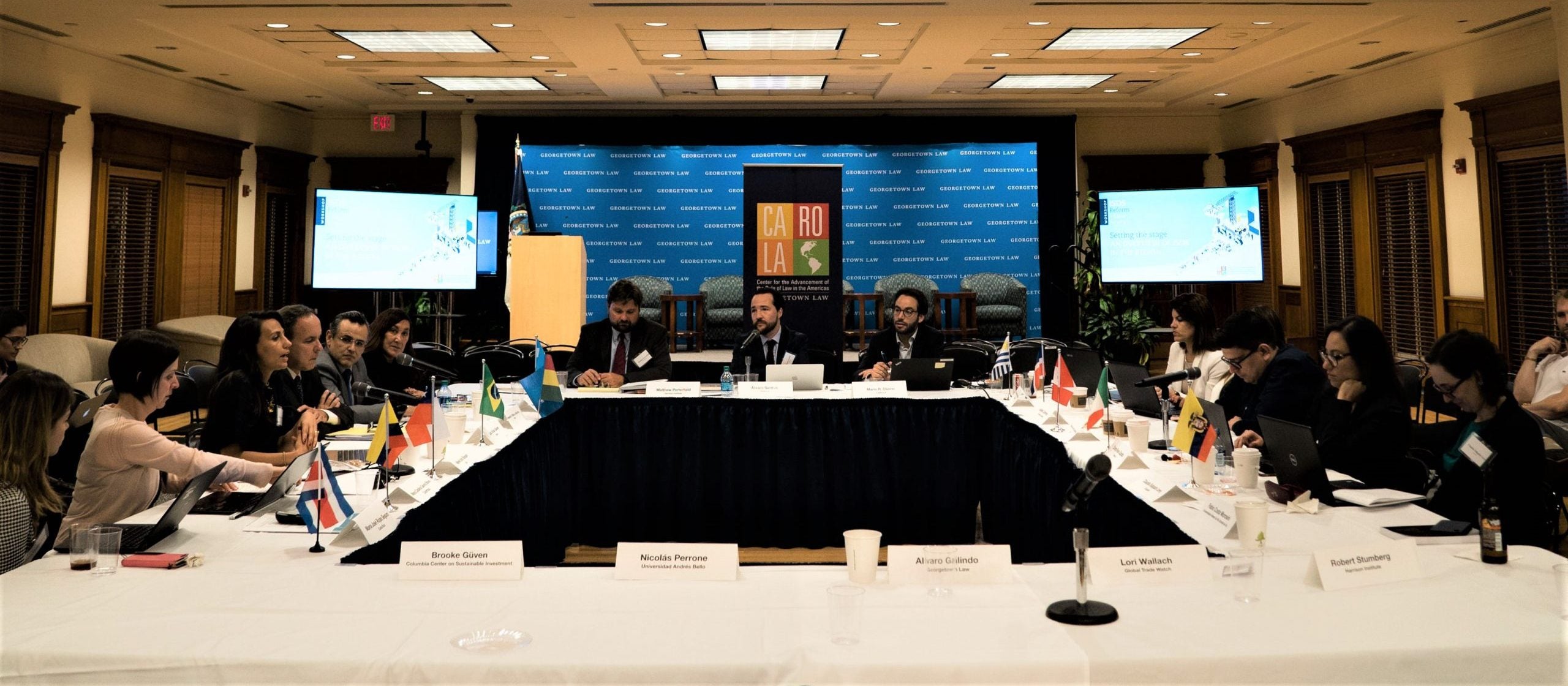
The Georgetown University Center for the Advancement of the Rule of Law in the Americas (CAROLA) is an important research institution focused on Latin American law and policy.   CAROLA seeks to create an open forum, in which issues concerning rule of law can be discussed, in order to understand the laws and legal system in the region. CAROLA builds on the Law Center's international reputation by conducting symposiums and talks, in which experts in both the academic and practical arenas of rule of law and judicial reform can address the issues and challenging problems facing these reform efforts.   
CAROLA SALUTES...

ANDRÉS BELLO

Andrés Bello


A man of diverse intellectual pursuits and achievements, Andrés Bello can be best described as the Renaissance man of post-independence Latin America.  His scholarly abilities were wide-ranging and remarkable; he was proficient in Spanish, English, French, Latin, and Greek, and mastered philosophy, law, and medicine, and then went on to become a senator in Chile, the founder of the University of Chile, the drafter of the Chilean Civil Code and the creator of enduring and influential treatises on foreign affairs and Spanish grammar. His work in the fields of law, education, and international relations shaped the politics of   post-independence Chile and the Latin American region as a whole, at a time when it was perhaps most in need of innovation and leadership.

Bello was born in 1781 in Caracas, Venezuela, to parents of Canary Island descent. He studied philosophy, law and medicine at the Royal and Pontifical University of Caracas and at one point tutored Simón Bolívar in geography and literature.  After his graduation in 1802, he received a series of official appointments, and also became the chief writer at the newspaper Gaceta de Caracas.

           He joined Simón Bolívar on a diplomatic mission to England in 1810 in an unsuccessful effort to gain support Great Britain’s support for Venezuelan independence. The collapse of the first Venezuelan government in July 1812 literally left Bello without a country, and forced Bello to stay in London where he eventually married Isabel Dunn.

            In 1819 Bello  took up residence in Chile, where he spent his last 36 years. He applied himself to the task of nation-building there, and  was elected senator, edited the official government paper, founded the University of Chile, and produced international influential treatises on legal topics, philosophy, and Spanish grammar. His sundry accomplishments in Chile influenced internal politics, enhanced the fledging nation's role in foreign relations, and improved its higher education system.

            While in Chile Bello held a variety of posts that allowed him to help shape domestic politics. One month after he arrived in Chile he was appointed Official Mayor of the Ministry of Finance. Bello was elected senator in 1837 and reelected in 1846 and 1855, and he continued to hold this post until he died in 1864. As a senator, Bello helped enact laws that helped to bring Chile into a position of enviable stability compared to the rest of nineteenth-century Latin America.  He drafted Chile’s Civil (Civil Code), and in 1855 it was promulgated into law.

         Bello's advancements reached beyond the boundaries of Latin America and commanded the attention of an international audience. His writings were particularly significant because the proposals he set forth in the legislature for the establishment of domestic order and international relations were successful not only in Chile, but well beyond its borders.

         Bello's reputation as an influential international scholar was confirmed by his treatise on Spanish Grammar: Gramática de la Lengua Castellana Destinada al Uso de las Americanos. Bello considered language to be an instrument of unity, and its preservation and standardization a way of avoiding the fragmentation of Latin America.  Since its publication in 1847 this book has remained the preeminent authority on Spanish grammar. Gramática has remained so influential that a century and half later Gabriel García Márquez paid homage to Bello in his most recent book, Memorias de mis putas tristes by having his narrator, also a writer, claim to keep Bello's book always within reach when writing, because it is "essential in the event I have a semantic question."

         Bello was perhaps one of the most significant figures in post-independence Latin America because he was able, through the dissemination of principles of civil and international law and the study of the Spanish language in its grammatical and literary dimensions, to develop mechanisms of unity and communication among the Spanish American nations.


Revised December 20, 2004 (JP)