

Event Recap: Confronting Crimes of Sexual Violence in Ukraine and Beyond
April 20, 2026 by icji
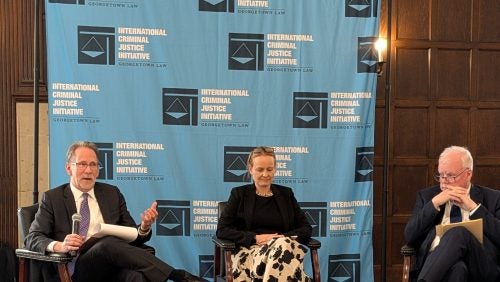
From Left: Amb. (Ret) Clint Williamson, Dr. Ingrid Elliott and Prof. Dermot Groome
On April 14 and 15, ICJI hosted discussions on conflict-related sexual violence (CRSV) at Georgetown University’s Main and Capitol Campuses. The events were moderated by Amb. (Ret) Clint Williamson, Georgetown’s senior director for international justice and the lead coordinator for the Atrocity Crimes Advisory Group for Ukraine (ACA), and featured two of ICJI’s distinguished legal experts working on the ACA project, Dr. Ingrid Elliott, Senior Fellow with ICJI, and Prof. Dermot Groome.
The discussions focused particularly on the evolution of awareness and investigations of CRSV from the time of the war in Bosnia in the mid-1990s to Russia’s full-scale invasion of Ukraine.
Panelists agreed that the International Criminal Tribunal for the former Yugoslavia (ICTY), created by the UN Security Council to investigate and prosecute atrocity crimes committed during the wars in that followed the breakup of the Yugoslav state, marked a “turning point” in attitude toward crimes of sexual violence in conflict. ICTY trials led to the creation of a set of jurisprudence on CRSV that never existed before and that forms the modern foundation of CRSV international criminal prosecutions today.
Notably, more than 30 percent of convictions at ICTY were for sexual violence. For the first time, rape may constitute the crime of torture, and the crime of rape was defined to include sexual penetration without consent, recognizing various coercive circumstances during conflict which render consent impossible. This was a particularly relevant to the case of women held in sexual slavery in Foča, Bosnia. (See Kunarac et al.)
It is only since Bosnia that we are learning just how prevalent sexual violence can be in conflict. This includes CRSV directed against men. Dr. Elliott said that contrary to popular belief, sexual violence against men is prevalent in many conflicts, particularly in detention where it is used as a method to break male opponents, military or political. She noted that what is unprecedented in Ukraine is cases of Russian wives calling their husbands serving in the military and encouraging them to rape Ukrainian women. “What is the rhetoric happening in Russia to cause this?”
Indeed, there was agreement that sexual violence is being used as a tactic by Russian forces. “The policy is evidenced by the patterns of occupation,” said Professor Groome. There is a clear pattern of CRSV across regions, particularly in places of detention, that is only explained by a policy that “ties it all together.” In Ukraine, it is estimated that around 80 percent or more of male PoWs report some type of sexual violence in detention by Russian forces.
Panelists also discussed the challenges facing accountability for CRSV in Ukraine. In addition to a huge number of cases, investigations are taking place in the midst of conflict when many people have been displaced from their homes and where the crimes have happened. Importantly, cases of CRSV need to be contextualized as part of other crimes, rather than looked at in isolation. Building successful CRSV cases means building larger cases that recognize it as part of wider patterns of violence. There was optimism from Ukraine’s commitment to prioritize advancing these cases and to build survivor-centered, trauma-informed investigations which would be safer for victims and more effective in terms of justice.
Given the sheer scale of potential crimes, the timeline for investigating and prosecuting the cases will be decades. For example, it is largely unknown what is happening in areas under occupation due to lack of access and fear. “It takes a long time to uncover the full extent of CRSV,” Dr. Elliott said, noting that these crimes are often reported some time after the violence, sometimes many years later, only when survivors feel safe to report and trust institutions. With this in mind, ICJI and its partners in ACA are trying to lay the groundwork for survivor-centered, trauma-informed investigations and prosecutions by providing critical advice, training and mentoring to Ukrainian counterparts.
*****
Dr. Elliott, MBE, is a criminal investigator and prosecutor with over 25 years of experience across the Bosnia State Court and the International Criminal Tribunal for the Former Yugoslavia (ICTY). She has deployed more than 35 times with the UK Preventing Sexual Violence in Conflict Team of Experts. Dr. Elliott is the primary penholder on the Murad Code, shaping survivor-centered investigative standards and leading major efforts to address stigma in justice processes.
Professor Groome is a professor at Penn State Dickinson Law and a former senior prosecutor at the ICTY with more than a decade of experience prosecuting war crimes. He drafted the first genocide indictment against a sitting head of state, Slobodan Milošević of Serbia, and led multiple landmark trials, including the prosecution of Ratko Mladić, the Bosnian Serb army commander. Earlier in his career, he served in the Manhattan District Attorney’s Office Sex Crimes Unit and worked on human rights issues around the world. He continues to shape the field through scholarship and his work with ACA.