

Turbulence in the Airline Industry: How the Air Traffic Controller Shortage Impacts The Tarmac
September 17, 2026 by Matt Fleischer (L'28)
In part 2 of his series Turbulence in the Airline Industry, Denny Center Student Fellow Matt Fleischer (L'28) takes a deep dive into air traffic control shortages.
The tarmac should be one of the more uneventful parts of the passenger’s journey. After clearing security, passengers proceed to their departure gates and are greeted with a comprehensive view of the tarmac, watching as planes take off, land, and park between flights. Unfortunately, flight caps resulting in fewer travel options and higher prices, as well as collisions causing injuries and fatalities, have turned the tarmac into a genuine source of concern for travelers.
This article is the second in a three part series detailing the turbulence threatening the modern aviation ecosystem. From the perspective of the everyday traveler, each article examines one major problem that the airline industry faces, its impact, and the policy solutions that our government should implement. This article focuses on how the ongoing air traffic controller shortage impacts the availability, affordability, and safety of flights coming and going from the tarmac.
How the Tarmac Became Troublesome
The country’s nearly 11,000 air traffic controllers[1] are the unsung heroes of the aviation ecosystem. They manage more than 30 million flights per year,[2] tracking airplanes during takeoff, transit, and landing and communicating with pilots to ensure safe distances between aircraft as they leave and return to the tarmac.[3] Essentially, without air traffic controllers, safe and affordable air traffic would not exist.
Despite their important role in the aviation system, there is an extreme shortage of air traffic controllers. Less than ten percent of American airport control towers have enough air traffic controllers[4]—and the problem is only getting worse.
How We Got Here
There are four main causes of the air traffic controller shortage: (1) stringent application requirements, (2) lengthy and inconvenient training processes, (3) age restrictions, and (4) recent hiring and training freezes.
The first step to becoming an air traffic controller is to be accepted into the national training program, FAA Academy. An acceptance requires applicants to pass a medical examination, security investigation, and multiple pre-employment aptitude tests.[5] Applicants must also be United States citizens and have either a Bachelor’s degree or one year of “progressively responsible work experience.”[6] While these requirements may seem like formalities, they create significant barriers to entering the profession—less than ten percent of all applicants to FAA Academy check all the boxes and are accepted.[7]
After being accepted, candidates undergo years of preparation across multiple locations before officially entering the field. First, all candidates must relocate to the FAA Academy in Oklahoma City for three to five months of paid academic training.[8] After graduating from FAA Academy, candidates must once again relocate for two to three years of additional classroom and on-the-job training experience.[9] While candidates can rank their regional preferences for post-academy training, candidates are relocated to locations all across the country.[10] These current FAA Academy and training processes discourage otherwise qualified candidates from pursuing air traffic control work: some may not have the interest in or ability to relocate to Oklahoma City, others may be unwilling to commit to a post-academy training process that separates them from their families, and many may be unable to spend years training before entering the job market.
Air traffic controllers are also beholden to age restrictions. First, applicants to FAA Academy must be under the age of 31,[11] disqualifying candidates in their thirties and forties seeking a mid-life career change. Second, federal law requires acting air traffic controllers to retire at age 56,[12] forcing those in good health into retirement. While these age restrictions were intended to prioritize passenger safety, a comparison with the age restrictions for commercial airline pilots reveals that air traffic controller age limits are entirely arbitrary. Unlike air traffic controllers, there is no maximum age to become a commercial airline pilot, and commercial pilots can retire nine years later at age 65.[13]
Finally, there have been multiple recent air traffic controller hiring and training freezes. Government shutdowns in 2025 and 2026 indefinitely froze all government hiring and training activities, slowing down the recruitment process. Read more about how government shutdowns impact the aviation system in part one of this series. The COVID-19 pandemic also suspended training for four months and required training facilities to operate at limited capacity for two years. These unexpected delays made it difficult for the federal government to hire and train air traffic controllers effectively and reduce the ongoing controller shortage.
Why It Matters
The air traffic controller shortage has impacted flight availability, affordability, and safety. In response to the shortage, the FAA has aggressively reduced flight service and increased mandatory controller overtime,[14] decisions that have negatively affected the passenger’s journey.
First, the controller shortage has caused the FAA to reduce flight service, creating fewer travel options for passengers and driving up costs. The FAA recently implemented and extended flight caps through 2027 at New York’s three major international airports[15] and Chicago’s O’Hare International Airport,[16] citing staffing shortages at the cities’ air traffic control facilities. By supporting fewer domestic and international flights, the FAA has inadvertently driven down supply and increased costs for travelers.[17]
Second, the controller shortage has caused the FAA to increase controllers’ mandatory overtime, draining hundreds of millions of dollars of federal funds and even risking countless lives. Figure 1[18] illustrates the rapid increase of air traffic controller overtime paid from 2008 to 2025. It reveals that overtime pay has more than doubled since 2018 and amounted to a whopping $259 million last year.
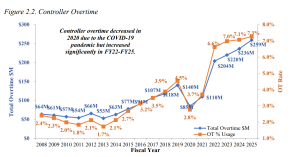
Figure 1: Overtime paid to air traffic controllers between FY 2008 and 2025. Chart originates from the FAA’s 2026 Air Traffic Controller Workforce Plan.[19]
Beyond federal funding, requiring air traffic controllers to work longer hours means they have begun “missing things” and making mistakes.[20] Since 2010, more than 18,000 reports concerning air traffic control safety issues have been filed with the Federal Aviation Administration (FAA) by pilots, air traffic controllers, and others in the aviation field.[21] These concerns are not merely administrative: they pose major concerns to both passenger and crew safety. In March, a controller reportedly stated, “I messed up” after a passenger plane collided with a firetruck, killing two pilots and injuring dozens of passengers.[22] In June, another airplane was grounded after a ground equipment vehicle struck it on the runway.[23]
Put simply, the air traffic controller shortage has left passengers with fewer efficient and affordable flights during takeoff and more dangerous flights during landing.
What We Should Do About It
The federal government should implement three policies to recruit and retain additional air traffic controllers. Increasing the number of controllers would add to the number of flights flown across the country, increasing options and decreasing prices for passengers. More controllers would also decrease the number of hours current controllers must work, reducing controller error and avoiding otherwise preventable tarmac collisions.
First, the federal government should streamline the air traffic controller hiring and training process. The FAA should build additional FAA Academies across the country, enticing those who would not or cannot relocate to Oklahoma City to apply to attend a training center in their region. The FAA should also guarantee that air traffic controller candidates would be assigned to post-academy training in a region that they select. This would ensure that candidates have control over what parts of the country they would live and work in before they enter the field, allowing them to prioritize proximity to friends and family or other personal goals.
Second, the federal government should modify existing air traffic controller age restrictions to resemble those regulating commercial airline pilots. By removing the maximum age to enter the field, additional applicants in their thirties and forties would be able to join the profession. Moreover, by increasing the mandatory retirement age from 56 to 65, seasoned air traffic controllers would have the option to remain in their positions for another decade, passing down their expertise to the next generation of controllers.
Third, the federal government should fund and expand the FAA’s new Air Traffic-Collegiate Training Initiative (AT-CTI) Partnership Program to better attract and retain future air traffic controllers from as early as high school. The AT-CTI program operates between ten colleges and universities and the FAA,[24] offering “aviation degrees that teach basic courses in air traffic control and aviation administration.”[25] Graduates of AT-CTI programs are able to bypass the first five weeks of training at FAA Academy[26] and complete the profession’s stringent health, security, and aptitude examinations at a young age, increasing the number of years they are eligible to serve as air traffic controllers. Currently, the AT-CTI is a non-funded partnership,[27] meaning that tuition at partner universities may cost students hundreds of thousands of dollars. The FAA should expand the AT-CTI program to additional schools and allocate funding—perhaps a portion of the $259 million used to pay mandatory air traffic controllers’ overtime last year—to make tuition affordable for thousands of controller hopefuls heading into college.
Conclusion
Across the country, air traffic control towers remain dangerously sparse. A series of logistical hurdles, age restrictions, and hiring and training delays have left the federal government unable to efficiently hire the next generation of controllers. Candidates must pass multiple health, security, and aptitude assessments, relocate to Oklahoma City, and spend years training in a city or state that they cannot choose. The hiring process disqualifies applicants over thirty years old and federal law forces otherwise healthy controllers into retirement in their mid-fifties. The government has also endured multiple shutdowns and the COVID-19 pandemic, events that froze training and hiring for months at a time.
With too few air traffic controllers, the FAA has made the difficult decision to reduce flight service and simultaneously require controllers to work overtime. The reduction in flights has given travelers fewer options at higher prices, and overworked controllers have been paid millions in mandatory overtime pay and made crucial errors responsible for otherwise avoidable injuries and deaths. This is a problem that the federal government can no longer ignore.
The federal government must enact multiple policies to combat the air traffic controller shortage. The FAA must build additional FAA Academies across the country and provide air traffic control candidates with more control over where they will train post-academy. The government must also remove the maximum age requirement and increase the retirement age to 65, reflecting commercial pilot standards. Finally, the FAA should fund and expand the AT-CTI program, an initiative that recruits high school students into the air traffic controller pipeline and prepares them to graduate college with an aviation degree before immediately entering FAA Academy training.
Air traffic controllers are the lifeblood of the aviation ecosystem. If the federal government does not act swiftly, the future of air travel could be up in the air.
[1] Federal Aviation Administration, The Air Traffic Controller Workforce Plan 2026-2028 (Washington, DC: Federal Aviation Administration, June 1, 2026), https://www.faa.gov/sites/faa.gov/files/Air-Traffic-Controller-Workforce-Plan-2026-2028_0.pdf
[2] U.S. Government Accountability Office, Air Traffic Control Workforce: FAA Should Establish Goals and Better Assess Its Hiring Processes (Washington, DC: Government Accountability Office, December 17, 2025), https://www.gao.gov/products/gao-26-107320
[3] U.S. Bureau of Labor Statistics, Air Traffic Controllers (Washington, DC: Bureau of Labor Statistics, August 28, 2025), https://www.gao.gov/products/gao-26-107320
[4] John Kelly, “Over 90% of U.S. airport towers are understaffed, data shows,” CBS News, January 31, 2025, https://www.cbsnews.com/news/over-90-percent-u-s-airport-towers-understaffed-air-traffic-controllers-data-shows/
[5] Federal Aviation Administration, Air Traffic Controller Qualifications (Washington, DC: Federal Aviation Administration, February 27, 2025), https://www.faa.gov/air-traffic-controller-qualifications
[6] Ibid.
[7] Ibid.
[8] Keaton S. Ziem, “Setting a Course for a Future in Air Traffic Control,” Embry-Riddle Aeronautical University, December 20, 2022, https://erau.edu/about/news-and-stories/hub-spoke/stories/setting-a-course-for-a-future-in-air-traffic-control
[9] Federal Aviation Administration, Air Traffic Controller Qualifications
[10] Ibid.
[11] Ibid.
[12] 5 USC 8335(a), https://uscode.house.gov/view.xhtml?req=granuleid:USC-prelim-title5-section8335&num=0&edition=prelim
[13] “How Old Do You Have to Be to Get a Pilot’s License?,” U.S. Aviation Academy, https://www.usaviationacademy.com/resource-center/how-old-start-flight-school/
[14] Federal Aviation Administration, The Air Traffic Controller Workforce Plan 2026-2028
[15] David Shepardson, “US extends flight limits at New York area airports,” Reuters, June 18, 2026, https://www.reuters.com/world/us/us-extends-flight-limits-new-york-area-airports-2026-06-18/
[16] Talia Soglin, “FAA extends flight caps at O’Hare airport for a year,” Chicago Tribune, July 10, 2026, https://www.chicagotribune.com/2026/07/10/faa-ohare-flight-caps/
[17] Kristen Altus, “Delta CEO Ed Bastian reveals what he says must happen for airline ticket prices to fall,” Fox Business, June 23, 2026, https://www.foxbusiness.com/economy/delta-ceo-ed-bastian-reveals-what-he-says-myst-happen-airline-ticket-prices-fall
[18] Federal Aviation Administration, The Air Traffic Controller Workforce Plan 2026-2028
[19] Ibid.
[20] Chantelle Lee, “The DHS Shutdown Is Over, But Its Impact on the TSA—and Air Travel—May Persist,” TIME Magazine, May 1, 2026, https://time.com/article/2026/05/01/dhs-shutdown-tsa-air-travel-impact-staffing/
[21] Joce Sterman and Emily Featherston, “Years of data show US air traffic control system ‘straining at the seams,’” Atlanta News First, June 9, 2025, https://www.atlantanewsfirst.com/2025/06/09/years-data-show-us-air-traffic-control-system-straining-seams-2/
[22] Verity Stevenson, “Air traffic controller’s ‘I messed up’ highlights human limits — but experts urge caution,” Canadian Broadcasting Corporation, March 29, 2026, https://www.cbc.ca/news/world/air-traffic-control-air-canada-laguardia-crash-9.7142788
[23] Ewan Palmer, “Southwest Jet Hit by Ground Vehicle in Airport Crash,” The Daily Beast, June 22, 2026, https://www.thedailybeast.com/southwest-jet-hit-by-ground-vehicle-in-memphis-airport-crash/
[24] U.S. Department of Transportation, Trump’s Transportation Secretary Sean P. Duffy Announces First California College to Join Air Traffic Controller Program (Washington, DC: Department of Transportation, January 22, 2026), https://www.transportation.gov/briefing-room/trumps-transportation-secretary-sean-p-duffy-announces-first-california-college-join
[25] Federal Aviation Administration, Collegiate Training Initiative (CTI) Schools (Washington, DC: Federal Aviation Administration, February 18, 2025), https://www.faa.gov/jobs/students/schools
[26] Ibid.
[27] Ibid.