

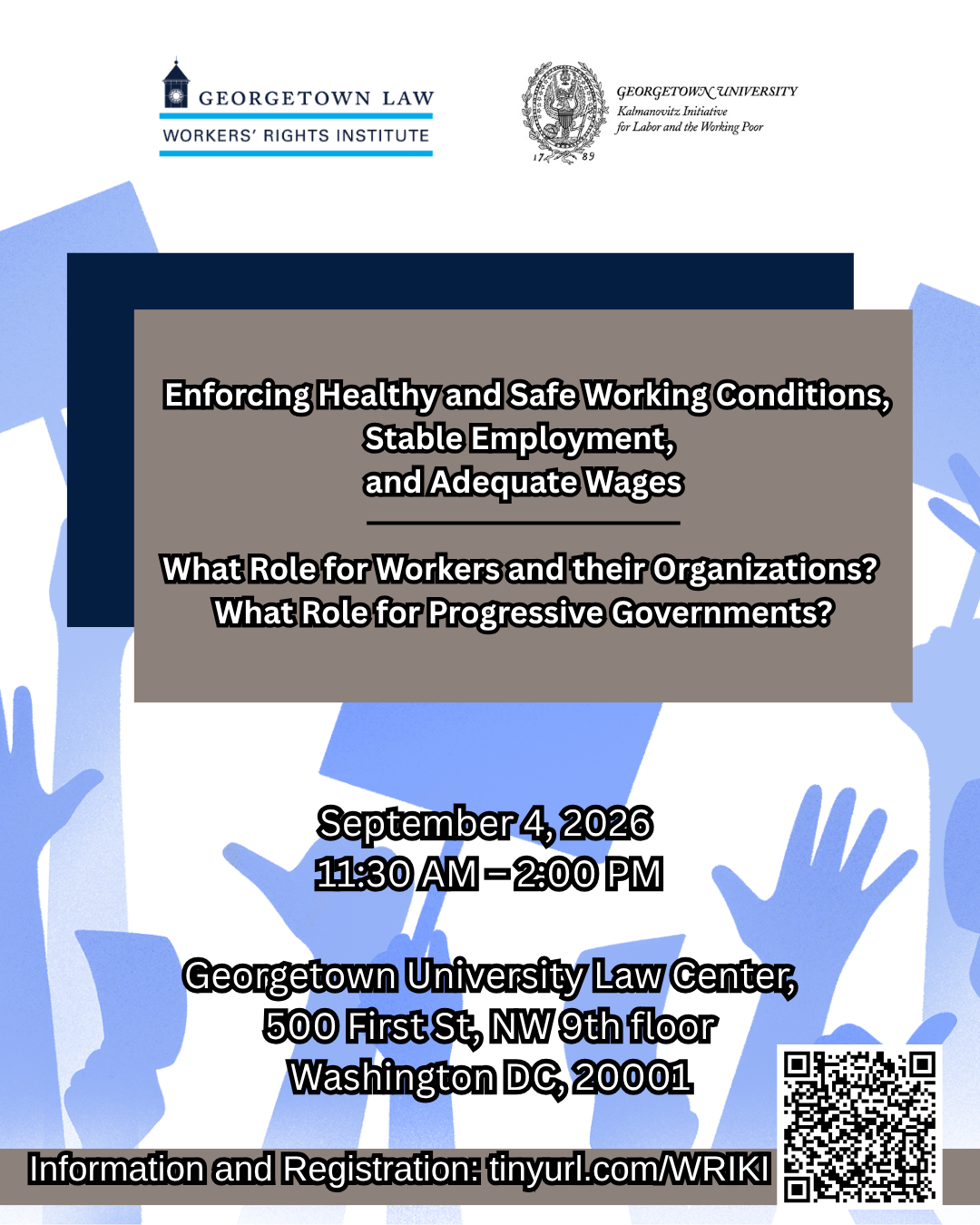
[Co]Enforcing Healthy and Safe Working Conditions, Stable Employment, and Adequate Wages
The Workers' Rights Institute at Georgetown Law (WRI) and The Kalmanovitz Initiative for Labor and the Working Poor at Georgetown University are hosting a Labor Day 2026 Seminar
Organized by Marta Rozmysłowicz, Affiliate Fellow at the Workers’ Rights Institute
September 4, 2026 | 11:30 AM – 2:00 PM | In Person
Georgetown University Law Center, 500 First St NW, 9th floor Conference Room,
Washington DC, 20001
Recent struggles led by organized workers have produced progressive labor laws at various levels of government- city, state, and national- in both the United States and Europe. These legislative measures seek to improve working conditions, curb exploitative algorithms, and enhance job security. They target abusive practices widely deployed by major employers such as Amazon within the logistics, warehousing, and transportation industries. However, while pro-worker legislation is essential, the law can only be as strong as its enforcement; labor standards on paper do not by themselves improve working conditions.
When it comes to enforcing the law, government agencies charged with protecting workers’ health, safety, wages, and job security operate at best with limited reach. Many employers, meanwhile, have shown that they lack the capacity and the incentive to self-regulate, choosing instead to undermine the law and engage in union busting. Workers, by their proximity to the labor process, are best positioned to know when a job is unsafe, when a quota is unreasonable, or when a wage or scheduling practice violates the law. However, existing legal frameworks tend to vest workers with little agency in enforcing labor standards.
The seminar seeks to address the following questions:
- What strategies can workers and their organizations develop to effectively enforce their rights in the workplace?
- How can progressive government at various levels provide the necessary infrastructure to make this possible?
- Does a focus on enforcing rights on the shop floor help build workplace organization?
- What is the role of mass education programs in advancing these objectives?
This seminar brings together rank-and-file worker organizers, scholars, and elected officials to examine “co-enforcement”: arrangements in which worker organizations partner with, pressure, or substitute for under-resourced agencies in enforcing labor standards. We look at emerging proposals in New York City to institutionalize mass worker education as a co-enforcement tool in warehousing and last-mile delivery, and we hear from worker organizers at Amazon about their campaigns to enforce the city’s Delivery Protection Act (DPA). In the international context, we turn to Poland, where a union has pushed to govern from the shopfloor, including at Amazon warehouses, while also campaigning to increase the enforcement capacities of the National Labor Inspectorate; this work has meant coordinating struggles with other unions, both larger and smaller, at the workplace level.
To get the most out of our discussion, we strongly encourage seminar participants to read the following: Vgontzas, Nantina, and Sanjay Pinto. 2026. “Mass Worker Education: Governing from the Shop floor,” NYU Urban Democracy Lab Working Paper.
Speakers
Luc Rene, driver at Amazon’s “last mile” warehouse DBK4 in Queens, NY and organizer at Teamsters Local 804 (confirmed) – will discuss the union’s organizing among workers at Amazon’s last-mile delivery stations in New York City, and the campaign to pass and enforce the Delivery Protection Act.
Bartek Kurzyca, long-haul truck driver for Amazon in Europe, organizer at OZZ Inicjatywa Pracownicza (Workers’ Initiative Union in Poland) and member of the union’s Executive Council (confirmed) – will discuss the union’s recent campaigns centered on co-enforcement: for the right to strike, a heat law that mandates work stoppage at high temperatures, as well as the push to equip Poland’s Labor Inspectorate with real enforcement capacity.
Roman Lupiński, warehouse associate at POZ1 Amazon Fulfillment Center in Poznań, Poland and organizer at OZZ Inicjatywa Pracownicza (confirmed) – will discuss the union’s efforts to enforce labor standards over a decade of organizing at Amazon. Roman will present Amazon Workers International, a network of organized warehouse associates and supporters that aims to coordinate workers’ struggles across national divides.
Nantina Vgontzas, assistant professor, Labor Studies, CUNY School of Labor and Urban Studies (confirmed), will present their proposal (co-authored with Sanjay Pinto) for mass worker education as a tool of co-enforcement in New York City, building on the city’s commitment to expand resources for the Department of Consumer and Worker Protection (DCWP). They will outline a pilot program in warehousing and last-mile delivery that would train a corps of warehouse workers and delivery drivers as peer educators so as to strengthen enforcement of the Warehouse Worker Protection Act, the Warehouse Worker Injury Reduction Act, and the proposed Delivery Protection Act.
Sanjay Pinto, sociologist based in Brooklyn, senior fellow at the Center for Urban Economic Development at the University of Illinois Chicago, fellow at the Worker Institute at Cornell ILR and Data & Society affiliate (confirmed), will present their proposal (co-authored with Nantina Vgontzas) for mass worker education as a tool of co-enforcement in New York City.
Aparna Raj, Democratic nominee for DC Council, Ward 1, (confirmed), will present her perspective on co-enforcement, mass worker education and what role the DC Council could play in empowering workers when it comes to enforcing labor standards.
Speaker from ROC DC/DCJWJ (TBC)
Moderator: Marta Rozmysłowicz is an organizer and lawyer with OZZ Inicjatywa Pracownicza (Workers Initiative) in Poland. She was a union representative and a member of the warehouse health and safety commission at Amazon’s Fulfillment Center POZ1 in Poznań. She is currently pursuing her PhD in labor law at the University of Warsaw, Poland.