

Meet Our Students: Esther Tetruashvily
July 6, 2023
Get to know Esther Tetruashvily.
Esther Tetruashvily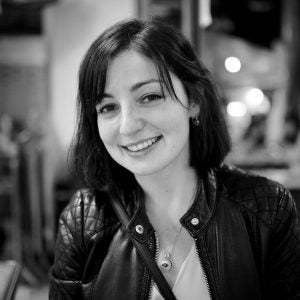
Who are you? Tell us about yourself!
My name is Esther Tetruashvily. I am a 3L student, a Technology Law Scholar, and a Fritz Fellow at Georgetown. Before coming to law school, I served as a U.S. Diplomat overseas, working in various roles in U.S. embassies in China, Tajikistan, U.S. Mission to NATO in Brussels and at the Russia Desk. I’ve always been passionate about human rights, human security, and international relations. Born in Azerbaijan and coming to the U.S. as a refugee has made me particularly sensitive to the vulnerabilities that people experience when the unthinkable happens to them and they are uprooted and forced to restart their lives. This has always made me aware of the various environmental, social, and economic forces that impact people’s lives. I bring that perspective into everything I do, especially now in law school where I consider the impacts of law and technology on society.
What drew you to Georgetown’s Tech Law Scholars Program?
I left the foreign service for law school because I became increasingly alarmed at how geopolitical technology competition could lead to a race-to-the-bottom in the export and procurement of artificial intelligence-enabled technologies. Serving as a human rights officer overseas, I observed how technology could be used as a shield by activists but also a sword by oppressive regimes. When I was looking for law school programs that could help me understand the soft and hard law that could help support innovation while heading off its greatest harms, the Georgetown Law Institute for Technology Law & Policy’s Tech Law Scholar (TLS) program(This link opens in a new tab) seemed like the perfect fit. With its unparalleled roster of faculty who are experts in technology, national security, and human rights law, and a curriculum that would let me specialize, I knew that the program would give me the training and tools I was seeking to find answers and come up with solutions to these pressing issues.
Tell us about your project with the Fritz Family Fellowship.
The Fritz Family Fellowship(This link opens in a new tab) is a unique program that gives students the opportunity to work across disciplines to research and find solutions to critical problems at the intersection of technology and society. With this multidisciplinary approach in mind, I’ve worked with diverse groups of centers, professors, and professionals on issues related to inclusive digital trade and the governance of artificial intelligence.
Last year, I worked with Professor Katrin Kuhlmann of the Center on Inclusive Trade and Development (CITD) and Professor Anupam Chander from the Georgetown Tech Institute’s Global TechNet Working Group to organize a conference, where participants developed an agenda for how to make digital trade more inclusive. I also worked with John Bransemer of the Center for Security and Emerging Technology (CSET) on a study on quantum computing and cybersecurity regulation.
This year I am working with Professors Neel Sukhatme (Tech Institute), Katrin Kuhlmann, and Dr. Heather Frase (CSET) to identify the unique AI harms that arise from global competition in artificial intelligence and the impact such a race would have on issues of digital trade, inclusion, global inequality, and the potential enablement of digital authoritarianism. Through the fellowship, we hope to create a matrix of harms and identify appropriate regulations and strategies to mitigate and prevent them and propose those solutions to policymakers.
Which class from the tech curriculum has been your favorite so far?
It is really hard to choose. We have so many classes that are great. I took a class on State Cyber Operations and Responses with Professor Pete Pascucci last fall, and an Advanced Foreign Intelligence Law class with Professor Laura Donohue in the Spring. Both classes really helped shape my perspectives on how to regulate emerging technologies and the associated trade-offs of doing so. But perhaps if I had to choose, I would pick serving as a student attorney in the Communications and Technology Law Clinic under the direction of Professor Laura Moy. It was an unbelievable experience, because not only did I get to synthesize all of the learning I was doing in my classes, but I could also put it to practice representing clients on issues ranging from algorithmic discrimination to surveillance of vulnerable populations.
What are you looking forward to most about your 3L year?
My close friend and fellow TLS-er Ashwin Ramaswami and I found an obscure provision in the Student Handbook last year where students can propose to lead a seminar. What started out as a debate about the potential harms of open source AI and what could be done about it, turned into a class we will be co-leading in the fall called the Law of Open Source Software(This link opens in a new tab). We are so excited that Professor Paul Ohm agreed to be our faculty supervisor and that Professor Urska Velikonja, Associate Dean for Academic Affairs, agreed to approve the course and support us. I am really looking forward to learning from the discussion and debates we have in this class and seeing what insights and solutions we’ll uncover. In addition to the class, some fellow TLS-ers and I are running Georgetown’s Cyber Law Society this year. We are already brainstorming a series of talks, events, and activities that we hope will bring our classes to life and introduce Cyber Law to more students on campus.
What advice do you have for prospective students who are considering Georgetown Law?
If you are interested in the intersection of emerging technology and the law, Georgetown really is the best place for you. I would encourage students to look at our website and join our events, in-person and online, and reach out to current students. I would add that if you are interested in policy, because of Georgetown’s location in D.C. we have regular interactions with lawmakers, agency leaders, and legal practitioners, which can often translate into valuable internships, experiences, and unique insights. If you know what area of the law you want to focus on, really do your homework on the program, the location, and the type of exposure you will have. I think that really makes all the difference.
What other interests do you have outside of law?
I am a total post-Soviet studies and science fiction nerd, and love anything that can combine those two. In my free time, I try to stay up on news in the region and read science fiction written from Russian and Chinese perspectives. One of my favorite short science fiction stories is called Folding Beijing(This link opens in a new tab), written by a Chinese economist. If you haven’t read it, you should! It’s amazing! I also enjoy spending time with my husband, Robert, and my family and friends, and whenever possible, traveling and exploring new cities and food.