

Meet our Students: Jay Conrad
March 12, 2024
Get to know Jay Conrad (LL.M.'24).
Jay Conrad
Who are you? Tell us about yourself!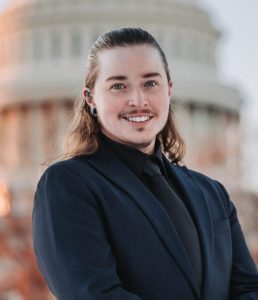
My name is Jay (they/them pronouns) and I am a legal scholar and policy advocate from Seattle, Washington. I pivoted to a career in law after being a filmmaker/photographer and digital marketer. My purpose in learning the law is to create real, tangible change related to data privacy. Technology’s ubiquity has resulted in my learning several fields of law within the niche realm of technology’s application therein. It’s made for a rich and holistic approach to determining legal solutions to address digital harms.
What drew you to Georgetown’s Technology Law & Policy LL.M.? How has it helped you to advocate for equitable tech policies?
I selected the Georgetown Tech Law & Policy LL.M. because of the institution’s vibrant history of privacy advocacy and its position of influence in U.S. politics. The program’s curriculum is an amazing mix of subjects, with each course specifically speaking to the advocacy strategies most effective in those spaces. Knowledge of these tactics, as well as how to communicate with stakeholders tied to different fields, has improved my advocacy and broadened my legal skill set.
How has your experience working in Senator Ron Wyden’s office deepened your understanding of policy and law?
Working in Senator Wyden’s office has been an incredible opportunity to experience policymaking in action. It’s a privilege to work with a tech-specific team as many offices merely assign part of one staffer’s time to tech policy issues. This also means that I get to learn from multiple minds and perspectives, which has significantly deepened my learning experience. I am really enjoying the fast-paced environment and the challenges of balancing legal precedence and politics against the need to address novel technology harms.
What is your favorite class you’ve taken in the Tech Curriculum?
This is a tough one! I really enjoyed National Security Cyber Law and Policy, a seminar-style class in which we learned about the ongoing discourse surrounding international cyber-affairs/warfare from someone who has been in the field for over a decade. International law is already tricky to apply, and seeing how that ripe discourse plays out in cyberspace was fascinating. It is very much an active and evolving area of law. Because of this, ingenuitive thoughts and analysis were encouraged, and classes felt more like think-tanks than an academic course. I learn very well in this environment and I appreciated having my creativity seen as an asset.
What advice do you have for prospective students who are considering Georgetown Law?
The Georgetown faculty and staff are exceptional — they are top leaders in their specialties and genuinely like being available to students. Take advantage of the chance to get to know your professors personally and to pick their brains about all the cool things that keep you engaged with the law. Do not sleep on the opportunity to do so! Schedule meetings, stay after class, stay curious, and ask for advice. Those conversions can be as illuminating and thought-provoking as an entire class, and much more personalized. Go for it!
What other interests do you have outside of law?
I enjoy live music, creating 3D textile sculptures, and learning the electric guitar when I’m not finding new vegan restaurants or convincing my friends to build sustainable communities in the woods.