In ‘Getting to Reparations,’ Professor Dorothy Brown, L’83, Charts the Path to Restitution for Black Americans
February 19, 2026
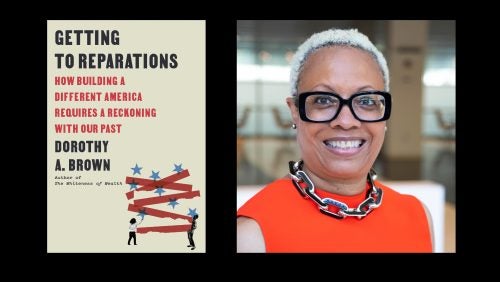
“Getting to Reparations” (cover image left) is the newest book by Professor Dorothy Brown.
When it came to the practical possibility of the U.S. government paying reparations to Black Americans in response to the enduring harms of slavery and racism, Professor and Georgetown Law alumna Dorothy Brown, L’83, once considered herself a skeptic.
“What’s the likelihood of that ever happening? It’s not going to work,” she recalls thinking. But after researching her 2021 book The Whiteness of Wealth, which exposed systemic racism in United States tax policy, she changed her mind.
“I realized that even if we had a perfect tax system that no longer disadvantaged Black Americans, if we wanted to close the racial wealth gap, we actually needed reparations,” says Brown, whose teaching and scholarship focus on the intersection of tax law and civil rights.
That realization became the catalyst for her new book, Getting to Reparations: How Building a Different America Requires a Reckoning with Our Past, in which Brown lays out the case for reparations for Black Americans and proposes a legal and policy framework that would facilitate restitution, informed in part by historical case studies of government compensation for harm paid to groups such as Japanese and Indigenous Americans.
Uncovering that historical precedent, Brown says, became central to her conviction that reparations for Black Americans are not only needed, but feasible — an outlook that she hopes that skeptical readers will come to share. “I wrote the book for skeptics because I certainly understand where you are,” she says. “A couple of years ago, I was there, too.”
Below, Brown discusses the policy pathway for reparations, strategies for bolstering public support and the Constitution’s unfulfilled promise of equality for all.
In Getting to Reparations, you highlight four historical cases where the federal government paid reparations. What did you find?
When I was a professor at Emory University School of Law, a colleague mentioned that she taught that the U.S. government paid reparations to Italy for Italians lynched in Louisiana in 1892. That stuck with me. I said, I wonder what else the United States government has paid reparations for? I found out that the Treasury paid reparations to white enslavers when slavery ended with the District of Columbia Compensated Emancipation Act of 1862. Then I found out about the Indian Claims Commission, which was created in the 1940s to compensate tribal nations for land we stole and land we paid too little for. I was also aware of reparations paid to Japanese Americans for mass incarceration during World War II. Slavery, lynching, land theft and mass incarceration are all things that Black Americans experienced, but we’ve never gotten compensation for. That became the frame for Getting to Reparations.
The book also lays out policy recommendations for making reparations a reality. How would it work, especially given the challenges of today’s political climate?
Step one, the next Democrat who is elected president signs an executive order on day one that creates a reparations commission. The reparations commission would then be tasked with studying all the economic harm that Black Americans have experienced, environmental racism, health disparities, all of it, and make recommendations for how we can address it. You give the commission time to study, analyze, make recommendations, and then in the same single term, you would have potential legislation that could be drafted and approved by Congress.
In addition to doing the substantive work that other commissions have had to do, this commission has one more burden: to bring the public along with them. A commission that would have a televised hearing talking about the harm that Black Americans faced after chattel slavery ended, as well as the different examples where reparations were paid, will be persuasive to build support such that Congress could enact reparative justice legislation.
What the current administration has taught us is that the president can move fast and break things. The next president can appoint a reparations commission on their first day in office and we should expect the commission to get to work immediately. I believe the actions of the current administration will increase support for the idea of reparations for Black Americans because of the blatant racism we are seeing. It is harder for many Americans to believe we live in a post-racial society when the president circulates on social media a picture characterizing former President Obama and former First Lady [Michelle Obama] in a racially derogatory light and refuses to apologize. The current climate will lead to reparative justice for Black Americans a lot sooner than we might think. I am extremely optimistic.
Since the book was published, you’ve continued to explore strategies to overcome public resistance to reparations. What have you found?
I’ve commissioned a political strategy firm to focus group test reparations, to show which messages convince opponents to become supporters. What the focus group testing shows is when people are told that we have these other examples [of reparations], but never paid anything to Black people, they think it’s unfair. This really confirmed what I was writing in the book, that if you tell people our history, people are fundamentally fair and believe in equal opportunity.
The second piece that moves opposition is learning that when the 13th, 14th and 15th Amendments were enacted, it didn’t end discrimination against Black people. When you talk about all the history that happened to Black Americans after slavery ended — when you teach people about Federal Housing Administration (FHA) redlining, the reality that the G.I. Bill did not benefit Black returning veterans the way it did white returning veterans and the laws that stripped Black people of property through eminent domain — people realize we haven’t fixed discrimination. Those two messages combined help move opposition to support.
You said you wrote this book for the skeptics. What do you hope they take away from it?
I find that skeptics are persuaded when they see that there were four instances where [reparations were paid] and when you teach people the history of the experiences of Black people in America. The 13th Amendment ended chattel slavery, but it didn’t end the fact that slavery shapeshifted. We went to sharecropping and convict leasing. We went to eminent domain, we went to sundown towns, we went to mass incarceration, we went to the school-to-prison pipeline. People aren’t aware of these systems that targeted black Americans. When I tell them, or when they read about it, they are as horrified as I was when I learned about some of this.
In light of Black History Month, how can we understand reparations in relation to foundational American ideals of freedom and equality?
When we talk about liberty, the pursuit of happiness and justice for all, if we are the rich mosaic that we claim to be, then we actually have to have a country that provides everybody with an equal opportunity. When people talk about reparations, they’re so focused on how much it’s going to cost, nobody ever asks: What would society look like on the other side of reparations? What would it look like if Black Americans were treated as equal to everyone else? What would it look like if Black success wasn’t aberrational? We never think about the cost of doing nothing.
We are harmed as a society when a segment of Americans are treated like second-class citizens and are consigned, literally and figuratively, to the back of the bus. They can’t live up to the ideals of our country because we are blocking them from living up to the ideals of our country. We have a Constitution that gives us a vision of what equality could look like — we just haven’t lived up to it.
What are you working on next?
I am working on a book proposal about billionaires — and that’s all I’ll say. Billionaires are my next target.
On Tuesday, Feb. 24, Brown will discuss Getting to Reparations in conversation with author and University of Pennsylvania Professor Marcia Chatelain at 4:00 pm in Hart Auditorium. Interim Dean Joshua C. Teitelbaum and Georgetown University Interim President Robert M. Groves will provide introductory remarks. For more information, or to RSVP, click here.