Professor Louis Michael Seidman Rethinks the Power of the Supreme Court in New Book ‘The Constitution Cannot Save Us’
August 4, 2026
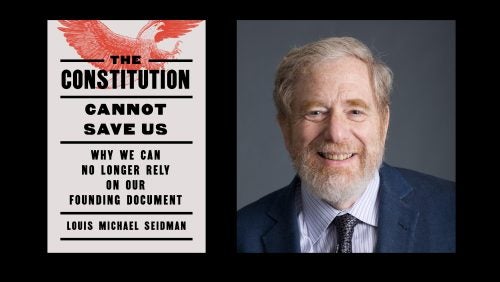
“The Constitution Cannot Save Us,” published in July, is the newest book by Professor Louis Michael Seidman.
Having come of age during the Warren Court and served as a law clerk for U.S. Supreme Court Justice Thurgood Marshall, Professor Louis Michael Seidman long believed in the promise of a progressive judiciary.
“I used to think that what we needed were justices who were humane and confident in their opinions and willing to do what was necessary to make the country a better place,” Seidman says. “I’ve come to think that that was misguided.”
Seidman’s latest book, The Constitution Cannot Save Us: Why We Can No Longer Rely on Our Founding Document, challenges prevailing theories of constitutional interpretation across the political spectrum and urges the reevaluation of the default consensus that the Constitution — and nine justices’ interpretations of it — are an indispensable check on popular democracy.
Seidman instead calls for a reinvigoration of electoral politics in guiding law and policy on matters ranging from reproductive rights to the role of religion in public life. “If we’re going to survive as a country, we have to try to reinvigorate the sense that we’re all in this together, that we’re not enemies, that we have common goals, and that when we disagree, we can work the disagreements out,” he says.
Below, Seidman discusses the pitfalls of constitutional absolutism, potential Supreme Court reforms and the question he’d ask those hesitant to critique the primacy of the Constitution.
The book takes a stand against “top-down constitutionalism.” What is that, and how did it come to be the norm?
For many years in this country, there was a kind of progressive consensus dating from the New Deal that involved experts and administrative agencies in control of things. The legal or constitutional manifestation of that era is sometimes called legal liberalism, or what I call top-down constitutionalism: the idea that Supreme Court justices were the experts in control who would lead us and the country in the right direction.
A big part of the book is an effort to show that the theories developed mostly by academics in order to support the extraordinary power that the Constitution — and the Supreme Court’s interpretations of the Constitution — has in American society, are just not justified. These theories don’t make sense and are subject to pretty obvious objections.
You’re a constitutional scholar who has explored similar ideas in past books such as From Parchment to Dust: The Case for Constitutional Skepticism (The New Press, 2021). What motivated you to return to the subject?
This book is really intimately associated with the Trump revolution, and trying to think about what that means and what to do going forward. The Constitution and the Supreme Court certainly are not going to [mitigate] Trumpism. The kind of elite control that top-down constitutionalism is based on is the very thing that so many people got angry about and rejected — in some ways with good reason.
The book argues that we ought to reject the authority that the Supreme Court and the Constitution have asserted over us. We’re not going to get there all at once. This is, in some ways, a utopian project, and certainly a long-term project. But there are some practical steps we could take that would advance us toward that goal. It is our country. We ought to be in control of it.
What kind of practical steps might help?
The long-term goal would be a Supreme Court that no longer had the power to use the Constitution to invalidate statutes, but there are short-term things that could be done that would move us forward that direction without embracing that much more radical end goal. There are already a whole bunch of doctrines the court uses to avoid deciding constitutional cases. If the court applied those more consistently and more generously, that would go a long way toward solving the problem. There are some other procedural reforms that I think would really help, such as requiring seven justices to grant review in a case where a lower court upheld the constitutionality of a statute.
In addition to institutional change, you emphasize the need for dialogue among the American public. Why is that important?
What in the end holds the country together? It’s not an ancient and outmoded document, it’s the willingness of people to listen to each other, to compromise, to work for the common good. All those things are what ultimately keep the country from unraveling, and in some ways the Constitution gets in the way of that. It encourages people to take absolutist positions. That’s not a way to encourage compromise and dialogue. That’s a way to assert power.
If readers could take one idea away from the book, what do you hope it is?
That there’s too much faith in a silver bullet or an easy solution — the idea that if only people would obey the Constitution, then things would be all right. What we need instead is the hard work of reconciliation. There are things that just cannot be tolerated — we can’t give into the racism, the xenophobia, the hatred, the violence — but that doesn’t mean that it’s wrong to try to think hard about what has led so many people down this road, and, to try to meet the legitimate grievances that people have.
The Constitution and Supreme Court are revered by many. What would you say to those who find this type of criticism hard to accept?
The ultimate test you have to ask is: Has obedience to the Constitution made the country better? Are we better off because of it? I think there’s a lot of reason to think that we’re not, and we’re certainly not going to be going forward. There was a very brief period in the late 1950s and 1960s when you had a progressive Supreme Court that tried to use the Constitution to promote social change. But for most of our history, as it does now, the court represented the most regressive forces in American society.
What are you working on next?
This is a book about the big picture. In the future, I want to focus on narrower pieces of constitutional doctrine to see how this approach might be applied. Right now I’m working on a long article about the religion clauses. The core idea is that we could reach a compromise about what has become a very divisive issue by defanging both the Establishment Clause and the Free Exercise Clause.