Georgetown Law Alumni, Policymakers Gather for AI and the Economy Summit
September 24, 2026

L-R: Katerina Eva Matsa of the Pew Research Center, Nicholas Johnston of Axios, Rachel Martin of National Public Radio, Battinto Batts of Arizona State University and Vivian Schiller (not pictured) of the Patrick J. McGovern Foundation discussed AI, misinformation and the media during the ‘Building Trust’ panel. Photo courtesy of White Wolf Creative.
Legal advocates, policymakers and industry leaders gathered to discuss issues at the intersection of artificial intelligence (AI) and the economy, workforce and education at “Preparing America for the AI Economy,” a national summit on AI literacy and governance held at Georgetown Law on Sept. 15.
The day-long convening was hosted by EqualAI, a non-profit organization that helps companies, policymakers and institutions implement effective AI governance, in partnership with Georgetown Law’s Institute for Technology Law & Policy (ITLP).
During a series of panel discussions and fireside chats, speakers explored the impact of AI on public trust and the future of work, the need to balance technological innovation with safeguards and the role of regulation in shaping the adoption of AI across institutions and communities.
“It was a privilege to bring together leaders from across industry, journalism, education and philanthropy to explore the many facets of AI literacy and governance in the workplace, media, classroom and beyond,” said EqualAI President and CEO Miriam Vogel, L’01, following the event. “As AI becomes more deeply embedded in everyday life, the balance between promoting technological innovation while preserving public trust in these tools will remain a critically important issue for policymakers, companies and users alike.”
Exploring ‘the limitations and capabilities’ of AI
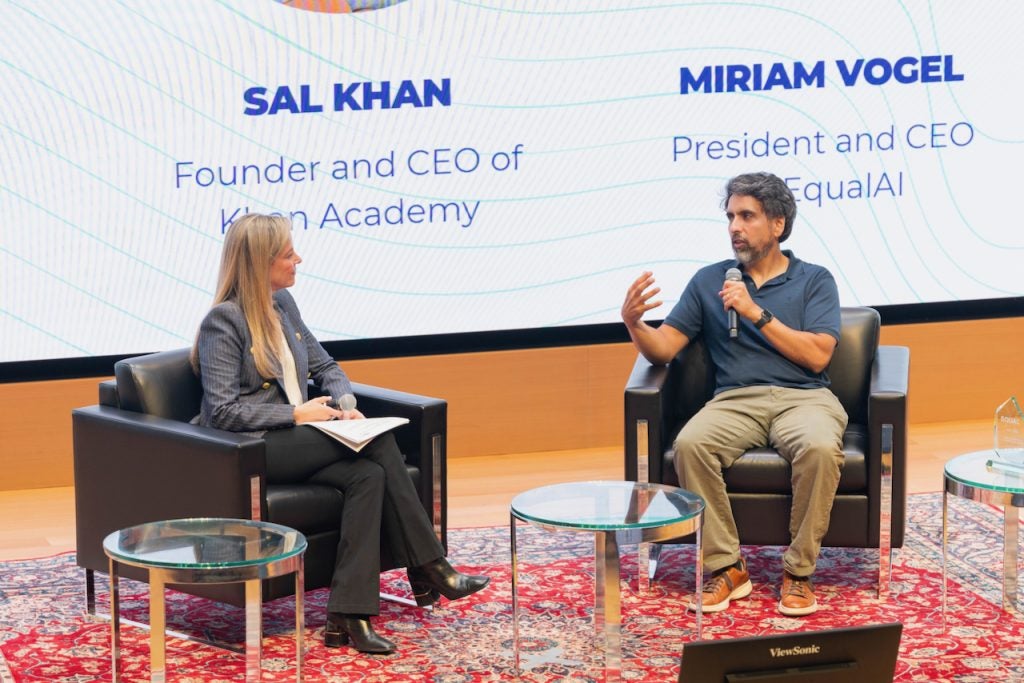
Khan Academy Founder and CEO Sal Khan (right) joined Miriam Vogel, L’01, to discuss the impact of AI on the future of education.
In his keynote address, Congressman Ted Lieu, L’94 (D-Calif.) discussed the role of public officials and lawmakers in governing the creation and deployment of AI.
“When it comes to technological revolutions, it didn’t take society a few years to understand the benefits and consequences. It took society decades,” said Lieu, who co-chairs the House Democratic Commission on AI and the Innovation Economy.

Congressman Ted Lieu, L’94, delivered the summit’s keynote address. “I do encourage people to become AI literate, to try some of these products and get a sense of the limitations and capabilities of AI,” he said.
Lieu, who recently introduced the bipartisan “AI Kill Switch Act” to require AI developers to maintain system shutdown capabilities and authorize government-ordered shutdowns of systems posing catastrophic harm, likened government oversight of AI to the regulation of the automobile industry.
“We don’t tell car manufacturers not to make cars,” he said. “If it has problems … we say, ‘Fix this before you can put this car back on the road’ … that is what this bill does.”
The address was followed by a fireside chat between Vogel and Sal Khan, the founder and CEO of the free online learning platform Khan Academy, who discussed the platform’s AI-powered learning assistant and the broader challenges and opportunities posed by AI adoption in the classroom and other learning environments.
“I do worry that when we say ‘ban it in the school’, you’re really just banning it for the kids whose primary access is the school,” Khan said, underscoring the need for AI literacy among young people preparing to enter the workforce. “Especially as you get into high school and college, students who don’t get authentic experience using [AI] … they’re going to increasingly be at a disadvantage.”
The conversation also highlighted broader questions about how governance and policy should respond to the rapid deployment of AI in the classroom and beyond. “Questions of how AI will be governed are foremost in policymakers’ minds right now, and students and faculty at Georgetown Law are deeply engaged in what that means for justice and the rule of law,” said ITLP Acting Executive Director Mary Pat Dwyer following the event. “We are honored to bring leaders in the field to campus to contribute to these discussions as part of our work exploring how emerging technologies like AI are reshaping society.”