Georgetown Law and O’Neill Institute Host Third Annual “Supreme Court Term in Review”
July 21, 2026
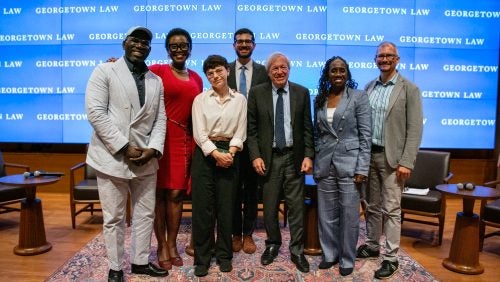
L-R: Jamelle Bouie, Prof. Michele Goodwin, Moira Donegan, Mark Joseph Stern, C’13, L’16, Erwin Chemerinsky, Sherilyn Ifill and Chris Geidner. Photo credit: Noah Friedman.
Top legal advocates, scholars and journalists convened at Georgetown Law July 1 to analyze the Supreme Court’s 2025-26 term and the far-reaching impact of decisions on voting rights, birthright citizenship, presidential power and more.
Co-hosted by the O’Neill Institute for National and Global Health Law and sponsored by the American Constitution Society, the Brennan Center for Justice, the Feminist Majority Foundation, Ms. magazine and Ms. Studios, the third annual “Supreme Court Term in Review” attracted more than 300 guests from Georgetown Law and the broader community.
“As we commemorate the 250th anniversary of the signing of the Declaration of Independence, there could be no better time or place to gather and consider the impact of the court’s consequential opinions on the rule of law, democracy and separation of powers,” said O’Neill Institute Faculty Director Professor Michele Goodwin following the event.
Goodwin moderated the “Supreme Court Term in Review” panel, which included Dean Erwin Chemerinsky of UC Berkeley School of Law, Professor Sherrilyn Ifill of Howard University School of Law, Mark Joseph Stern, C’13, L’16, of Slate, Moira Donegan of The Guardian U.S., Jamelle Bouie of The New York Times and Chris Geidner of Law Dork.
The panelists discussed the significance and impact of the court’s recent ruling on voting rights in Louisiana v. Callais, decisions related to presidential firing power in Trump v. Slaughter and Trump v. Cook and the 6-3 decision in Trump v. Barbara, which struck down an executive order ending birthright citizenship, among others.
“[The court is] effectively allowing the kind of extreme racial gerrymandering that we thought we got rid of with the Voting Rights Act, that the 15th Amendment was written to deal with,” said Bouie regarding the court’s 6-3 decision in Louisiana v. Callais, which concerned alleged racial gerrymandering and redistricting in the state of Louisiana. “It is obliterating Black representation from the South.”
Confronting precedent and judicial review
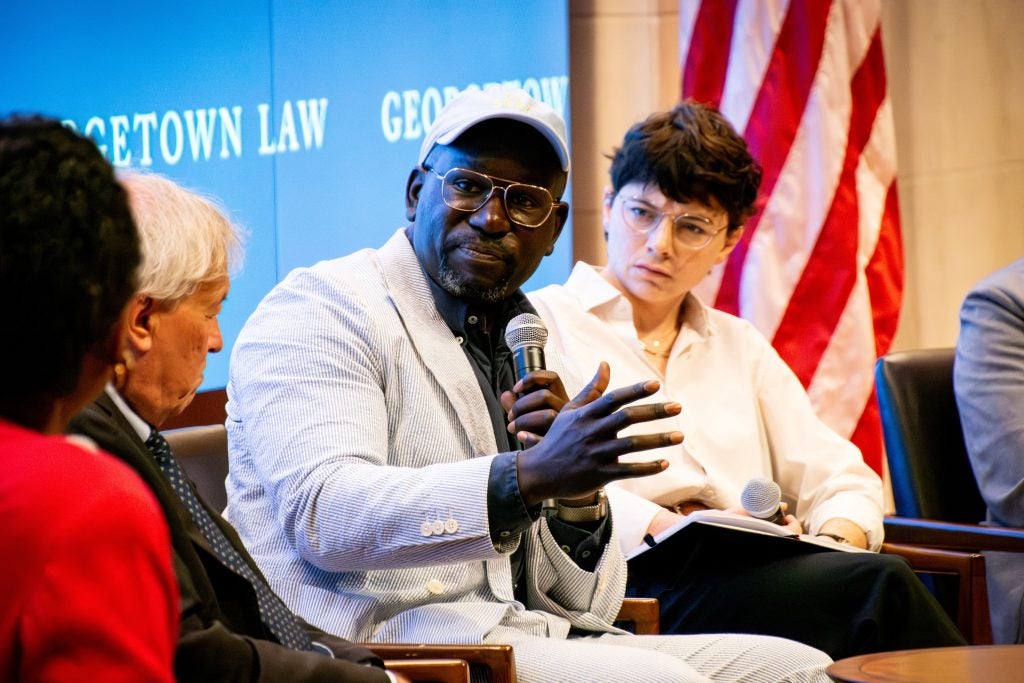
“It is obliterating Black representation from the South,” said New York Times columnist Jamelle Bouie (center) of the court’s decision in Louisiana v. Callais. Photo credit: Noah Friedman.
Potential threats to civil liberties and the expansion of executive power were top of mind even when the justices sided against the presidential administration, such as in Trump v. Barbara, in which the court upheld birthright citizenship, and in Learning Resources, Inc. v. Trump, in which the court held 6-3 that the International Emergency Economic Powers Act (IEEPA) does not permit the president to unilaterally impose tariffs.
“The tariffs case is enormously important because it does show in recent, extreme instances, the Supreme Court is willing to stand up to Donald Trump,” said Chemerinsky. Still, he noted that of the 31 rulings involving challenges to presidential administration this term, 26 ruled in favor of the administration. “This in itself is unprecedented,” he said. “Never has the Supreme Court heard so many challenges to an administration.”
In addition to discussing the term’s landmark cases, the panelists addressed the court’s overturning of longstanding legal precedent in cases such as Trump v. Slaughter, which expanded presidential firing power, and the bolstering of executive power — and judicial authority — more broadly.
“We are in the midst of an absolute power grab by this court,” said Ifill. “They have taken power from Congress and abrogated it to themselves, and sometimes to the president.”
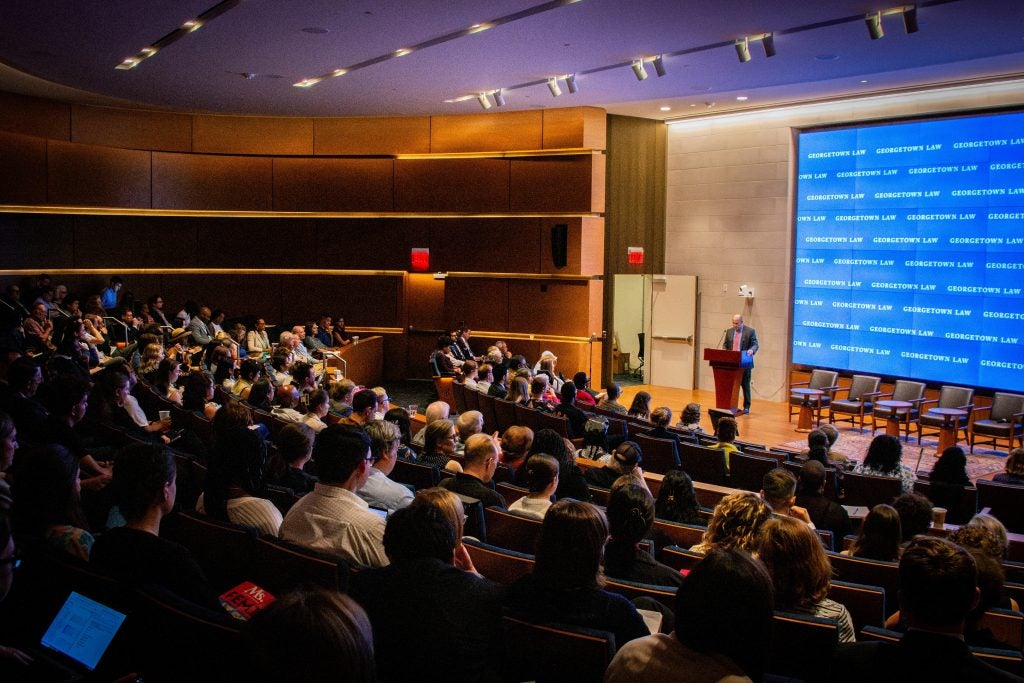
Hundreds of attendees convened for the third annual “Supreme Court Term in Review” hosted by Georgetown Law and the O’Neill Institute for National and Global Health Law. Photo credit: Noah Friedman.