

Our Work
Founded in 2014, the Center on Privacy & Technology is a leader at the intersection of privacy, surveillance, and civil rights.
Latest Work

Comments on the Privacy Risks of Period-Tracking Apps
Associate Korica Simon was quoted in USA Today speaking about period-tracking apps’ collection of user data and what privacy concerns such apps raise in the wake of the leaked Supreme Court draft opinion in Dobbs v. Jackson Women’s Health Organization.
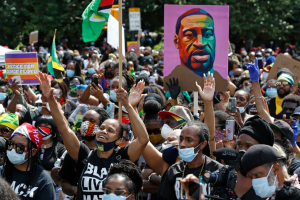
Settlement Will Prevent Clearview AI from Selling Face Recognition Technology to Private Firms
The ACLU of Illinois reached a settlement with Clearview AI on the matter of selling its faceprint databases. Last July, the Center, represented by Georgetown Law’s Civil Litigation Clinic, filed an amicus brief in the ACLU’s lawsuit, alleging violations of Illinois’ Biometric Information Privacy Act. While the lawsuit was specific to Illinois, the effects are far-reaching. It permanently bans Clearview from providing its massive faceprint database to private actors, nationwide, and bans them from providing it to law enforcement in Illinois for five years.

Testimony to the House of Commons of Canada on Police Use of Facial Recognition Technology
Associate Cynthia Khoo appeared before the Canadian House of Commons Standing Committee on Access to Information, Privacy and Ethics on March 21, 2022, testifying on police use of facial recognition technology based on her work as a Research Fellow at the Citizen Lab (University of Toronto). Khoo raised key concerns with facial recognition and algorithmic policing technologies, including systemic discrimination, constitutionality, transparency and accountability, and reliance of law enforcement on private sector commercial vendors.
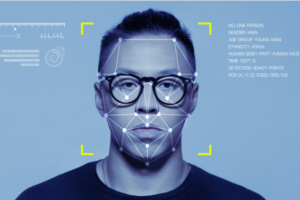
Op-Ed: New Jersey Should Restrict Law Enforcement’s Use of Facial Recognition Technology
The Center joined fifteen civil and digital rights groups in signing a letter and op-ed opposing law enforcement use of facial recognition technology in New Jersey. The letter highlights various harms that would result from law enforcement use of facial recognition technology, including an expansion to the over policing of Black and Brown communities.

Executive Director Emily Tucker Named a 2021 Soros Justice Fellow
Associate Jameson Spivack spoke about face recognition policy and privacy implications as part of the Tech Institute's "Tech Ideas Lunches" series open to Georgetown Law students, faculty, and staff.
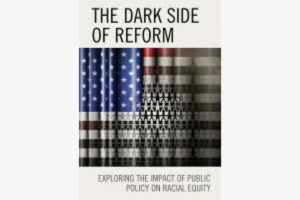
Chapter in The Dark Side of Reform
Executive Director Emily Tucker's chapter, "Four Racial Justice Principles for Policy Response to Carceral Technology," was published in The Dark Side of Reform by Lexington Books. The book addresses the development of social policies with the potential to advance racial equity and the implications of such policy proposals.
Advocacy for DC Community Control Over Police Surveillance Model Bill
Associate Cynthia Khoo filed comments in response to the Office of Science and Technology Policy's Notice of Request for Information on Public and Private Sector Uses of Biometric Technologies. The Center's submission focused on biometric surveillance of low-wage workers, and highlighted the importance of situating biometric surveillance technologies in their full historical context through a racial justice and socioeconomic justice lens.
Advocacy for DC Community Control Over Police Surveillance Model Bill
The Community Control Over Police Surveillance Model Bill (CCOPS) was a bill supported by the Community Oversight of Surveillance coalition that would require DC entities to obtain Council approval before acquiring new surveillance technology and entities would be required to report why they wanted to use the technology and the impact it would have on civil rights and liberties. The Center on Privacy and Technology was a client of the Communications and Technology Law Clinic and asked the clinic to advocate on our behalf at coalition meetings about CCOPS.
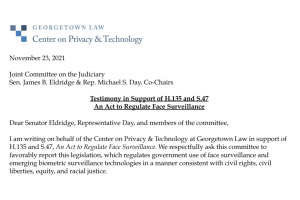
Written Testimony in Support of An Act to Regulate Face Surveillance to the MA Judiciary Committee
Associate Jameson Spivack submitted written testimony in support of S47/H135, An Act to Regulate Face Surveillance, to the Massachusetts Judiciary Committee. The bill, which would strengthen the state's existing face recognition regulation, builds on the work of grassroots Massachusetts organizations whom the Center has previously supported in pushing for face recognition legislation.

Jameson Spivack Quoted in Asahi Shimbun Article
Jameson Spivack was quoted in the Asahi Shimbun about tech companies' suspension of face recognition technology and who the dominant firms in the face recognition market are.