

Our Work
Founded in 2014, the Center on Privacy & Technology is a leader at the intersection of privacy, surveillance, and civil rights.
Latest Work

Privacy Center sues Department of Homeland Security
The Privacy Center, together with Amica Center for Immigrant Rights and Americans for Immigrant Justice filed a lawsuit under the Freedom of Information Act seeking records from DHS regarding the agency’s management and use of DNA. As the Privacy Center reported in its 2024 publication, Raiding the Genome, since 2020, DHS has built out a massive DNA-collection program. The three organizations filed a FOIA request in the summer of 2024 to uncover critical further information about DHS’s DNA-collection program, but the agency has yet to meaningfully respond. Read the full press advisory.
Privacy Center quoted in WIRED article about CBP’s DNA collection program
Director of Research and Advocacy Stevie Glaberson was quoted in a WIRED article about CBP's DNA collection program. "Taking DNA from a 4-year old and adding it into CODIS flies in the face of any immigration purpose. That’s not immigration enforcement. That’s genetic surveillance,”said Glaberson. The article also cited the Center on Privacy & Technology's 2024 report "Raiding the Genome."
Privacy Center Re-Releases 2022 Report on ICE Dragnet Surveillance Practices
The Privacy Center re-released "American Dragnet: Data Driven Deportation in the 21st Century," the first report to quantify the sweeping surveillance power of U.S. Immigrations and Customs Enforcement (ICE). A new foreword situates the findings against the backdrop of ICE's expansive surveillance powers in the control of an increasingly authoritarian regime. Read the full press advisory.

Three year anniversary of “American Dragnet”
Three years ago, we released our report “American Dragnet: Data-Driven Deportation in the 21st Century,” a two-year investigation into the sweeping surveillance powers of the U.S. Immigration and Customs Enforcement (ICE). What we found is that ICE surveillance is much broader than people realize – it’s a dragnet. Their tactics include: using facial recognition to search 1 in 3 drivers, accessing the driver’s license records of 3 in 4 adults, and accessing the utility records of 3 in 4 adults. The report describes the surveillance apparatus that Trump is using to target immigrants, activists and anyone else who challenges his agenda. We’re re-releasing it today with a new foreword. Today, those powers are wielded by an increasingly authoritarian regime. Given the second Trump administration’s disregard for privacy and civil rights protections, the percentage of people now watched is likely much higher. Under the guise of immigration enforcement, the new administration has begun to grow its already massive digital infrastructure, aggregating data across federal agencies and destroying crucial privacy guardrails in the process. We don’t know how far the administration will go in testing the limits of its powers. But what’s clear is that the struggles for immigrant justice, free speech, and privacy are interconnected, and that building solidarity is more crucial than ever.
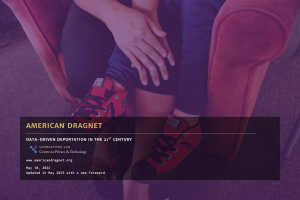
Center on Privacy & Technology at Georgetown Re-Releases 2022 Report on ICE Dragnet Surveillance Practices
The Center on Privacy & Technology at Georgetown Law re-released “American Dragnet: Data-Driven Deportation in the 21st Century,” with a new foreword in May 2025. The 2022 report was the first to quantify the scope of the surveillance operations being carried out by the federal government through Immigration and Customs Enforcement (ICE). Today, the Trump administration is using the digital surveillance apparatus the report describes to target immigrants, activists and anyone else who challenges his agenda. Emily Tucker, the Privacy Center’s Executive Director said, “Mass surveillance is fundamentally incompatible with democratic self-governance. The danger of ICE’s data dragnet is not only that individual people will be targeted, but that our ability to act together as a people will be permanently undermined.” The full press advisory is available at this link.

Testimony on California SB 274
Director of Research & Advocacy Stevie Glaberson submitted testimony taking no position on California SB 274, which seeks to tighten California law on data collected through automated license plate readers (ALPRs). Stevie submitted testimony that generally supports state action to tighten laws to protect residents from ICE targeting through state-collected data, and supplied the legislators with the findings and recommendations from American Dragnet in support of their efforts.

Privacy Center quoted in Context piece about AI and Trump’s immigration policy
Associate Emerald Tse was quoted in an article in Context, "How AI is aiding Trump's immigration crackdown," about the Trump’s administration's increased use of surveillance technology to further their immigration policy. “These data intensive tools aggregate all of these data points and create associations,” said Tse, “(They) can implicate the people in your household, your neighbours, your workplace, literally every aspect of your life.”

Privacy Center quoted in Mother Jones piece about ICE and FBI use of face recognition at the border
Executive Director Emily Tucker was quoted in a Mother Jones article detailing how ICE and the FBI are using Clearview AI tech for facial recognition at the border. “All of the evidence we have is that [Clearview] is a corporation that cares not at all about civil rights and that their founders have a potentially ideological agenda inconsistent with democracy,” Tucker said.

“Watching the Watchers: Immigration, Surveillance, and the Law” event hosted by American Constitution Society
Associate Emerald Tse was a panelist for "Watching the Watchers: Immigration, Surveillance, and the Law," an event hosted by the student organization American Constitution Society. Emerald framed the discussion by sharing with students the history of surveillance and technology in the US immigration system, while other panelists focused on methods of oversight and legal challenges.
Privacy Center quoted in MSNBC op-ed about ICE and civil liberties
Executive Director Emily Tucker was quoted in Julio Ricardo Varela's op-ed in MSNBC: "The deep roots of ICE's disdain for civil liberties." The quote is from an article in WIRED from 2023 in which Tucker says: "Calling ICE a rogue agency doesn’t even quite get at how bad the problem is with them. They are always pushing to the limits of what they are allowed to do and fudging around the edges without oversight."