

Our Work
Founded in 2014, the Center on Privacy & Technology is a leader at the intersection of privacy, surveillance, and civil rights.
Latest Work
Privacy Center jointly submitted report to the UN Human Rights Council
The Center on Privacy & Technology at Georgetown Law and seven other organizations jointly submitted a report to the UN Human Rights Council, “Entrenching Authoritarianism: Expanding the Terrorism Framework and the Infrastructure of Surveillance to Repress Expression and Stifle Dissent.” The report shows the surveillance system available to the Trump administration and its use to repress freedom of expression. Truthout covered the release in this piece, “Rights Groups Detail “Authoritarian” Reality of US Surveillance in Report to UN.”
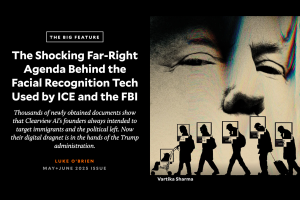
Privacy Center quoted in Mother Jones piece about ICE and FBI use of face recognition at the border
Executive Director Emily Tucker was quoted in a Mother Jones article detailing how ICE and the FBI are using Clearview AI tech for facial recognition at the border. “All of the evidence we have is that [Clearview] is a corporation that cares not at all about civil rights and that their founders have a potentially ideological agenda inconsistent with democracy,” Tucker said.
“A Theory of Law for the Next Founding Generation” paper published
Executive Director Emily Tucker co-authored a paper with philosopher David N. McNeill titled "A Theory of Law for the Next Founding Generation." The paper argues that no one gives us our rights except ourselves. In order to protect our rights under the autocratic aspirations of the current administrations, there must be a fundamental reformation in our understanding fo the relationship between constitutional legitimacy and democratic self-rule.
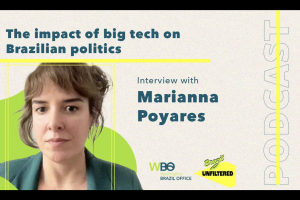
Privacy Center Fritz Fellow on “The Brazil Unfiltered” podcast
Marianna Poyares spoke with Prof. James Green (Brown University) on the Brazil Unfiltered podcast episode "The Impact of Big Tech on Brazilian Politics" about the reception in Brazil of Meta's recent decision of ending fact-checking and its impact in the upcoming Brazilian elections.

Contribution to “Information Ecosystems and Troubled Democracy” report
The Observatory on Information and Democracy published their report: “Information Ecosystems and Troubled Democracy.” This extremely relevant report explores the epidemic of mis- and disinformation and how media, AI, and Big Tech all play a role in disseminating this mis- and disinformation at the cost of democracy. Co-authored by our Executive Director Emily Tucker (and Robin Mansell, Flavia Durach, Matthias Kettemann, Théophile Lenoir, Rob Procter, Gyan Tripathi), the report helps untangle how information ecosystems resulting from human decisions and actions can have disastrous consequences for democracy.

Letter to the FTC Urging A New Rulemaking Process to Protect Privacy and Civil Rights and Restrict Discriminatory Data Practices
The Center signed onto a letter alongside 44 groups working on privacy, civil rights, media democracy, or consumer advocacy, urging the FTC to launch a rulemaking process to protect privacy and civil rights and restrict discriminatory data practices.
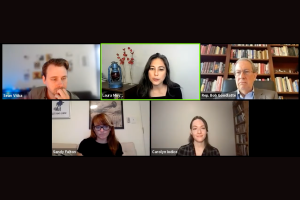
Panel: In Recognition of the 20th Anniversary of the Enactment of the Patriot Act
Associate Director Laura Moy participated in a panel discussion on the current state of surveillance in the US. In recognition of the 20th anniversary of enactment of the Patriot Act, the Fourth Amendment Advisory Committee is hosting a panel discussion on the current state of surveillance in the US. The panel will discuss how surveillance practices have changed over the past 20 years and what's happening now. They were joined by former Colorado Sen. and member of SSCI Mark Udall and former Virginia Rep. and House Judiciary Chair Bob Goodlatte.

Associate Cynthia Khoo Interviewed in the National Post
Associate Cynthia Khoo was interviewed for an article in the National Post, "Hate speech bill won't curb freedom of expression, but enhance it, supporters argue."
House Oversight Committee Hearing on Face Recognition
Senior Associate Clare Garvie testified before the House Committee on Oversight and Reform. She argued that in the absence of regulation police use of face recognition poses risks to our First, Fourth, and Fourteenth Amendment rights. Because of those risks, a moratorium is appropriate.