What I’m Working On: Associate Professor Eun Hee Han, L’07, on Accent-Based Discrimination
November 25, 2025
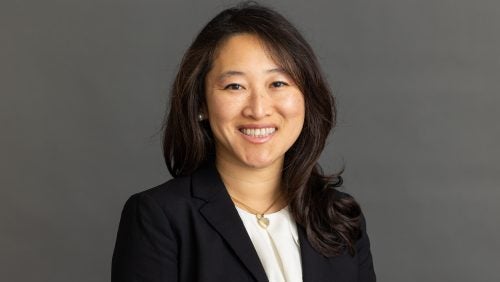
Associate Professor of Law, Legal Practice Eun Hee Han, L’07
Growing up on Saipan, a Pacific island home to a small but diverse population, Associate Professor Eun Hee Han, L’07, observed cross-cultural communication firsthand. At Georgetown Law, she applies the same lens to her scholarship, which focuses on the intersections between language, law, culture, citizenship and identity.
“What I try to look at in my scholarship is who belongs,” says Han, who teaches legal research, writing and analysis as part of Georgetown Law’s first-year Legal Practice Program. “That can be looking at who belongs in a specific context, like a law school classroom, or more generally, in terms of who is acknowledged within the law and how their experiences are acknowledged within the law.”
A graduate of Georgetown Law, Han served as a law fellow in the Legal Practice Program while a student. After practicing law in the private sector, she transitioned to academia. Most recently, she taught legal research and writing and served as associate director of the Scholarly Writing Program at the George Washington University Law School before joining the Law Center faculty in 2019.
Below, Han discusses her recent scholarship on accent-based discrimination, how editing Wikipedia can benefit students and what she hopes first-year students take away from their legal practice classes.
What are you working on?
My paper “Assuming Accent: Recognizing the Intersection of Race and National Origin in Title VII Discrimination” is forthcoming in the University of Colorado Law Review. In the piece, I’m specifically looking at the Asian American experience and how, under Title VII — which protects against discrimination based on someone’s belonging in a protected class — courts have tended to classify accent-based discrimination as national origin discrimination.
I critique how this classification ignores some aspects of the racialized experience Asian Americans face when it comes to their speech. Listeners may apply the racialized model minority and perpetual foreigner stereotypes to Asian American speakers, such as through assuming that someone has an accent where they don’t or assuming that an accent has more of a detrimental impact on communication than it does. I argue for an intersectional approach that recognizes that accent-based discrimination can implicate both national origin and race.
What sparked your interest in the topic?
As a professor of legal practice, I think all the time about how people communicate and how we communicate within the law and about the law. “Assuming Accent” is an extension of thinking about how people are heard and how people speak and listen to each other in the legal context.
Some of “Assuming Accent” is inspired by an article that one of my Georgetown professors, Mari Matsuda, wrote when I was a student, called “Voices of America: Accent, Antidiscrimination Law, and a Jurisprudence for the Last Reconstruction,” which is still cited frequently. I was looking back at it and thinking about different ways that accent is still relevant to how we speak and engage with each other today, even beyond what Professor Matsuda was writing about.
“Assuming Accent” also overlaps with some of the things that came up during the COVID-19 pandemic, when comments directed to Asian Americans reflected assumptions about where they were assumed to be from, or whether or how they spoke English.
Do you have other recent projects that look at communication and the law?
I co-authored a piece called “Disrupting Data Cartels by Editing Wikipedia” (2023) in a special issue of the Yale Journal of Law and Technology with Professor Amanda Levendowski Tepski and Professor Jonah Perlin, L’12. We argue that Wikipedia is an important source of information that can provide the public with access to information about the law and their rights.
In the piece, we discuss how teaching students to edit Wikipedia can allow students to learn about genres of legal writing, put developing research and writing skills into practice and also develop students’ sense of ethics and professional identity. By encouraging students to think about how they can provide information to a wider audience, we encourage students’ ability to democratize knowledge and provide access to justice.
Additionally, I co-authored a piece with Associate Professor Tiffany Jeffers and UC Irvine School of Law Professor Susan McMahon, L’06, called “The Unending Conversation: Gut Renovations and No-Demo Renos” (2023) in the Stetson Law Review Forum. We argue that when teaching, law professors should make clear that every step of legal reasoning involves choices about whose perspectives are included in legal discourse. Both pieces aim to consider more perspectives in legal discourse.
What excites you about teaching legal practice?
When students come into class, they are first-year students who may or may not have any experience with the law. They may or may not have any familiarity with reading cases, talking about the law, the judicial system or anything else. It’s my job to help them understand what law is, how law works, how to formulate a question in the law and how to answer and analyze it. For me, that falls under that idea of belonging and allowing people to develop a voice in the law. I want to help my students figure out how they want to be heard.