Georgetown Law Journal Hosts Symposium on Labor Rights and Civil Rights Challenges
January 8, 2026
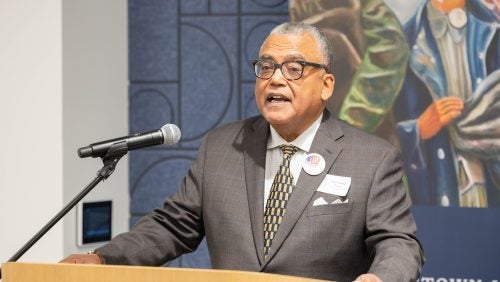
Mark Gaston Pearce, former NLRB Chair and former Georgetown Law Workers’ Rights Institute Director, moderating a panel at the Georgetown Law Journal’s 2025 symposium.
Tackling such topics as federal employee layoffs, challenges to the National Labor Relations Board, and attacks on workplace diversity initiatives, 165 scholars, policymakers, advocates, and students gathered October 24 for The Georgetown Law Journal’s Volume 114 symposium on “The Labor Movement and Civil Rights in the Modern Era.”
“Since the beginning of the Trump II presidency in January, we have seen unprecedented attacks on workers, unions and the movement at large—to the point where this issue would be almost irresponsible not to address,” said Senior Symposium Editor Freedom Gobel.
The day-long symposium, co-sponsored by Bloomberg Law, featured four panels and a keynote address by Professor Heather Steffen, who is an adjunct professor in Georgetown University’s Master’s Program in the Engaged and Public Humanities.
Crisis at the NLRB: Legal Challenges, Political Power, Future Labor Rights
On one panel, labor leaders and professionals examined the evolving challenges facing the NLRB and the broader labor movement.
“In these unprecedented times, the NLRB faces an 8-10% turnover rate, with attorneys, investigators and even students declining opportunities to work at the agency,” noted former NLRB Chair and former Georgetown Law Workers’ Rights Institute Director Mark Gaston Pearce. “The current administration is not embracing the foundational lessons that shaped its creation.”

Richard Bensinger
Despite rising political division, statistics show that 88% of Americans under 30 support unions. Richard Bensinger, founder of the Organizing Institute and the first organizing director of the AFL-CIO, emphasized the urgency of action, saying, “If workers hold together and we take advantage of public support, it is not the moment to retreat, it’s the right moment to organize.”
Jennifer Abruzzo, who served as General Counsel of the NLRB during the Biden administration, urged the labor community to make “lemonade out of lemons,” reminding attendees that important precedents remain in effect and that many employers are following the law.
Former General Counsel and Board Member of the NLRB Richard Griffin focused on employer strategies aimed at undermining the Board’s authority, noting continued cases of unfair treatment and discrimination that must be identified and challenged. Cathy Creighton, Director, Buffalo Co-Lab, concluded the panel by adding that many view the NLRB as nonfunctional and believe it is time for states to step in. California, New York and Massachusetts have already expanded private-sector organizing rights, showing how strong union density translates into real political power.
The panel closed with a call for urgency and imagination. “Broad, bold thinking is key to continuing this battle,” Abruzzo stressed.
Academic Freedom as a Labor Issue
Following the “Crisis at the NLRB” panel, Professor Heather Steffen delivered the keynote address, titled “Academic Freedom as a Labor Issue.” Steffen examined contemporary threats to academic freedom, which stem from legislative pressures, external actors and internal actors within institutions.
In her remarks, Steffen discussed the fact that various groups within academia have been more vulnerable. “Academic workers who are most frequently targeted by right-wing attacks often hold marginalized identities, including workers of color, LGBTQ+ workers, religious minorities and people with disabilities,” she said.
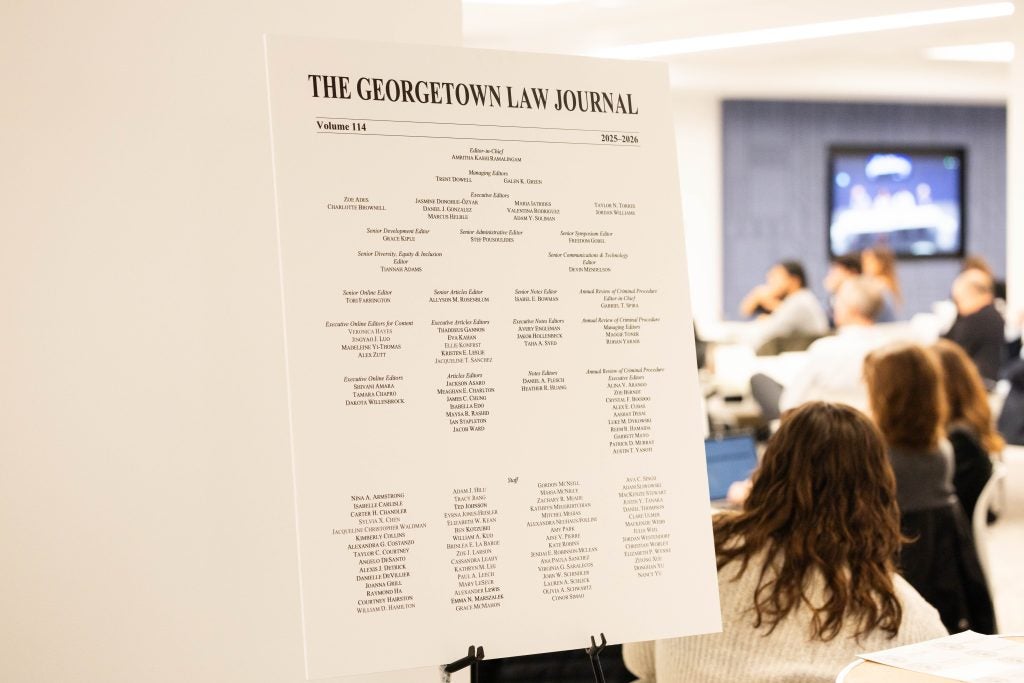
A peek at the audience at the GLJ symposium
Steffen urged the audience to reframe academic freedom not merely as a privilege, but as a fundamental right, concluding with a call to action: “If we are committed, creative and collective, that is how we will improve and expand academic freedom.”
Beyond academic discussion, the goal was to host a conversation grounded in real solutions for real people and to inspire action. “At a program primarily attended by aspiring lawyers, I hope attendees consider not just what they can do as advocates within the confines of the law, but are starting to recognize the ways that their legal education and power can be used to address the needs of the public even when the law fails to operate and protect,” said Gobel.
The Georgetown Law Journal will publish an issue based on the symposium in 2026.