Georgetown Law Welcomes Two New Faculty Members
August 14, 2026
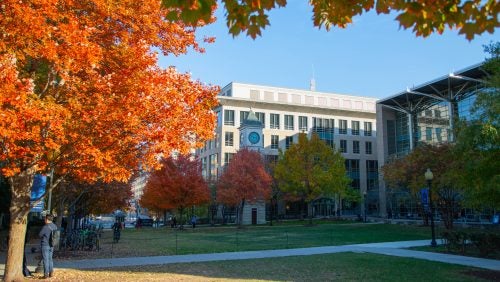
This summer, two distinguished legal scholars joined the Georgetown Law faculty as full professors: Cathy Hwang, whose teaching and research focus on business law, and Jayesh Rathod, an immigration law expert who is the new co-faculty director of the Law Center’s asylum clinic.
“I’m thrilled to welcome these new colleagues, who together represent the breadth of what Georgetown Law offers: preparing students both for private legal practice and for careers in public interest law,” said Dean M. Elizabeth Magill, who herself joined the Law Center faculty this summer as well.
Two additional professors, Bethany Lipman, L’14, and Frances Walters, who taught at Georgetown Law last year as visitors, have joined the full-time faculty as associate professors of legal practice.
With these additions, the full-time Georgetown Law faculty now numbers 139 professors.
Cathy Hwang, Anne Fleming Research Professor and Professor of Law
Corporate contracts scholar Cathy Hwang credits two main role models with the decision to become a lawyer: the fictional detective Nancy Drew and an aunt who served as a high-ranking prosecutor in Taiwan.
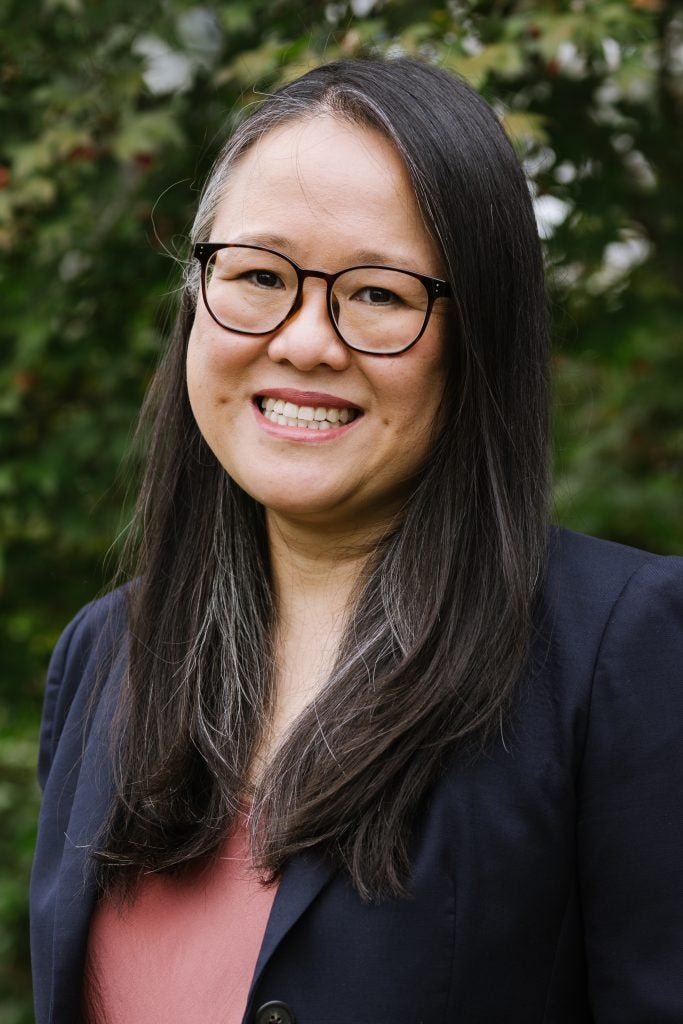
Prof. Cathy Hwang
“I said, ‘I want to be a girl detective.’ She told me, ‘That’s not a real job. You should be a lawyer,’” Hwang recalls of a childhood exchange with her aunt, who was in law school at the time. “I don’t know if I would have been a lawyer without that conversation.”
The first woman in her immediate family to attend college, Hwang graduated from Pomona College, where she majored in economics and international relations. She earned her J.D. from the University of Chicago Law School and practiced in the mergers and acquisitions group at Skadden, Arps, Slate, Meagher & Flom.
Having grown up between San Diego, Hong Kong and Taiwan, Hwang was drawn to transactional work in part because of the international opportunities it offered. But the desire to explore emerging issues in her field coupled with an affinity for mentoring junior attorneys cemented her desire to become a professor.
Prior to joining the Georgetown Law faculty, Hwang was the Edward F. Howrey Professor of Law at the University of Virginia School of Law, where she directed the John W. Glynn Jr. Law & Business Program from 2022-2023 and was the first woman of Asian descent to hold a tenured position at the law school. She began her academic career at the University of Utah and from 2014-2017 served as an academic fellow at the Rock Center for Corporate Governance, a joint initiative of Stanford Law School and Stanford’s Graduate School of Business.
Hwang notes that the guidance she received from her former law professors as she prepared to enter legal academia proved invaluable — and informed her approach to teaching. “There was no way I was going to be able to [make the transition] without that kind of mentorship and support,” she says. “I try to give my students that kind of encouragement as well.”
As a scholar focused on mergers and acquisitions, corporate contracts and corporate governance, Hwang points to the fast-moving nature of business law and the relationship between transactional lawyering and contract design as key drivers of her work. As she prepares to begin teaching at the Law Center, Hwang is excited to share that enthusiasm — and the practical applications of her field — with students in the classroom.
“I always tell students that understanding business law is an integral part of legal practice,” she says. “So many things are organized as businesses. Understanding that is how you unlock the world.”
Jayesh Rathod, Professor of Law and Co-Faculty Director, Center for Applied Legal Studies
Jayesh Rathod didn’t always know he wanted to be a lawyer, but he did aspire to make change in the world. He attributes this to his mother, who was a community organizer in the textile industry before she and his father and oldest sister immigrated from India to the United States in 1970. “Community service was an important value in our family, and it has shaped the career choices that I’ve made,” he says.
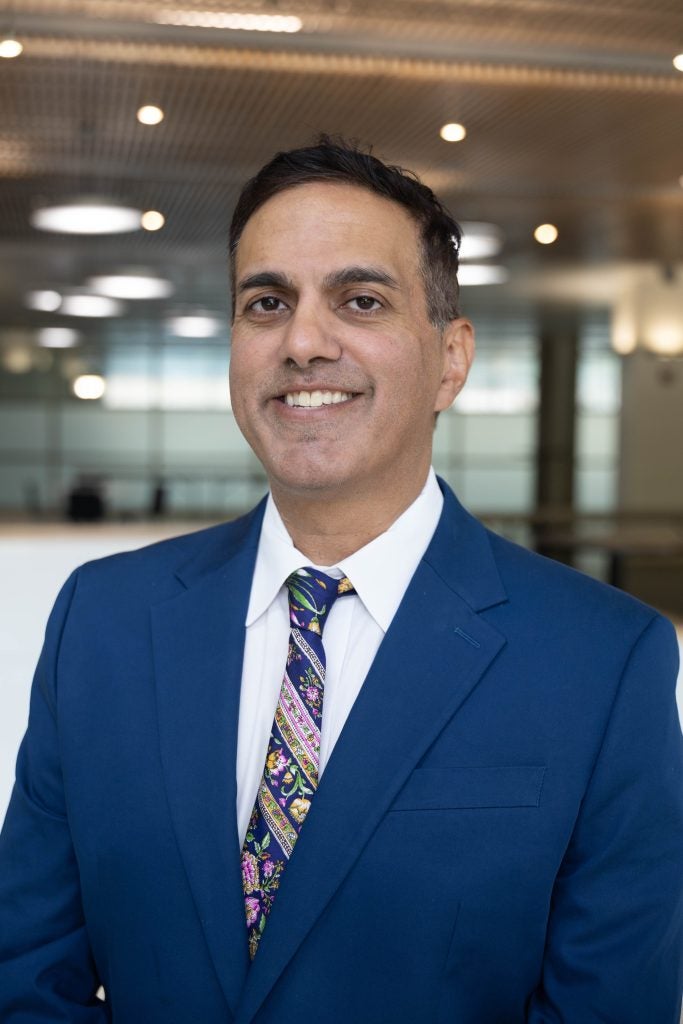
Prof. Jayesh Rathod
After graduating from Harvard, Rathod worked at a civil rights nonprofit and at an international development organization before deciding to go to law school. He loved his time at Columbia Law School, and especially appreciated his semester in a prisoners’ rights clinic.
Following law school, he was a law firm associate and had a judicial clerkship, then joined CASA, a Maryland-based advocacy organization. He found representing immigrants and workers fulfilling, yet still felt unsure about the next step in his career. The answer came during coffee with a mentor who had been teaching at American University Washington College of Law who suggested that Rathod look into opportunities there. A three-year fellowship turned into two decades with the AU clinical program, which included launching the school’s first law clinic focused exclusively on immigrants’ rights and earning the Society of American Law Teachers’ Great Teacher Award in 2023.
Now at Georgetown Law, he’s co-faculty director of the Center for Applied Legal Studies (CALS), one of the school’s oldest clinics. First founded in 1981 by recently retired Professor Emeritus Philip Schrag, more than 30 years ago CALS narrowed its focus to representing asylum applicants. Rathod arrives at a time when immigration enforcement and policy are in a volatile state, so he’s facing the immediate challenge of figuring out, together with clinic co-director Professor Andrew Schoenholtz and their fellows and students, how to adjust the clinic’s scope of work beyond asylum cases only.
He’ll also continue with his own scholarship, which covers U.S. immigration law and the small but growing number of Americans exploring emigration to other countries. “I recently completed a study of transgender U.S. citizens who are departing the country, studying the circumstances that led them to exit and the immigration pathways they are pursuing,” he says. “I’ve also begun interviewing immigration attorneys in Canada to understand how asylum claims by U.S. citizens are being received and the legal hurdles they’re encountering. It’s cognitively dissonant to think of a U.S. citizen as a refugee, but it will be interesting to see what the future holds,” he says.
He’s looking forward to getting to know his new colleagues and workplace. He’s already something of a Hoya-in-law: his artist husband, Michael Dowley, C’03, graduated from the College of Arts and Sciences and now teaches painting and design courses there as an adjunct, and his late father-in-law, Joseph Dowley, C’68, L’76, stayed involved in Georgetown alumni organizations throughout his life. “There’s something personally significant to be joining an institution that mattered so much to him,” says Rathod. “It’s the transitive property: Joe Dowley loved Georgetown, and I loved him, so it follows that I must love Georgetown, too.”
Despite the uncertain times ahead in his field, Rathod is prepared to get to work. “It is a very challenging time to practice immigration law,” he says. “A friend who works in this area asked me recently, ‘Why would students even want to do it?’ But honestly, what I found at American, and I’m sure the same is true at Georgetown, is that students want to be engaged in upholding the rule of law, even in a fundamentally broken system. And I am excited to support students in that effort, to guide them and to work alongside them.”