What I’m Working On: Professor Stephanie Barclay on Constitutional Rights and Democratic Governance
June 11, 2026
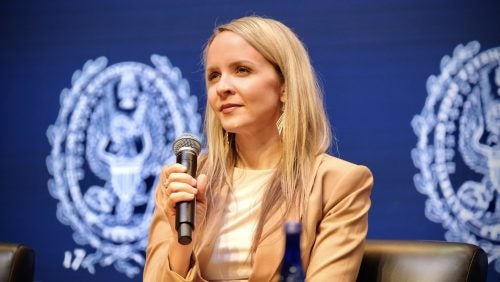
Prof. Stephanie Barclay
For constitutional law scholar and Anne Fleming Research Professor Stephanie Barclay, constitutional rights are at the heart of the tension between judicial power and democratic governance.
“Constitutional law is to government actors like law is for citizens,” says Barclay of one of the arguments central to her forthcoming book, Constitutional Rights in a Democracy, which draws on her studies at Oxford University, where she is currently completing a Ph.D. in Law. The book is also grounded in her experience litigating constitutional cases at the trial and appellate level, including before the U.S. Supreme Court. “A well-designed constitutional law ultimately ought to be designed to better help government actors fulfill their obligations to those they govern,” she adds.
Before joining the Georgetown Law faculty in 2024, Barclay began her academic career as an associate professor of law at BYU Law, where she earned her J.D., and then directed the Religious Liberty Initiative as a Professor of Law at the University of Notre Dame Law School. In addition to her scholarship and teaching, Barclay serves as faculty co-director of the Georgetown Center for the Constitution, where she launched a research fellows program to offer mentorship and support for early-career academics working on constitutional issues. “That is a really meaningful program, not just because we’re helping scholars individually, but because it builds a community,” she says.
Below, Barclay discusses her new book, how archival research helped shed light on the Supreme Court’s surprising treatment of religious minorities and the area of First Amendment law she’d like to focus on next.
You are currently working on your first book, Constitutional Rights in a Democracy (Oxford University Press, 2027). What does it explore?
The book asks the question: What legal work should a constitutional right do, and which branch or branches of government should do that work. Assuming the answer to that question involves some meaningful role for an unelected judiciary, this raises the age-old question of how to square the tension between judicial adjudication of constitutional rights and democratic principles. I argue that there is an important role for courts to adjudicate constitutional rights, and my goal in the book is to offer a model that is more consistent with democratic principles than many other alternatives, and one that is rooted in notions of human flourishing.
You also have an article, “Normativity and Discretion,” forthcoming in the Virginia Law Review. Is it related?
That article grows out of about two chapters of the book, and one in particular that thinks about what normative considerations — that is, considerations of how the how the law ought to operate — should inform judicial action in contexts where legal sources don’t fully resolve the issue the judiciary needs to adjudicate. I argue that one of those normative considerations should be that whatever rule or reasoning the judiciary ultimately adopts should offer guidance to lower courts and citizens in terms of: What does this actually mean? Principles of democracy should also be a consideration. The bigger the impact [a court’s] ruling is going to have on a democratic process, the more cautious they should be, and the more clarity they should feel like they need to have, in terms of the rightness of what they’re doing to engage in that sort of democratic interference.
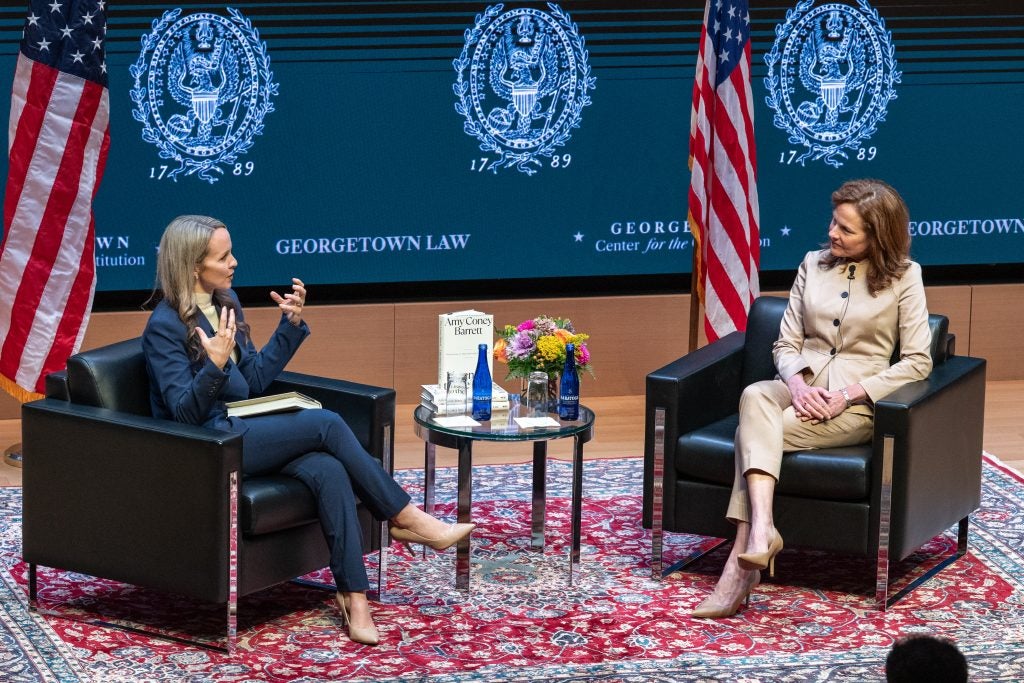
Fireside Chat with U.S. Supreme Court Justice Amy Coney Barrett and Professor Stephanie Barclay, Co-Director for the Georgetown Center for the Constitution, at Georgetown Law on October 28, 2025.
Your article “The Untold Story of the Proto-Smith Era: Justice O’Connor’s Papers and the Court’s Free Exercise Revolution” was published in the University of Pennsylvania Law Review in February. What does it explore?
That article looks at Justice Sandra Day O’Connor’s recently released Supreme Court papers. One of the typical misconceptions or myths you hear about constitutional adjudication is that the judiciary is always going to inherently be more sympathetic to minority groups than the legislature, so we need to vest the judiciary with special power to stand up for those minorities.
The “Proto-Smith Era” piece is a fascinating example where the judiciary was pretty hostile to religious minorities. If you go through these papers of Justice O’Connor, you’ll see the Supreme Court refer to religious minorities as “oddball” groups and “squeaky-wheel faiths.” It describes them along the lines of being unpleasant or disfavored groups. They have a lack of sympathy for these vulnerable minorities. You see the legislature try and protect those religious minorities, and then the Supreme Court invalidate legislative action, and the legislatures respond again to try and protect religious minorities, so there’s this tension back and forth between the judiciary and the legislature that is exactly the opposite of what like that myth of the judiciary protecting religious minorities looks like.
What was the research process like?
It was really interesting; it almost felt like I was reading someone’s private correspondence. You feel a little bit like, Am I allowed? Yet, it is — you just go to the Library of Congress and they’ll give you the boxes. My co-author Matthew Krauter and I went through the papers, which were only recently released within the last year-and-a-half or two, so there’s still a lot to mine. It was a treasure trove of information. Scholars like to say that there’s something inherent in the nature of judicial reasoning that will make it more principled and more alive to issues [such as religious accommodation]. But when it comes to the Court’s reasoning, it doesn’t get much more transparent than looking at their actual notes of their conferences.
Religious liberty cases have come before the Supreme Court in recent months. What is it like for your scholarly focus to be in the spotlight?
I’m interested in any constitutional issues that are pending before the Court, and there is something exciting about the fact that my area of work is in flux. In January, at the Fifth Circuit, there was litigation about the Ten Commandments in Louisiana and Texas, and some of my scholarship was cited by the parties and discussed in oral argument. I was also asked by SCOTUSblog to become a regular commentator. That has been a fun addition to my work and a way to have my thoughts be part of the discourse in a more timely way.
What are you working on next?
Some of my future scholarship is likely going to focus on threats and opportunities posed by AI to First Amendment rights. That’s a whole new frontier I’m excited about.