Yale Law’s Justin Driver Discusses ‘The Fall of Affirmative Action’ and Path Forward for Higher Education
March 3, 2026
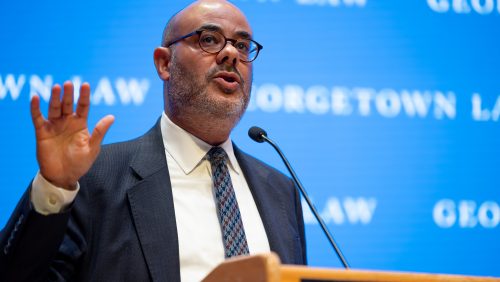
Author and Yale Law Professor Justin Driver delivered the 2026 Thomas F. Ryan Lecture in Hart Auditorium.
Leading constitutional and educational law scholar Justin Driver, the Robert R. Slaughter Professor of Law at Yale Law School, joined the Georgetown Law community on Feb. 25 to deliver the 2026 Thomas F. Ryan Lecture, “The Fall of Affirmative Action.”
Driver’s work explores the United States Supreme Court’s role in shaping public education and constitutional debates over race, speech and equality. His lecture, drawn from his latest book The Fall of Affirmative Action: Race, the Supreme Court, and the Future of Higher Education, traced the aftermath of the Court’s decision to end race-conscious admissions in higher education in Students for Fair Admissions (SFFA) v. Harvard (2023) and laid out his view of the legal pathways available to universities who value diversity in admissions.
“The Supreme Court’s decision … is, by my lights, a calamitous opinion, a deeply misunderstood opinion,” said Driver, noting the subsequent decrease in Black student enrollment at many universities. “It seems to me that the Trump administration is brandishing a misapprehension of that decision in an effort to intimidate many institutions, not just higher education, but elementary and secondary schools, the business world [and] nonprofits.”
Driver also challenged prevailing understandings of the decision and its impact, arguing that, for example, the end of affirmative action has intensified, rather than alleviated, an admissions paradigm that centers narratives of racial victimization.
“Under the old regime, a Black applicant like myself could check the ‘Black’ box and then write a personal statement about why I wanted to study Proust or Plato or intellectual property or anything else under the university’s wide sun,” he said. “Under the new regime, however, Black applicants are incentivized to write personal statements that sound in racial victimization.”
‘The promise of dissent’
Driver underscored that avenues for admissions diversity that don’t defy the Court’s decision in SFFA v. Harvard remain possible for colleges and universities. “We would do well to think about what the Equal Protection Clause requires, rather than only focusing on what it forbids,” he said, citing such possibilities as admissions preferences for descendants of the enslaved, members of tribal nations and students from urban areas.
Despite the challenges posed by the Supreme Court’s decision, Driver expressed optimism about the future of racial diversity in education, emphasizing the role of universities in allowing the legal process around affirmative action and related issues to unfold, rather than assenting to political pressure. “In the age of President Trump, the perils of acquiescence are profound, and the promise of dissent is boundless,” he concluded.
First held in 1985, the Ryan Lecture is given annually to honor the memory of the late Thomas F. Ryan, L’76, and brings leading academics and public servants to campus to share their work and insights on a range of important topics. Driver’s lecture was preceded by welcome remarks by Interim Dean Joshua C. Teitelbaum and followed by a question-and-answer session with Professor Kevin Arlyck, associate dean for research and academic programs. Watch the full lecture below; captions will be available within 24 hours: