

Our Work
Founded in 2014, the Center on Privacy & Technology is a leader at the intersection of privacy, surveillance, and civil rights.
Latest Work

No, We Don’t Live In A F#%*ing Simulation
Executive Director Emily Tucker and philosopher David McNeill co-taught a virtual mini-course entitled No, We Don’t Live In A F%#*ing Simulation to 34 students exploring the simulation hypothesis, long-termism, and the imminent threat of artificial general intelligence (AGI). The course received 86 applicants coming from academia, government (globally), NGOs and non-profits (globally), law, social work, computer science, and the private sector. The 34 students represented more than 12 countries. The Center on Privacy & Technology hopes to offer the course again.
Op-Ed: Chatbots Are Creating Algorithmic Dependence
Executive Director Emily Tucker published an op-ed in Tech Policy Press entitled "Our Future Inside The Fifth Column- Or, What Chatbots Are Really For" about the corporate and capitalist goals of companies designing chatbots. Chatbots, Tucker warns, are part of a larger scheme to sow algorithmic dependence in the economic spaces most important to the public interest. “The goal is no longer to dominate crucial industries, but to convert crucial industries into owned intellectual property.”
Executive Director Emily Tucker’s Article Translated and Republished
Executive Director Emily Tucker’s article "Our Future Inside The Fifth Column - Or, What Chatbots Are Really For” was translated into Italian and published in the AI Aware magazine. In it, Tucker analyzes how major tech companies use chatbots and artificial intelligence as tools for marketing monopoly consolidation and political influence rather than for the common good. It also points out the media's lack of critical attention towards this and the dangers of corporate power accumulation. AI Aware aims to provide in-depth and accessible analysis on the ethical, social, and technical issues related to AI. The original piece, in English, was published on Tech Policy Press in June 2023.
“Sam’s Plan to Too-Late Regulate” blog
On May 16, 2023, Sam Altman, the CEO of OpenAI, testified before Congress that the government should regulate technologies being marketed as "artificial intelligence." The Privacy Center posted a blog explaining why Altman's regulation is "too-late regulation": regulation that is both too late in the tech development process and too late in the industry adoption timeline to be meaningful. Read the whole blog here.

“Pulling Back the Curtain on the Technologies Automating Inequities in the Criminal Legal System” blog
In recent years there has been a major shift in the criminal legal system: law enforcement authorities have been increasingly using algorithmic technologies when making critical decisions about policing and punishment. Associate Jameson Spivack wrote a blog detailing how these algorithmic technologies are reinforcing and automating biases in the criminal legal system. Read the whole blog here.

Privacy Center Hosts Launch Event for New Interactive Digital Narrative on Algorithms in the Criminal Legal System
On March 29, 2023, the Privacy Center hosted published a new interactive digital narrative titled "Cop Out: Automation in the Criminal Legal System," which explores the algorithmic technologies that are increasingly used to inform or make critical decisions about policing and punishment. This publication's release was accompanied by an in-person roundtable discussion focused on strategies of resistance. Read the full press advisory.
Blog Post Named the Most-Read Tech Policy Press Contributor Post of 2022
Executive Director Emily Tucker's blog post "Artifice and Intelligence" was named the most-read Tech Policy Press Contributor post of 2022. The post explained why the Privacy Center decided to stop using the terms “artificial intelligence,” “AI,” and “machine learning” in its work to expose and mitigate the harms of digital technologies in the lives of individuals and communities.
Podcast Interview: Taking Action
Senior Associate Cynthia Khoo spoke to Daniel del Pielago, Housing Director at Empower DC, for their podcast Taking Action, a one-hour radio show aired live every Tuesday at 1pm ET on WPFW 89.3 FM. She was interviewed alongside Ben Winters, Senior Counsel and lead of the AI and Human Rights Project at the Electronic Privacy Information Center (EPIC). Cynthia and Ben spoke about algorithmic housing discrimination, as well as algorithmic discrimination more broadly.

Response to President Biden’s AI Executive Order
The Privacy Center signed on to comments relating to OMB's guidance following the Biden AI EO. Comments were written by Just Futures Law, Surveillance Resistance Lab, UCLA Center on Race and Digital Justice, Mijente and Media Justice, many of whom have been and continue to be partners in Privacy Center efforts. The comments focused on the OMB guidance specifically as it relates to DHS and federal acquisition and use of AI impacting immigrant communities.
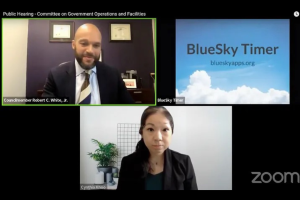
“Testifying for the DC Stop Discrimination by Algorithms Act” blog
On September 22, 2022, Senior Associate Cynthia Khoo testified on behalf of the Privacy Center to support the Stop Discrimination by Algorithms Act (Bill B24–558) (SDAA) in a hearing before the Committee on Government Operations and Facilities at the Council of the District of Columbia (DC Council). Read her whole testimony and more context on our blog here.