

Our Work
Founded in 2014, the Center on Privacy & Technology is a leader at the intersection of privacy, surveillance, and civil rights.
Latest Work
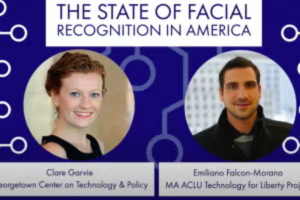
The State of Face Recognition in America Webinar
A student chapter of AI4ALL, a US-based nonprofit dedicated to increasing diversity and inclusion in AI research and policy, invited Senior Associate Clare Garvie to give a webinar with Emiliano Falcon-Morano of ACLU-MA on face recognition use by police.

Computing for the Common Good
As part of UMass Amherst's annual Computing for the Common Good symposium, senior associate Clare Garvie joined Kade Crockford, Prof. Erik Learned-Miller, and Prof. Fran Berman for a discussion about the types of regulations needed for the artificial intelligence sector.

Panel: Racial Bias in AI
Center Policy Associate Jameson Spivack spoke as part of an expert panel, "Racial Biases in Artificial Intelligence," for a webinar hosted by the University of Maryland business school.
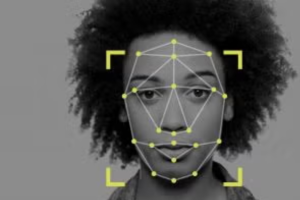
Report: Legislative Approaches to Face Recognition Around the Country
Policy Associate Jameson Spivack and Senior Associate Clare Garvie’s paper analyzing how lawmakers around the US are trying to regulate face recognition was published in the AI Now Institute’s biometric technologies report.

Amici Curiae Brief in support of Petitioner
The Center's Policy Associate Jameson Spivack was interviewed and quoted in The Hill about recent legislative efforts to combat the potential discriminatory effects of AI. "I think that any legislation needs to recognize that while these technologies affect everyone, they disproportionately affect vulnerable people."
The FAA Reauthorization Act of 2018
On October 5, 2018, a federal law was signed requiring privacy and racial bias assessments of the federal government's use of biometric technologies at airports—the first-ever federal law requiring artificial intelligence bias testing. The law was enacted following the Center's December 2017 report, Not Ready For Takeoff, which found privacy and bias problems in these deployments.
Coalition Letter to Axon’s AI Ethics Board
The Center co-wrote a 42-organization coalition letter to Axon's new "AI Ethics Board." The letter urges the board to center the experiences of policed communities in its process, and argues that integrating face surveillance with body-worn cameras would be "categorically unethical."
National and Local Civil Rights Groups Urge Strong Ethical Review of Axon’s Police Technology
Following the launch of a new "artificial intelligence ethics board" at Axon, a major U.S. police technology vendor, the Privacy Center joined 41 other civil rights, racial justice, and community organizations in a letter with recommendations for how the board can uphold its ethical responsibilities when reviewing the company's products. Read the full press release.