Georgetown Law Celebrates 25th Anniversary of the American Constitution Society
January 26, 2026
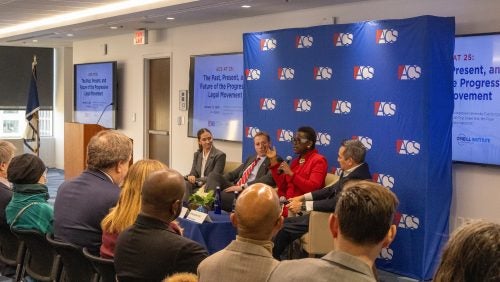
L-R: ACS Georgetown Chapter President Tessa Freeman, L’27; ACS President Phil Brest; ACS Board Chair-Elect Professor Michele Goodwin; and ACS Board Chair Amb. Keith M. Harper (Ret.) discussed the organization’s history and role in the progressive legal movement at a Jan. 12 anniversary event.
Leading legal scholars, practitioners and students gathered on Jan. 12 to celebrate the 25th anniversary of the American Constitution Society (ACS), the nation’s foremost progressive legal organization – which began as a student group at Georgetown Law.
At a panel and reception sponsored by ACS, the Washington, D.C. ACS Lawyer Chapter, the Georgetown University Law Center ACS Student Chapter and the O’Neill Institute for National and Global Health Law, attendees reflected on the origins, growth and future of the progressive legal movement.
Since its founding at Georgetown Law, ACS has expanded into a network of more than 250 student and lawyer chapters nationwide that bring together advocates, judges, scholars and elected officials working on a range of issues such as access to justice, constitutional interpretation and democracy and elections.
“At 25, ACS is poised to engage fully in the struggle to determine whether our country remains a democratic republic committed to liberty, equality and the rule of law as described in our Constitution,” said Professor Emeritus Peter Rubin, associate justice for the Massachusetts Court of Appeals, in his opening remarks. “Until the idea of a Constitution committed to the protection of human dignity, individual rights, liberties and genuine equality returns to its proper place in our law and culture, no restoration of our society will be complete.”
‘An inclusive perspective’
ACS was formally launched in 2001, when Rubin, then a professor at Georgetown Law, convened a small group of progressive lawyers and advocates to incorporate the organization at the national level. The flagship student chapter of ACS — then known as the Madison Society — was established on campus two years earlier by students of Rubin’s, in part to serve as a counterweight to the Georgetown Law student chapter of the Federalist Society.
Lawton Cummings, L’00, the flagship chapter’s founding student president, recalls feeling the need for a forum committed to balanced discourse on a view of the Constitution as a living document.
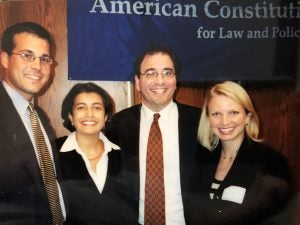
Former ACS Georgetown Chapter Presidents David Fauvre (left), L’03; Prof. Anupama Chaturvedi Connor (second from left), L’02; and Lawton Cummings (right), L’00, with Professor Emeritus the Hon. Peter Rubin (second from right).
The chapter’s early success, coupled with the legal and political climate following the Supreme Court’s Bush v. Gore decision that determined the outcome of the 2000 presidential election, underscored the demand for an organization dedicated to promoting a progressive understanding of the Constitution and the rule of law.
“ACS for me was very much an opportunity to show an inclusive perspective that honors individual rights and a diversity of views,” said Cummings, who went on to found ACS lawyer chapters in New York City and Denver after graduation. “In my opinion, the most exciting conversations are those that involve intellectual rigor … [it was] exciting for me to have speakers who may have different takes, but who have commitment to the truth and have integrity about the Constitution.”
Notable speakers in the organization’s early years included then-U.S. Attorney General Janet Reno, then-First Lady Hillary Clinton (who spoke to students while running in the primary that would lead to her election to the U.S. Senate), federal judge and former U.S. Representative Abner Mikva and attorneys and legal scholars such as former Solicitor General Walter Dellinger, former NAACP Legal Defense Fund President Elaine Jones and renowned death penalty lawyer George Kendall.
“We had Vice President Gore’s legal team during Bush v. Gore come speak with us immediately following their oral argument at the Supreme Court in one of the classrooms in McDonough Hall,” said Professor Anupama Chaturvedi Connor, L’02, who served as Georgetown Law’s second ACS student president. “They were still buzzing with adrenaline from their argument and the students could feel it.”
An ‘incredible community’
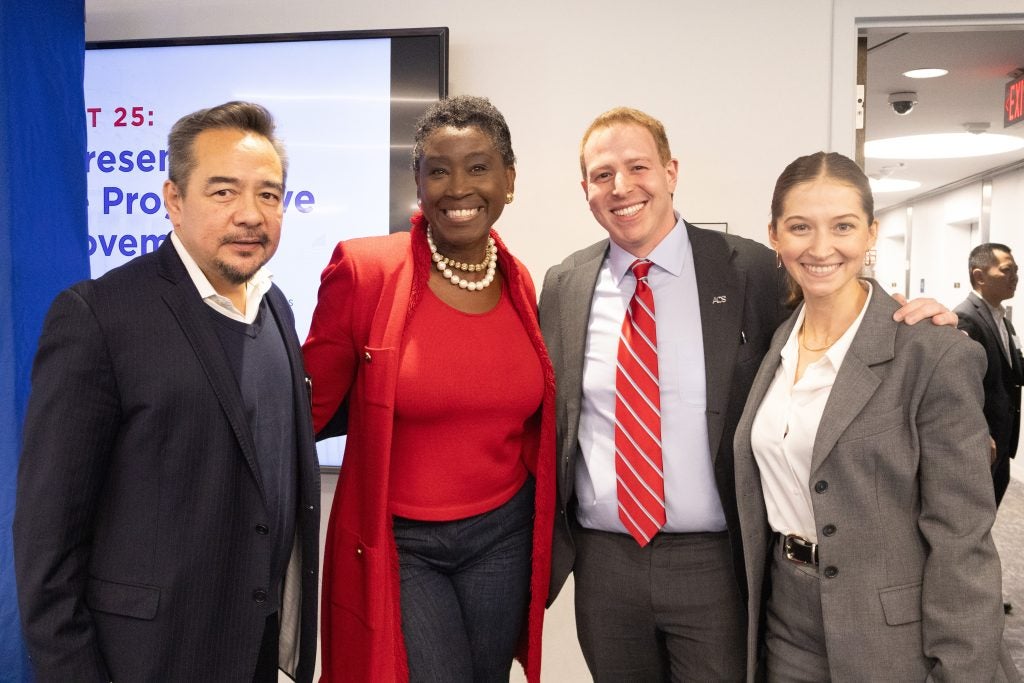
L-R: ACS Board Chair Amb. Keith M. Harper (Ret.); ACS Board Chair-Elect Professor Michele Goodwin; ACS President Phil Brest; ACS Georgetown Chapter President Tessa Freeman, L’27.
At the anniversary event on Jan. 12, Rubin’s remarks were followed by a question-and-answer discussion with ACS President Phil Brest, ACS Board Chair-Elect Professor Michele Goodwin and ACS Board Chair Ambassador Keith M. Harper.
During the wide-ranging discussion, which was moderated by ACS Georgetown Chapter President Tessa Freeman, L’27, the panelists addressed current challenges and priorities such as the role of state courts and attorneys general in guarding against executive overreach and opportunities for law students interested in public interest — including ACS’s role in helping support the next generation of legal advocates.
“I was drawn to ACS by the incredible community of the Georgetown chapter, as well as by the commitment of [the national organization] to supporting and advocating for laws and legal systems that propose a progressive vision of the rule of law and work towards equality for all,” Freeman said prior to the event. “As a 1L, ACS was such an important space for making friends among my peers as well as meeting upper-year students that became both friends and mentors. I also loved attending events where incredible professors and attorneys spoke about how the law was working right now, in the real world, outside of my law school casebooks.”
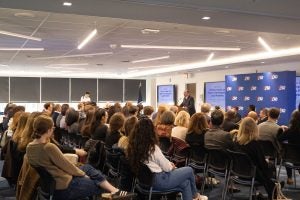
Professor Emeritus the Hon. Peter Rubin delivers opening remarks at “ACS at 25: The Past, Present, and Future of the Progressive Legal Movement.”
On campus today, the ACS student chapter offers social and educational programming, including events at which attorneys and professors share their expertise on wide-ranging areas of the law. This semester, the chapter will host campus events on timely legal topics such as redistricting, the recent U.S. actions in Venezuela and the First Amendment.
Career guidance is also a core part of the chapter’s offerings, Freeman says, including panel discussions (the chapter’s first annual Career Week was held last fall), a newly established peer mentorship program and opportunities to connect with the broader ACS network of legal professionals.
While ACS’s campus offerings have evolved in the decades since its founding, past and current student members underscore that the organization’s core commitments remain the same. “ACS’s role is more important today than it was 25 years ago because the rule of law and its vital role in promoting equality and justice is under attack in ways in which we could not have imagined back then,” Connor said. “I hope that students will continue to join and re-energize the organization because it has a critical role to play at this unprecedented time in our history.”