‘The Sim’ Returns: Georgetown Law Students Face National Security Crises in Simulation Exercise
March 23, 2026
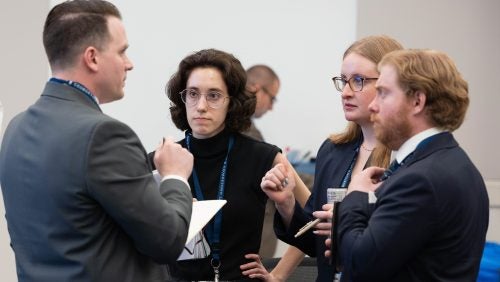
During the simulation, students navigated fast-moving national security crises and honed their legal reasoning and leadership skills.
For the students who took part in this year’s National Security Crisis Law: Edge Technologies Simulation (“Sim”), time was of the essence. A foreign actor had attacked a U.S. satellite fleet — with potentially dire consequences. Gathered for a National Security Council meeting, the group had to weigh options such as diplomatic protest, trade sanctions and cyberattacks in deciding how to respond.
Eighteen Georgetown Law students took part in this year’s Sim, the most in-depth offering of its kind among law schools and the capstone experience for those studying national security law at Georgetown.
Part of a semester-long course taught by Center on National Security (CNS) Director and Professor Laura K. Donohue, the Sim last took place in 2020. After campus closures during the COVID-19 pandemic forced a pause, Donohue took the opportunity to revamp her playbook and incorporate many of the tech advances — including satellite weaponry, virtual reality, blockchain and artificial intelligence — that preoccupy today’s national security experts.
In their assigned roles as agency heads and other federal and intelligence officials, students worked long hours over March 13 and 14 and honed their legal judgment, decision-making and communication skills under conditions that replicated real-world structures and limitations — an experience not otherwise found in a law classroom or textbook.
“I found it genuinely energizing to work through the tension between acting decisively under uncertainty and respecting the legal and institutional constraints that make those decisions legitimate,” said Caroline Moffatt, F’21, L’26, who played the role of Pentagon undersecretary for intelligence and security. “I’m walking away with a much sharper instinct for how to structure legal analysis and a deep sense of gratitude for the opportunity to learn alongside my classmates.”
First held during the 2009-2010 school year, the Sim grew to include some 300 participants from a dozen law schools before its hiatus. This year’s simulation was limited to the students in Donohue’s seminar, but it could expand again in the future.
“We are pushing the bounds of legal pedagogy,” Donohue explains. “The Sim requires that students not just have a strong command of constitutional, statutory and regulatory provisions, but also legal and political processes. Students must become adept at determining what information they need and how to obtain it, and how to exercise strong professional judgment.”
The siloed nature of top-secret environments also presents unique difficulties. “The Sim teaches students how to protect against a range of cognitive biases and to navigate interpersonal and group dynamics to ensure that attorneys are able to provide the strongest advice to their clients,” she said.
Joining the students in their mission were some 30 real-world national security practitioners and academics — many of them alumni — who meticulously developed the exercise’s storylines and responded to the students’ actions in real-time as members of the control team, or what Donohue calls the “collective brain” of the simulation.
For students, the chance to forge connections with alumni working in national security law is one of the most valuable aspects of the exercise. And for alumni who return to campus as members of the control team, the Sim proves a welcome opportunity to give back to the next generation of practitioners.
“Coming back to campus underscored how enduring and relevant the simulation remains, while also highlighting how much the national security landscape — and the students engaging with it — has evolved,” said Logan Perel, L’12, L’13, who first participated in the simulation as a J.D./LL.M. student in 2012 and this year returned as a member of the control team. “The students performed exceptionally well, demonstrating preparation, creativity and a level of professionalism that is a testament to Georgetown Law’s legal education.”
Read on below for a look at the Sim in action.
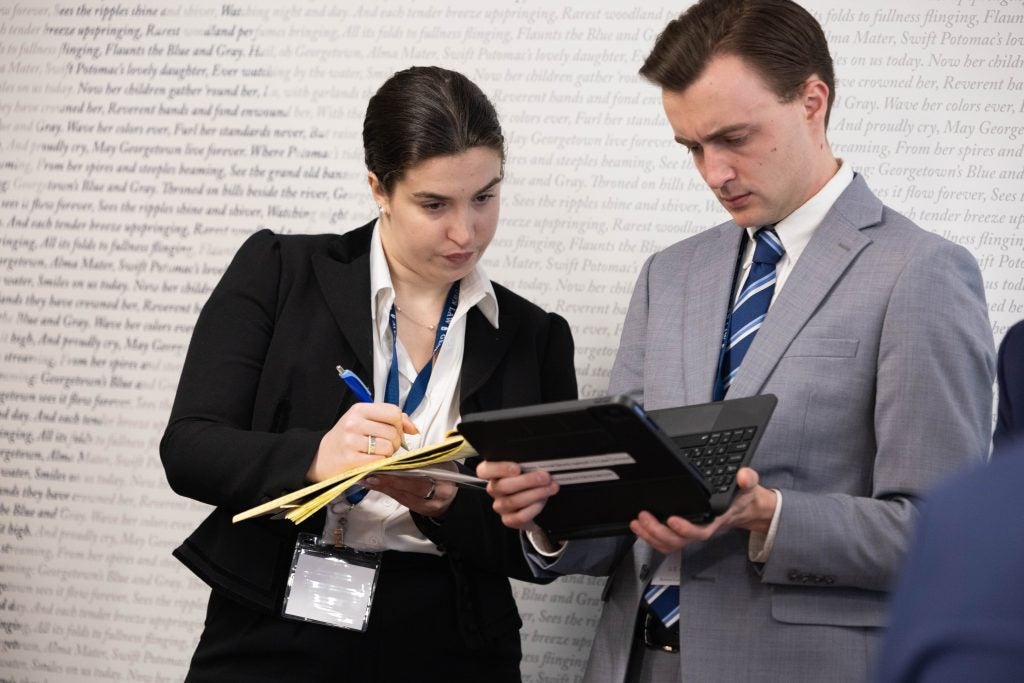
For Caroline Moffatt (left), F’21, L’26, who played Pentagon undersecretary for intelligence and security, the most surprising challenge was the interplay between legal ambiguity and edge technologies. “I came in expecting the hard part to be the policy trade-offs, but the greater difficulty was that the underlying factual and technical picture was itself contested,” said Moffatt, seen here consulting with a fellow Sim participant Ben Pribe (right), L’27, in the role of director of the National Security Agency (NSA).
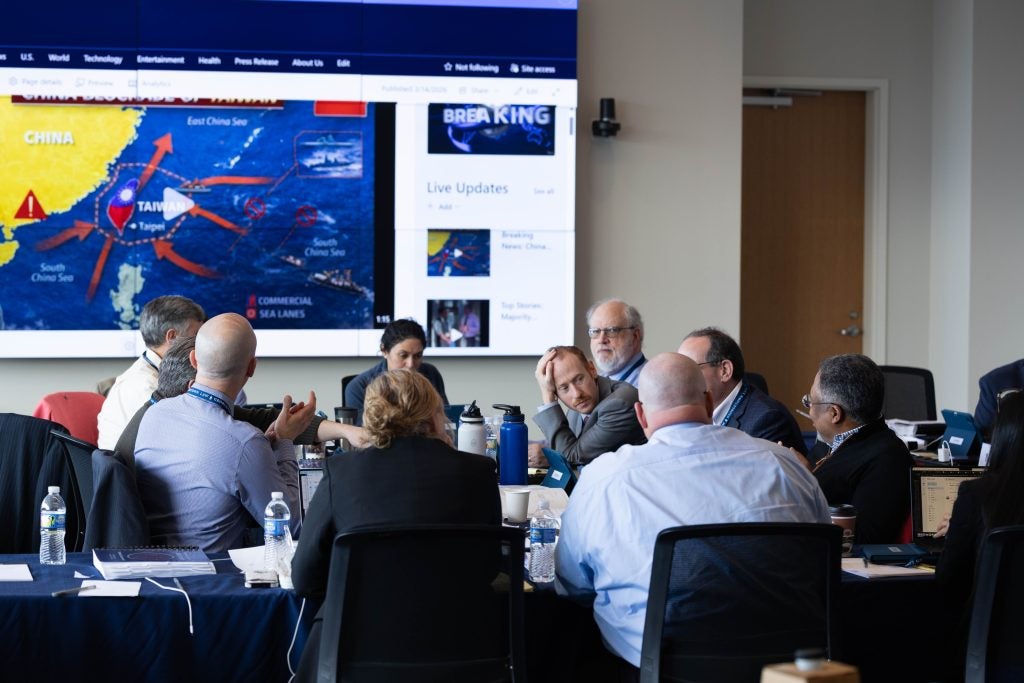
In the control room, a team of approximately 30 national security experts and practitioners hailing from a range of institutions including academia, the federal government and Congress, military entities, the private sector and U.S. attorney offices responded to student queries in real time.
Logan Perel (pictured above listening intently to another control team member), L’12, L’13, who played the role of Treasury secretary, said returning to campus for the exercise was both energizing and nostalgic. “The simulation remains an impressive, immersive way to pressure-test legal reasoning, judgment and collaboration under realistic constraints,” he said.
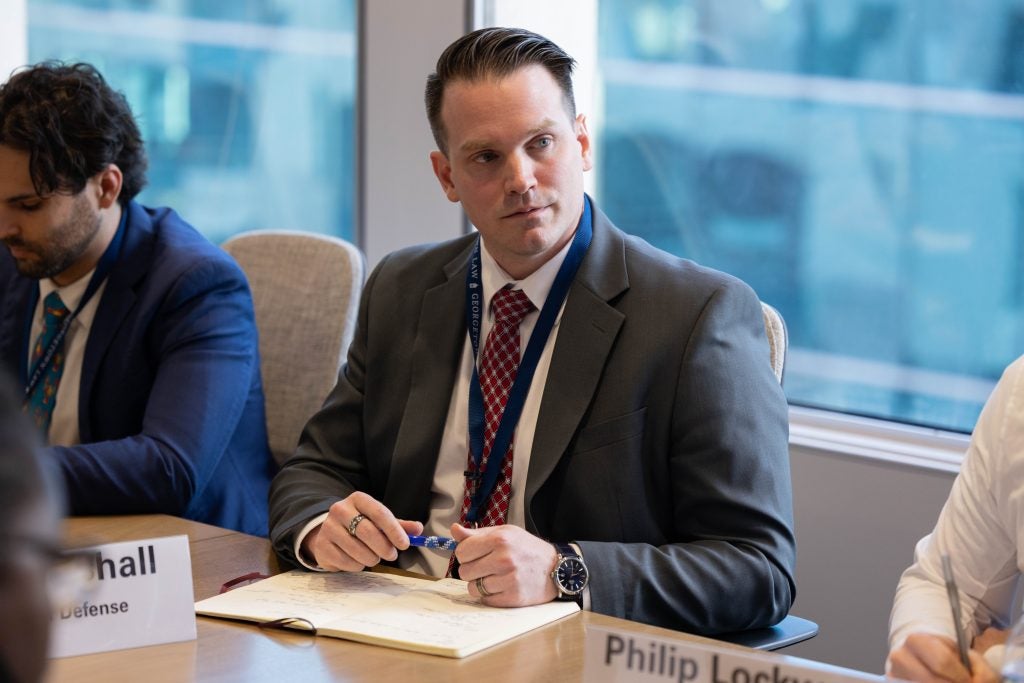 National security law LL.M. student Chris Marshall (above), L’26, played the role of U.S. Secretary of Defense. “In my professional career, I have not experienced a more challenging, realistic exercise designed to enhance the hard and soft skills of national security lawyering,” he said. “More than a class, the simulation is a testing lab transforming students into national security practitioners.”
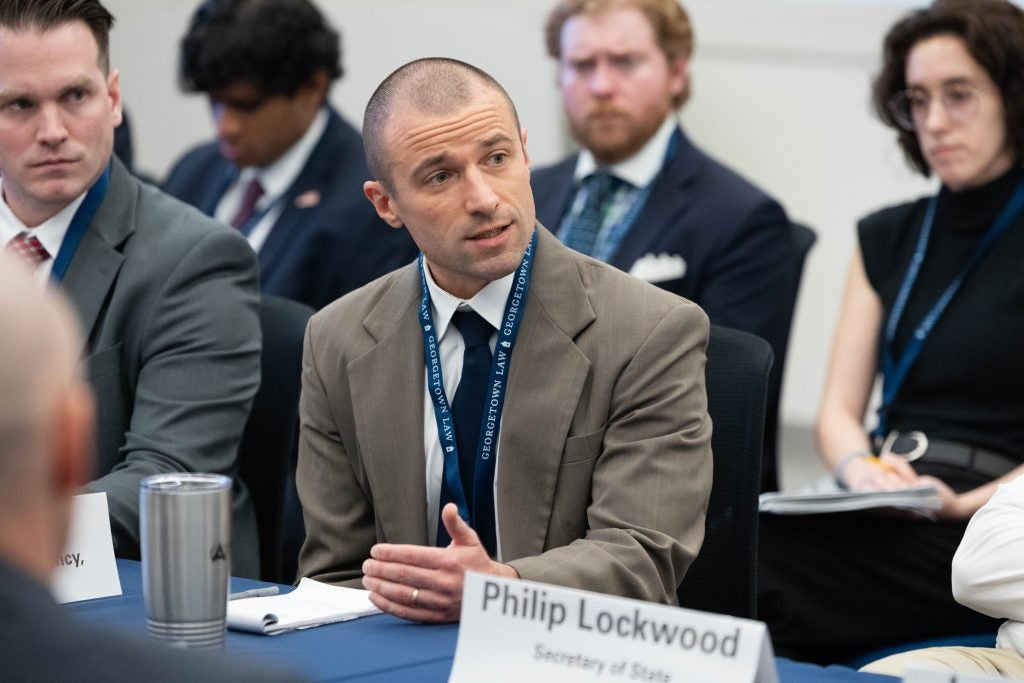
During National Security Council (NSC) deliberations, students practiced advising their agency heads. Elliot Huss (above), LL.M.’26, playing the director of the Central Intelligence Agency (CIA), was one such participant who obtained advice from his classmates in real-time.
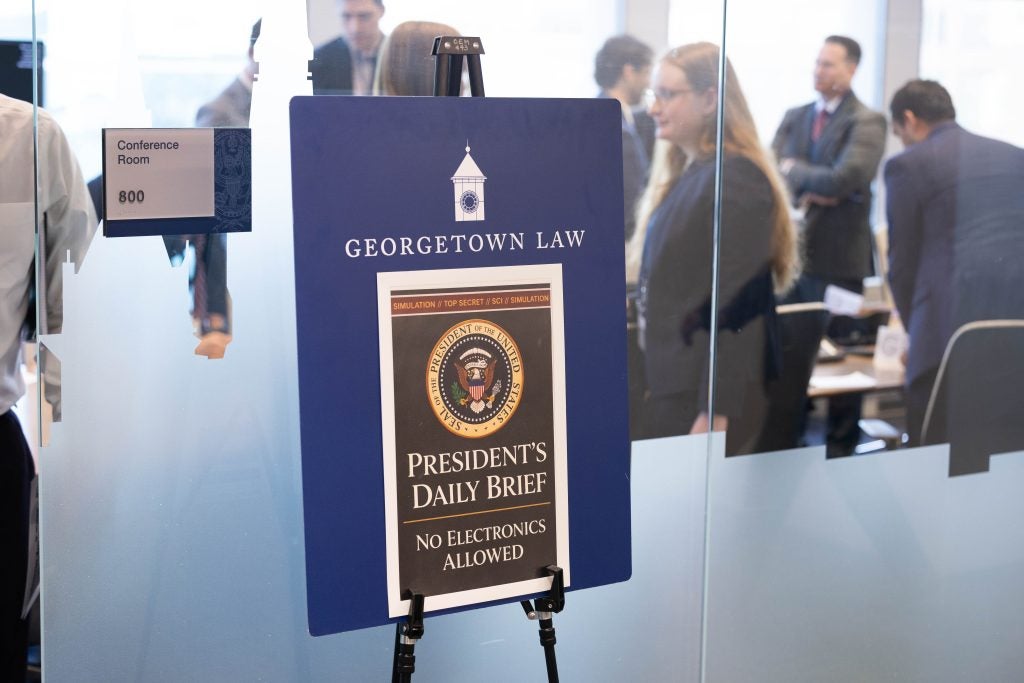
At mock presidential briefings and NSC meetings, students followed a no-electronics rule and practiced real-world protocol, such as standing when the president (played by Professor from Practice Mary DeRosa) entered the room.
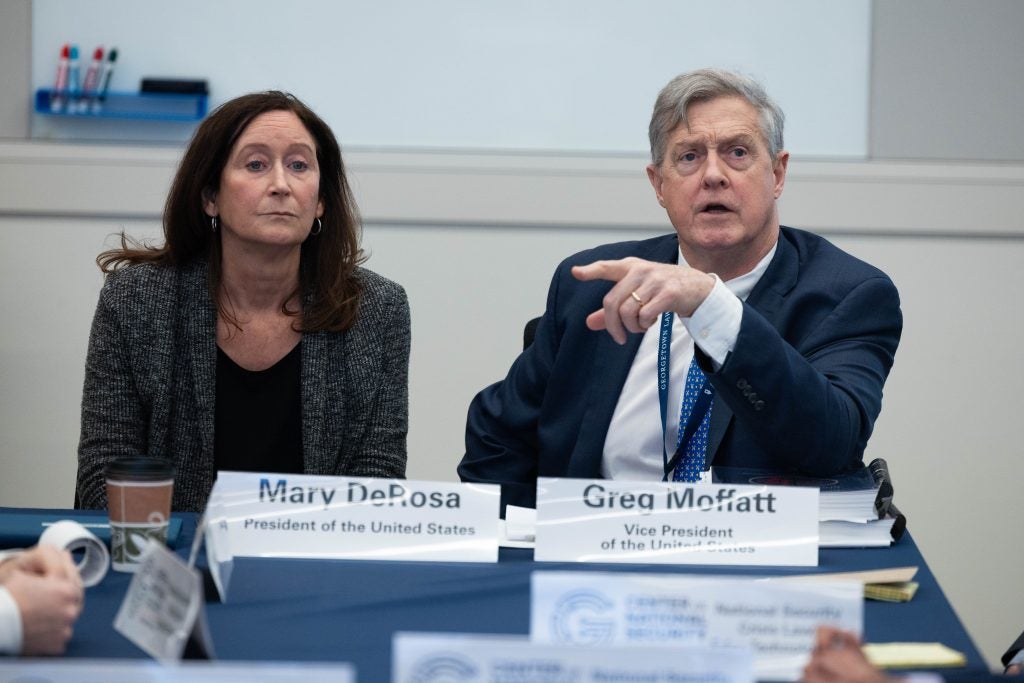
CNS Co-Director and Professor from Practice Mary DeRosa (left), played the role of U.S. president. She was joined by Board of Visitors member Greg Moffatt (right), F’81, L’91, in the role of vice president.
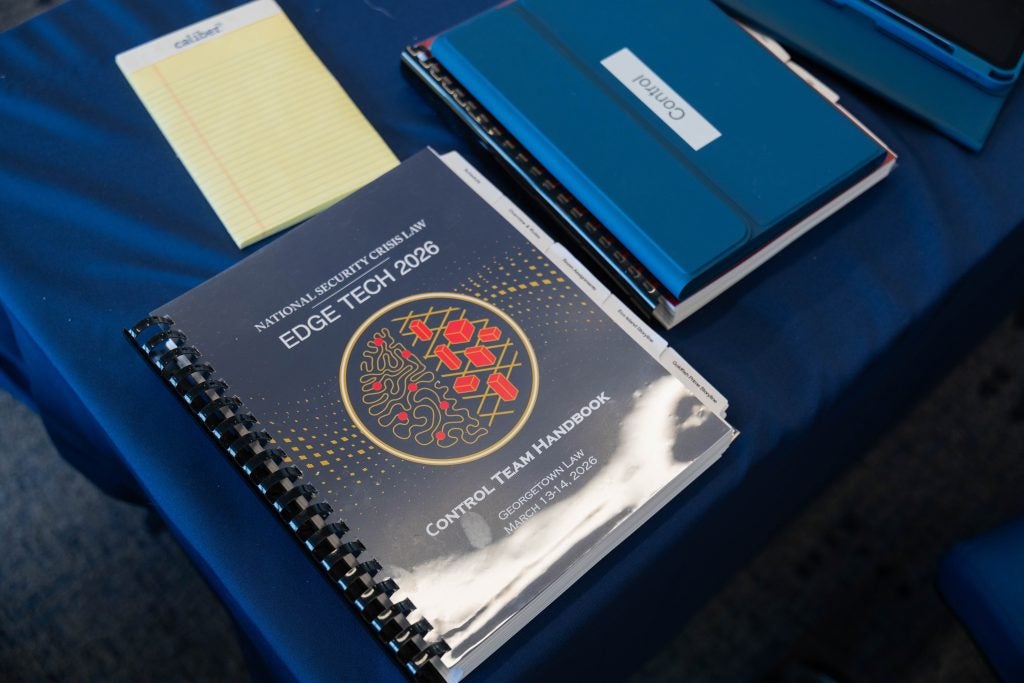
The control team handbook — a 421-page guide to the simulation — outlined the storylines and fictional threats that students faced over the course of the weekend, including foreign attacks on U.S. telecommunications infrastructure and growing domestic extremism.
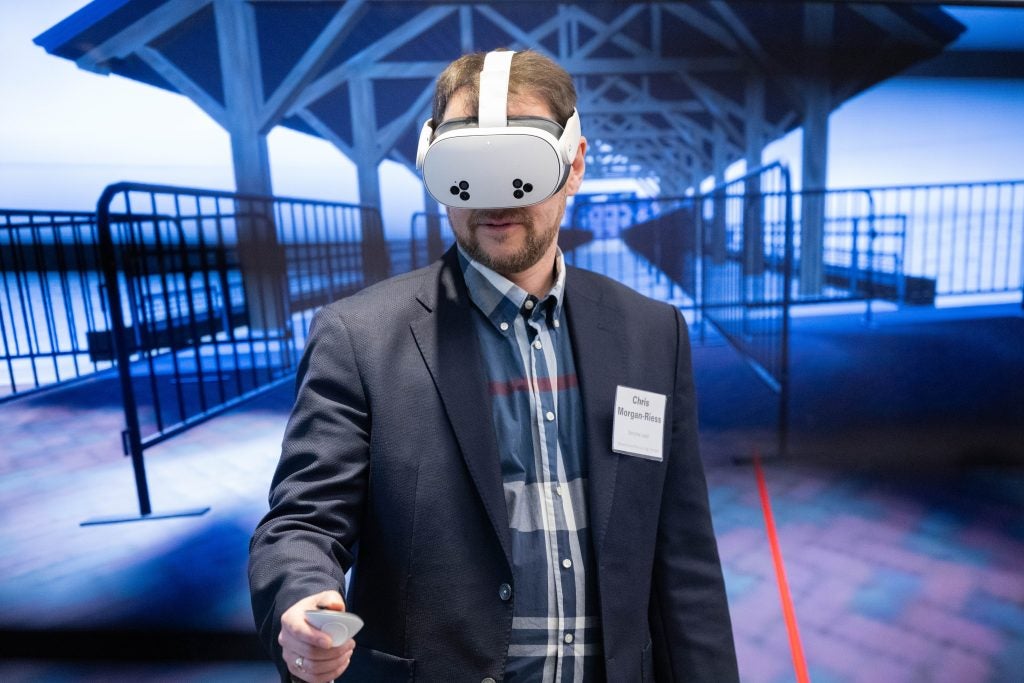
Students and control team members were encouraged to try out “Global Heroes,” a virtual reality video game central to one of the simulation storylines. The game was programmed for the Sim by CNS Research Assistants Diana Chantz, L’27, and Greg Hopp, L’25, with work beginning on it more than a year prior to the exercise.
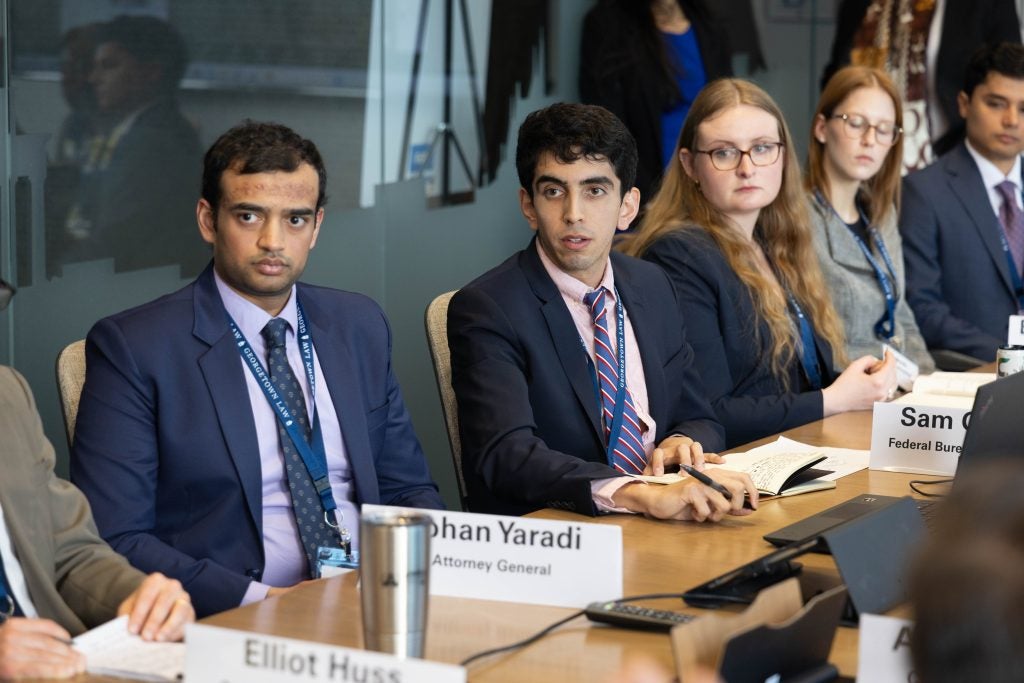
For Sam Guerrero (second from left), L’27, who played the role of FBI director, learning how to approach a media interview, brief senior government officials and participate in the inter-agency coordination process were among the highlights of the exercise. Another benefit? The chance to assess his strengths and weaknesses and receive feedback from the control team.
“I was drawn to the Sim because I felt that it would provide an opportunity to think hard and deep during what felt like a real-world situation,” he said. “Georgetown is located at the heart of our country’s national security apparatus and Georgetown Law’s expansive network in the national security law space allows me to learn from the best.”
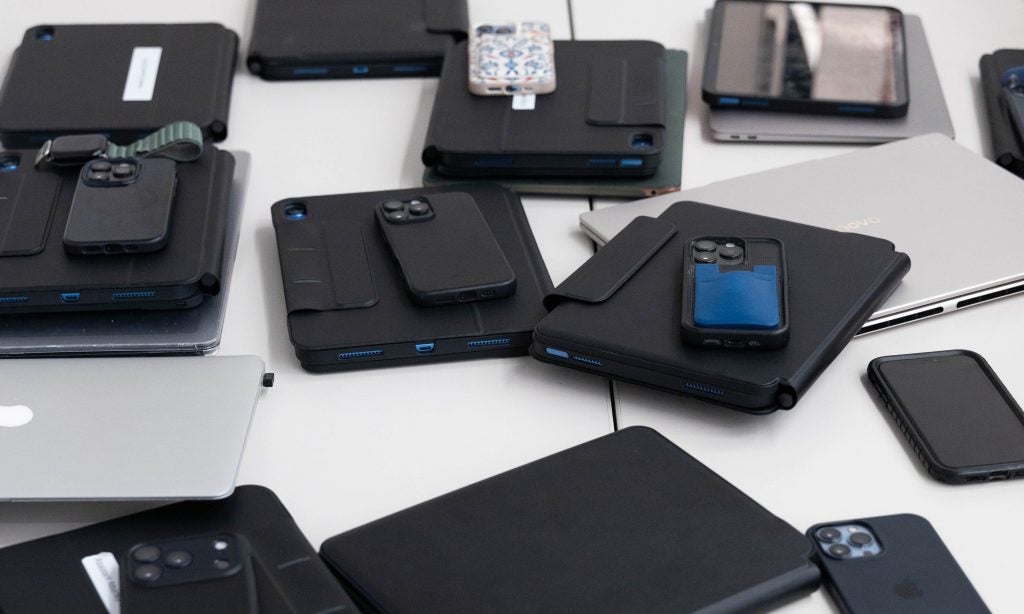
Throughout the weekend, students received information or “injects” in real time via simulation-specific email accounts and tablets (pictured above). Other sources of information included an AP Wire, a bespoke broadcast network called the Video News Network (VNN) and a forum website known as “Leddit.”
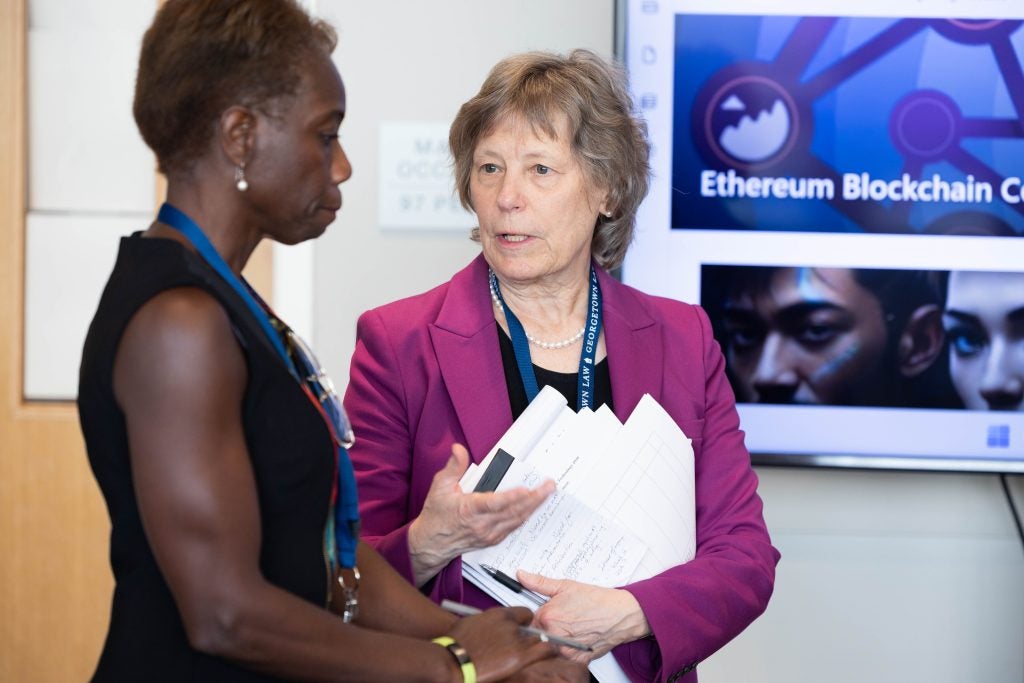
Student performance was assessed by a team of judges who provided detailed feedback to the students at the Sim’s closing reception. This year’s judges included Rosemary Hart (right), who has taken part in the Sim since its inception, and Nancy Fortenberry (left), L’10, who was a student in the Sim before becoming a judge.
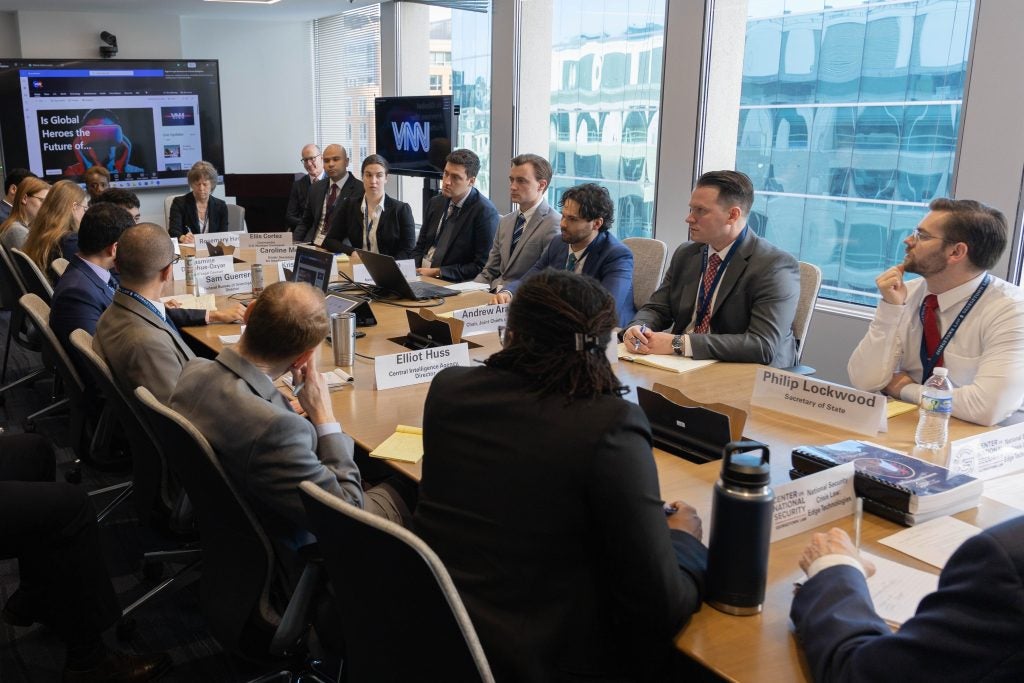
Above, members of the control team meet with students during a presidential briefing. Following the weekend intensive, students debriefed and discussed their performance with members of the control team — and celebrated their hard work at dinner on Saturday evening.
“Putting the Sim together takes a village,” Donohue reflected, underscoring the essential work of campus administrators, events staff and CNS team members in making the exercise possible. “I am grateful to everyone who gives their time to help make it come to fruition. What we do here can have a profound impact on the field. At the end of the day, it is not just important for our students, but for the future of U.S. national security.”