Expect the Unexpected: What Happens When Trade Laws are Upended?
June 3, 2026
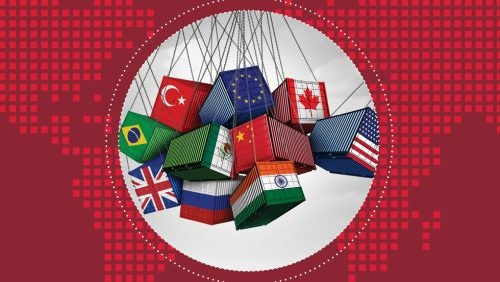
Since the second Trump administration took office in early 2025, trade law has been on a wild ride.
Decades-old norms and agreements have been cast aside, the administration has imposed tariffs left and right (stretching boundaries so far that the Supreme Court responded), while journalists and policymakers alike parse social media posts to decipher the administration’s next move.
Imagine what this must be like for a law professor whose carefully crafted syllabus explaining how the World Trade Organization (WTO) operates becomes obsolete overnight. Or for a trade lawyer fielding anxious calls from a client wanting to know whether to move ahead with plans with an overseas manufacturing partner. What about for an LL.M. student wondering what the job market will look like after graduation?
One of the best places to shed light on this tricky situation is right here at Georgetown Law: the Institute of International Economic Law (IIEL), which was founded in 1999 by Professor John H. Jackson, a giant in the field of international trade. IIEL continues to be a leading convenor in the space, and in March, a Law Center alumnus who is a prominent trade lawyer in Washington, D.C. joined two of IIEL’s three faculty co-directors and its executive director for a conversation about how they have experienced the volatility in trade law over the past year.
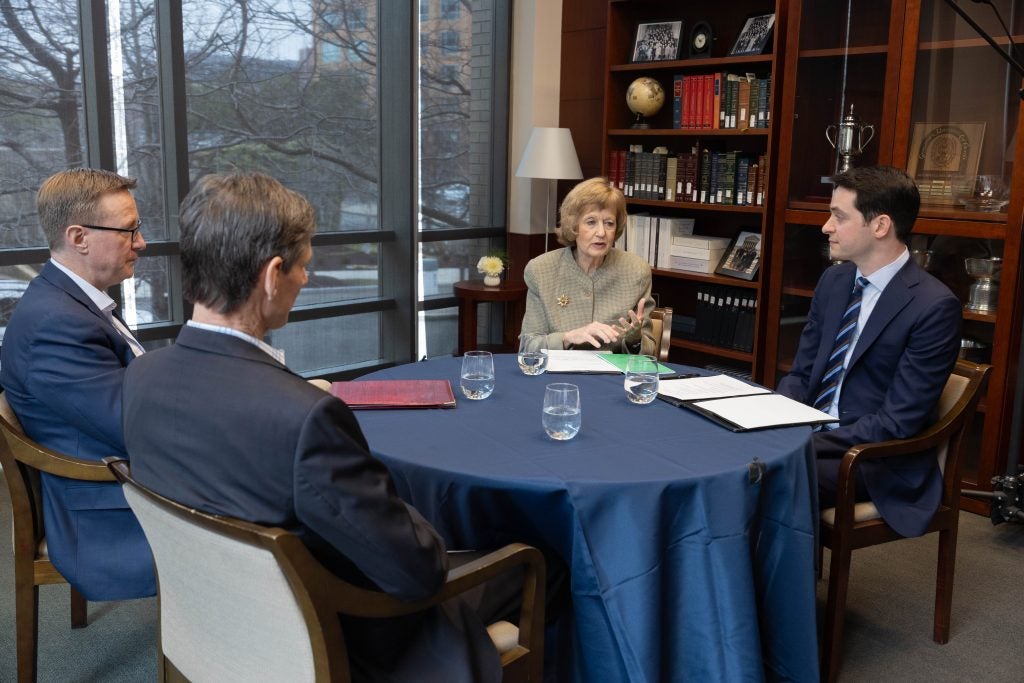
L-R: Panelists Orava, Schaffer, Hillman and Schuker met on the Georgetown Law campus in early March to discuss the current state of international trade law.
THE PANEL
Professor from Practice Jennifer A. Hillman, co-director of IIEL’s Center for Inclusive Trade and Development and the 2025-6 academic co-director of the Center for Transnational Legal Studies (CTLS) in London. Hillman has served as a member of the World Trade Organization’s Appellate Body, a commissioner at the United States International Trade Commission, and general counsel at the Office of the United States Trade Representative.
Scott K. Ginsburg Professor of International Law Gregory Shaffer, who joined the Georgetown Law faculty in 2023 after teaching law at the University of California, Irvine, the University of Minnesota, Loyola University Chicago and the University of Wisconsin. Shaffer is a past president of the American Society of International Law and the author of several books, most recently Rule of Law Under Pressure: A Transnational Challenge.
Stephen J. Orava, L’93, a partner at King & Spalding LLP, where he is chair of the firm’s International Trade practice and managing partner of its Brussels office.
MODERATOR: IIEL Executive Director Daniel Schuker, who has held senior roles at the White House, the Department of the Treasury and the Senate Judiciary Committee.
Schuker: Steve, what is your approach to advising clients now, when the rules are being rewritten in real time? I imagine they don’t want to hear, “No one really knows.”
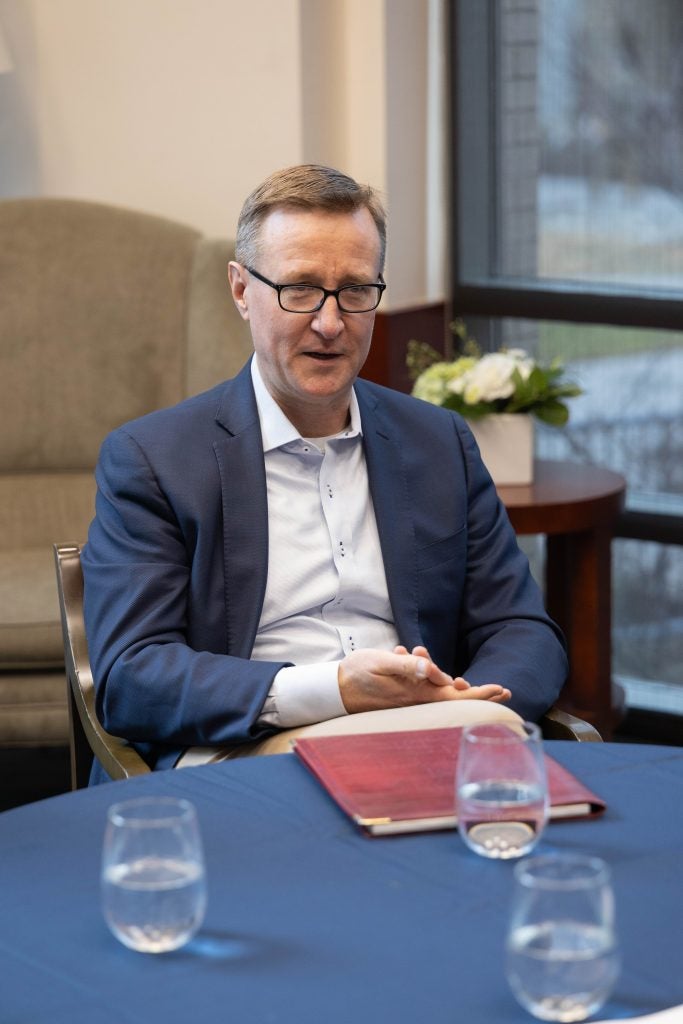
Stephen Orava, L’93
Orava: Initially I was playing the role of a psychiatrist more than a trade lawyer. The changes were so significant that a lot of the discussion we were having with boards and senior executives was: Let’s take this step by step.
We still do trade remedy, compliance, sanctions and export controls, but it is in hyperdrive in terms of the additional measures and statutes that are being used and this additional level of uncertainty. We did have a first Trump administration, so we could anticipate how some of this would play out, but day to day, there’s much more counseling work, discussing how to deal with the uncertainty, trying to help companies understand their priorities and the language that needs to be used to talk to this administration. And that is at a pace that we just haven’t seen before. It’s also incredibly intellectually challenging. It is a fun time to be a trade lawyer, but it’s exhausting.
Schuker: The challenge lately seems to be defining what the law is on Monday morning versus what it is on Monday afternoon. Jennifer and Greg, how are you adapting the way that you are teaching?
Hillman: We’ve had to change our teaching materials. We kind of threw our casebook out and went to an online e-book, in part because it can be updated quite regularly to bring in very different perspectives about why we trade.
Shaffer: We’re all trying to figure out where we are and where we’re going. I bring in current events every day to address using core analytics, for a grounding in how we think about these issues from a law and policy perspective.
Schuker: What do you think about the Supreme Court’s ruling in Learning Resources, Inc. v. Trump, the case regarding the president’s use of the International Economic Emergency Powers Act (IEEPA) to impose tariffs?
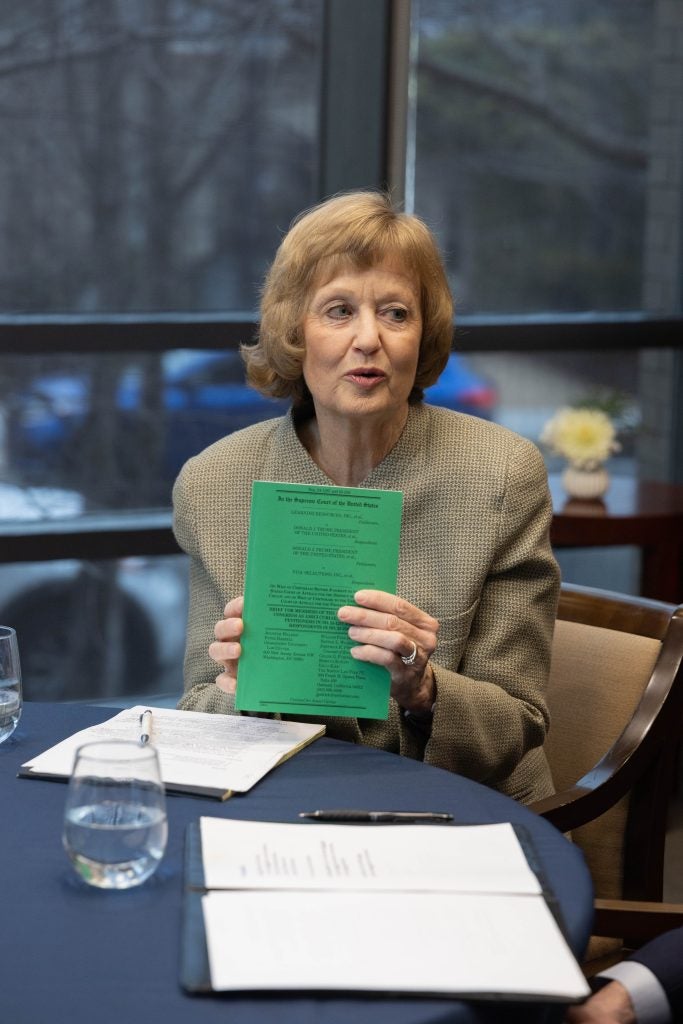
Prof. Jennifer Hillman with the Supreme Court amicus brief she worked on with Members of Congress
Hillman: Very early on last year, I heard that the administration might invoke IEEPA to impose tariffs. I had two international LL.M. students as research assistants who helped me write a piece for the IIEL website, basically saying, “No, IEEPA is not a tariff statute.” When the Supreme Court ultimately ruled that IEEPA can’t be used for tariffs, their opinion was almost exactly what we had argued in that piece that I’d debated with my students a year before.
One of the things that flowed out of that IEEPA piece was working with House and Senate members on a series of amicus briefs as this issue made its way through the courts, ultimately culminating in an amicus brief filed by 207 members of the House and Senate before the United States Supreme Court. Which is a testament to Georgetown Law, that members of Congress reached out to me and our colleague [IIEL Visiting Scholar] Peter Harrell to shape the intellectual underpinning behind these arguments. It was very fulfilling to see how much of the line of argument in this brief was in the Supreme Court’s opinion.
Orava: I have clients who welcomed the Supreme Court’s decision, because they’ll get some of their tariff revenue back. I have clients who are facing overcapacity in China or other issues, and the tariffs were keeping them in business, keeping their employees working. I’ve got folks who wanted to make significant investments, and now there is a significant lack of predictability as to whether the economics make sense. So while the Supreme Court provided some clarity on IEEPA, the president is going to pivot to other tools on his desk. It could generate a much more patchwork type of tariff regime, but tariffs are not going to go away.
Shaffer: What concerns me is the extent to which the administration can use other statutes to try to replicate what they did under IEEPA, which was ruled unlawful. What does that say about the rule of law, if the president can do whatever he wants with respect to tariff policy?
Schuker: How has scholarly work changed in the last decade, and where do you think the focus is heading?
Shaffer: When the WTO was thriving, there was a highly judicialized system putting forth lots of fascinating case law. And a lot of the scholarship addressed interpretive nuances in that case law. What you didn’t see was any scholarship, really, on national security. You see a lot more today regarding the U.S. and China, and about the whole world of e-commerce and data exchange. How do we think about that from a national security, human rights, privacy or development perspective? And because there’s so much going on domestically, U.S. scholarship has turned a little bit more internal. There are also fundamental concerns about how we think of the system going forward. How much discretion do we provide countries? Can we even have an international legal system, or is everything up for grabs?
Hillman: All of us taught for a long time from the perspective of the WTO, but it’s really clear now that so much of the focus is no longer on the WTO. A lot of the scholarship has had to focus on all of the action that’s occurring under regional trade agreements. That’s even where a lot of the dispute settlement is moving. You’re seeing a lot of the WTO focus shift to the clash between the United States and China, with the world saying, “What is happening to the WTO if the world’s two largest trading economies are fundamentally having a trade dispute outside of the WTO? Where does that leave us?” And you are seeing scholarship around what the WTO continues to do well, because there’s no question that the WTO is absolutely successful in a lot of things, particularly its transparency.
Schuker: Steve, how have the developments at the WTO affected your practice?
Orava: The bottom line is that clients come to us and ask, “How can you help us?” – whether that’s help us make more money or help us mitigate risk. And the toolkit has just changed. We turned ourselves into a bilateral and transactional world; whether that’s good or bad. It used to be that the WTO was effective – you could use it for leverage, you could use disputes tactically, strategically. That’s just not the case anymore. And now what our lawyers do every day is put together both the legal and factual case for the administration to do something or not, and the accompanying political strategy. The WTO is simply not part of that calculus at the moment.
Schuker: We’ve talked about uncertainty today. Steve, as you provide actionable guidance to clients, how have you handled the wave of policy announcements that have often come over social media instead of the traditional government channels?
Orava: We look at the social media posts as signaling. You cannot give advice based on social media posts. You cannot give any definitive direction about the scope of a measure without seeing it be implemented. You can’t give any advice about how tariffs will stack or not stack with other measures that are already in place. So all of this advice waits on actual implementation, and that includes proclamations, executive orders, Federal Register notices, customs guidance and everything in between, as well as a lot of phone calls to try to get some clarity.
We make clients aware of the posts – because what happens is, it gets reported in the press, a CEO reads the paper or sees it on their feed, and they immediately start asking questions. So we need to make them aware of that signaling, as well as give them confidence that we’re going to follow up with what the actual implementation looks like.
Schuker: What are you hearing from audiences outside the U.S. about how they’re thinking about trade, the WTO and the rules-based order?
Hillman: People overseas really just want to understand the objective of the administration’s trade policy. Is this all about raising revenue? Is this all about creating a huge tariff wall so that everything has to be built in the United States? Is this all about national security? I would say most of the rest of the world still believes in the WTO. So they’re trying to understand how they hold dear to what they believe in and at the same time, respond to a United States that no longer adheres to any of that, without being naively taken advantage of or undermining their own long-term interests.

Prof. Gregory Shaffer
Shaffer: I had a student ask, “Is globalization over?” No, globalization is thriving, particularly in Asia. There’s a lot of trade. People’s careers are invested in that, so that’s not going away. If you’re based in Singapore, Thailand, Taiwan, you’re focused on trade. If you’re based in the Netherlands, trade is still a central part of your economy. And so they’re navigating this world, trying to understand what the developments are in the United States, but trade remains quite central to their interests and economies.
Orava: I’m the managing partner of our Brussels office, so I spend a lot of time with the Europeans. And I think while there is, at least on the policy basis, still a belief in the WTO, industries in Europe are experiencing the same pressures, like Chinese overcapacity. There are challenges across the EU industrial base, and the EU is starting to pivot to saying, “Well, maybe we also need to do something that might not perfectly align with our WTO obligations.” Whether it’s made-in-Europe provisions or preferences in government procurement or trying to figure out a way to incentivize clean technologies or critical minerals – they are starting to move in a different direction because they’re seeing the erosion of their industrial base.
Shaffer: It puts Europe in an interesting challenge, because part of its DNA is that it’s a multilateral organization itself – its original purpose was to create a single market. So there’s a lot of pressure given its history, but also then the pressure within the member states who are then putting pressure on the European Commission to formulate policy going forward. It’s a fascinating time for Europe.
Schuker: What has surprised you most about the developments of the past year?
Hillman: I assumed that a core focus of our trade policy was going to be disputes with China. But what surprised me the most is that so far the winner by far of this trade war has been China.
Shaffer: I hadn’t thought through the amount of uncertainty that would come from using tariffs as the weapon of choice with respect to everything. I also thought that Europe would stand up to the administration, as it did in the first one. I think the core difference was the war in Ukraine. Europe prioritized that, and basically accepted higher tariffs applied by the United States in violation of WTO rules without retaliating, and made other commitments.
Schuker: If a student or a junior associate told you today, “I want to be the next great trade lawyer,” what skills and areas of knowledge should they focus on?
Shaffer: Law changes every day, right? And so if you’re just trying to understand what the newest thing of the day is, that’s not going to help you in terms of your core analytics, in terms of being able to deal with facts and make the best arguments that you can.
Hillman: You need to be very aware, when a problem is presented to you, of thinking through whether this is a problem that you litigate, mediate in some other way or lobby about, thinking about all of the tools in your toolkit.
There are arguably more tools now, in the sense that you’re not as bound, at least in the United States, by international obligations as we used to believe. And you do need to have a basic understanding of the economics of trade. I would not recommend anybody go into trade remedies if they’re really mathphobic or statisticsphobic. So you do need to understand the interplay between the policy, the politics, the economics and the law – and that I don’t think has really changed – but obviously, you need to be able to use all of the modern tools, from AI on down.
Orava: First and foremost, they need to be a good lawyer and they need to write well. The rest can be taught or learned through experience. Unfortunately, we don’t get to write briefs to the Supreme Court most of the time. What we do is collect facts and data and put them into an advocacy piece. So having the ability to understand economics and politics, be able to manipulate data and build it all into an analytical piece to effectively advocate for positions. That’s what we want.
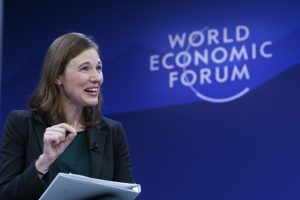
Prof. Kathleen Claussen was a panelist at the 2026 World Economic Forum in Davos, Switzerland
Professor Kathleen Claussen, IIEL’s third co-faculty director, has also stayed busy over the past year-plus, speaking, writing and teaching about the changing landscape of international trade. In January, she was a panelist at the World Economic Forum in Davos, Switzerland, discussing “Governments as Economic Super Actors.” She is a co-author on two forthcoming legal journal articles, “The ‘America First Trade Policy’ in Practice” in American Journal of International Law and “The Foreign Commerce Power” in California Law Review. She has also written a series of “What Just Happened” columns for the website Just Security explaining various tariff advances and setbacks. Claussen’s pre-academia work included serving as legal counsel at the Permanent Court of Arbitration in The Hague and as an associate general counsel at the Office of the U.S. Trade Representative.
Bonus Content! This article is the cover story for the Spring 2026 issue of Georgetown Law Magazine. It was adapted from a roundtable discussion held on the Georgetown Law campus earlier this spring. To go deeper, watch this video of the entire conversation: