Chief Judge James E. Boasberg Addresses ‘The Georgetown Law Journal’ Banquet
August 28, 2026
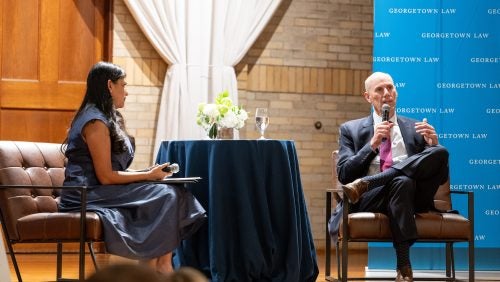
'The Georgetown Law Journal' Editor-in-Chief Amritha K. Ramalingam, F’23, L’26, left, with the Hon. James E. Boasberg, right.
It’s been a Georgetown Law tradition since 2013: at the end of each academic year, editors of the school’s flagship legal journal come together with their alumni predecessors for a festive dinner and an address by a prominent figure in the legal world. On May 5, the banquet’s featured guest was the Hon. James E. Boasberg, chief judge of the United States District Court for the District of Columbia.
More than 160 people – current members of The Georgetown Law Journal (GLJ) editorial board, alumni and friends – gathered at St. Francis Hall in northeast Washington, D.C. to hear Boasberg reflect on his career trajectory and the polarized political context he and his colleagues work in today. In conversation with outgoing Editor-in-Chief Amritha K. Ramalingam, F’23, L’26, Boasberg spoke both to the future lawyers in the room and to those who’ve already been practicing for years or decades.
“Particularly these days, I want you all to think very carefully about the place you go to work – is that a place that you are proud to be working for?” he said. “If you’re standing up, representing [an] entity, furthering its goals – that you don’t agree to, and in fact may be antithetical to your values – then you have to ask yourself, ‘Are you in the right place?’”
Boasberg began his time on stage talking about the example of his father, also a lawyer, who moved their family to Washington, D.C. in 1964 to work under Sargent Shriver, who as director of the Office of Economic Opportunity led President Lyndon Johnson’s “War on Poverty,” an initiative that launched many educational and job training programs intended to address the root causes of economic inequality. “It was inspiring to me… truly seeing the idea and the image that law could be a force for good,” he said of the origins of his own interest in a career in public service.
The judge offered plenty of sound career advice, such as to be proactive in seeking out mentors (“They’re not going to come to the library where you’re studying and tap you on the shoulder and ask if they can mentor you,” he quipped) and to prioritize opportunities to try something unexpected but interesting (in his case, taking a clerkship with Dorothy Wright Nelson on the U.S. Court of Appeals for the Ninth Circuit in part because he’d have the chance to live in Pasadena, Calif. for a year). He also shared how difficult it can be to sentence a defendant and the ways he has developed a collaborative approach to working with his clerks.
Being careful to steer clear of political rhetoric, he also talked about the challenging environment for himself and other judges, and about how he hopes the legal community will respond.
“We federal judges, particularly in D.C., have been on the front lines of a lot of controversy… There’s a lot of noise out there from a lot of different quarters and a lot of different people. But I think we’re all – whether we were appointed by Republican presidents or Democratic presidents, or what our political views are – we’re just trying to plow forward and keep doing our job,” he said. “When you’re out as a lawyer, practicing, you need to speak up for things that matter to you and that you believe in, and I hope those will include the independence of the judiciary and the rule of law. We [judges] can’t really defend ourselves, we can’t give press conferences, we don’t talk about the reasoning of our cases – and we depend on people like you.”
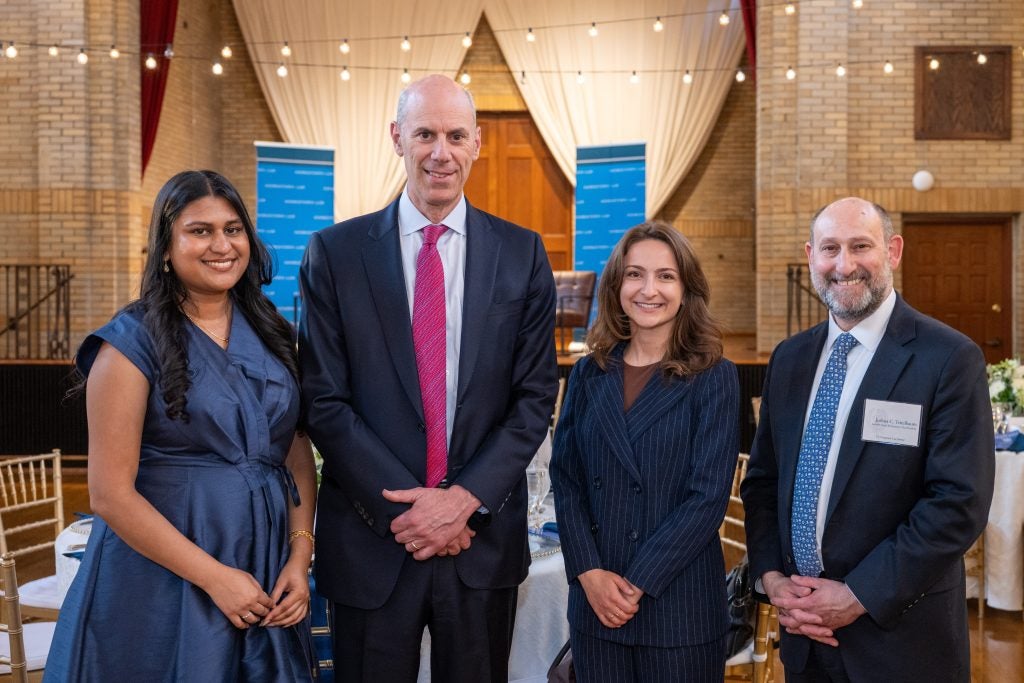
L-R: Ramalingam, Boasberg, incoming GLJ Editor-in Chief Maria McNiece, L’27, Interim Dean Joshua C. Teitelbaum
Journal Highlights
In addition to the conversation with Boasberg, the evening’s program also included remarks from the outgoing and incoming GLJ editors-in-chief, who brought the alumni up to date on current activities and priorities for the editorial boards.
Ramalingam, who will soon join Latham & Watkins in their Washington, D.C. office, expressed her appreciation both for her editorial team’s contributions and for the professors who submit work for publication (including Georgetown Law professors Michele Goodwin and Anupam Chander, both of whom attended the banquet). She mentioned also the growing body of content published exclusively on GLJ Online, the production of the key resource publication The Annual Review of Criminal Procedure and the October symposium the Journal held on the state of the labor movement.
“Thanks to [them], our mission to elevate scholarship that allows critical thinking on the most pressing issues of today is not just a statement I get to say at events like this, but an action that guides the spirit of our journal,” she said.
The Journal’s new Editor-in-Chief, Maria McNiece, L’27, also took the podium to preview some of the pieces that will be published in the year ahead. “It is both an honor and a privilege to help shape the work that finds its way into briefs, opinions and future scholarship, and to lead a team that does that work with such care. This is what The Georgetown Law Journal has done for more than a century, and it is what Volume 115 is committed to carry forward,” she said.
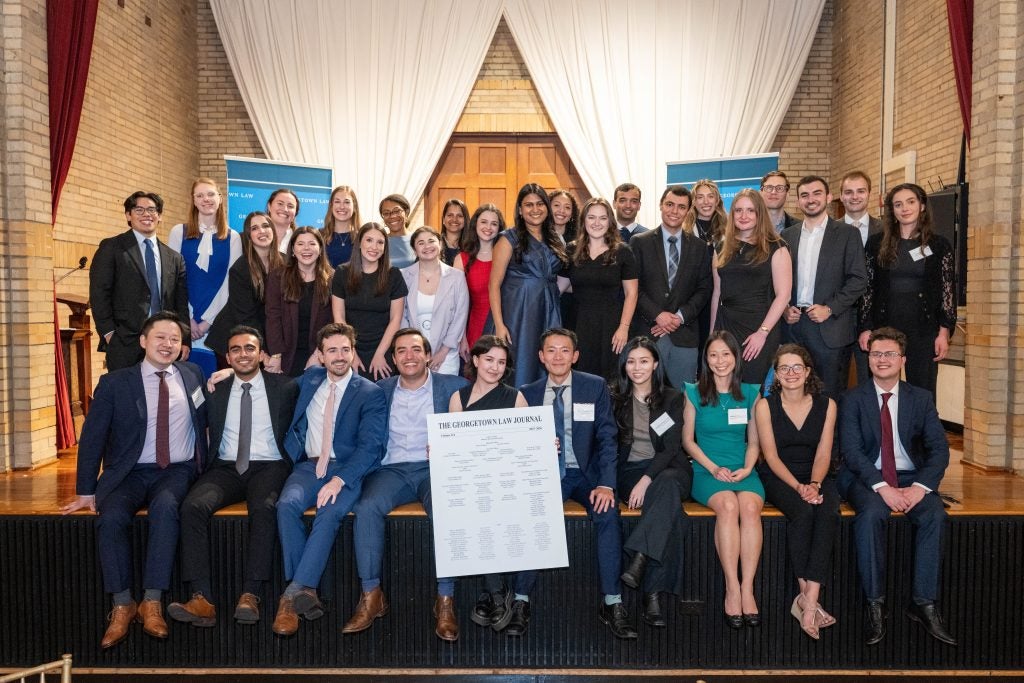
Editors of the 114th volume of The Georgetown Law Journal