Making Them Whole: Georgetown Law’s Newest Clinic Represents Workers
December 5, 2025

Professor Llezlie Green and students in the Georgetown Law Civil Justice Clinic
For five years, "John" worked at a trade association, and all seemed to be fine with his bosses. But in the fall of 2024, he was fired.
This came after he’d had trouble renewing his access badge for a building with enhanced security measures. Something had fallen through with the paperwork he needed from the police. As he tried to resolve matters, the complications snowballed until he was let go. Then his application for unemployment benefits was denied because his employer listed “gross misconduct” as the reason for his firing, which John didn’t think was fair.
John sought help appealing the denial of benefits and eventually found the Civil Justice Clinic at Georgetown Law. Anna Rose Aubrey, L’25, and Jimmy Starke, L’25, both 3Ls and students in the clinic, got to work, conducting multiple interviews, tracking down documents, researching and writing their arguments, all under the supervision of a clinical fellow. Soon, the clinic team and John sat in the clinic’s offices in McDonough Hall for the phone-in trial before an administrative judge. Aubrey and her partner presented their opening statement, took testimony from their witnesses, cross-examined the opposing side, and made their closing arguments.
“It was such an adrenaline rush. We were passing notes to each other and to our clients, calling up facts and rebuttals in real time,” Aubrey recalls. “The responsibility is on you and your team. These are very high stakes. These are real people. It was a very different feeling for me from anything else that I’ve experienced in law school.”
A Proud Tradition
The Civil Justice Clinic is Georgetown Law’s newest clinic, joining a movement that began in the early 1970s, when the Law Center became one of the nation’s first schools to create opportunities for students to gain practical experience representing real clients. Several early clinics, such as the Juvenile Justice Clinic, founded in 1973, are as active as ever, and over the years, the clinical program has grown to 17 clinics, tackling a broad spectrum of legal fields: environmental law, appellate litigation, nonprofit and corporate law, criminal cases and more. Georgetown Law regularly tops various clinical program rankings, a point of pride for Hoya Lawyas everywhere.
More than 300 students are enrolled in clinics every year, each earning 10-12 credits. For many students, the hours required are equivalent to a full-time job, and most minimize their other classroom and activity commitments while in a clinic. Students practice under the supervision of their faculty under the D.C. Court of Appeals’ Rule 48, which permits students to practice law under faculty supervision.
Launched by Professor Llezlie Green in the spring of 2024 with six students and a graduate fellow, the Civil Justice Clinic has hit the ground running and now has 12 students and two fellows each semester. Green ran a similar clinic at American University Law School for 13 years, and brought a blueprint that had already been pressure-tested and honed by students across town at another school with top-rated clinics. “I was already licensed to practice in the courts here, and had relationships with potential client referral sources – that part wasn’t quite as challenging as it might be if you were basically building something completely from scratch,” she says. The biggest difference she’s found in her new academic home is the amount of time her students are able to devote to their clinic work, given the high credit load. “Georgetown students, as a general matter, work very hard and have a strong work ethic. It’s lovely to see that translate into representation of their clients,” she says.
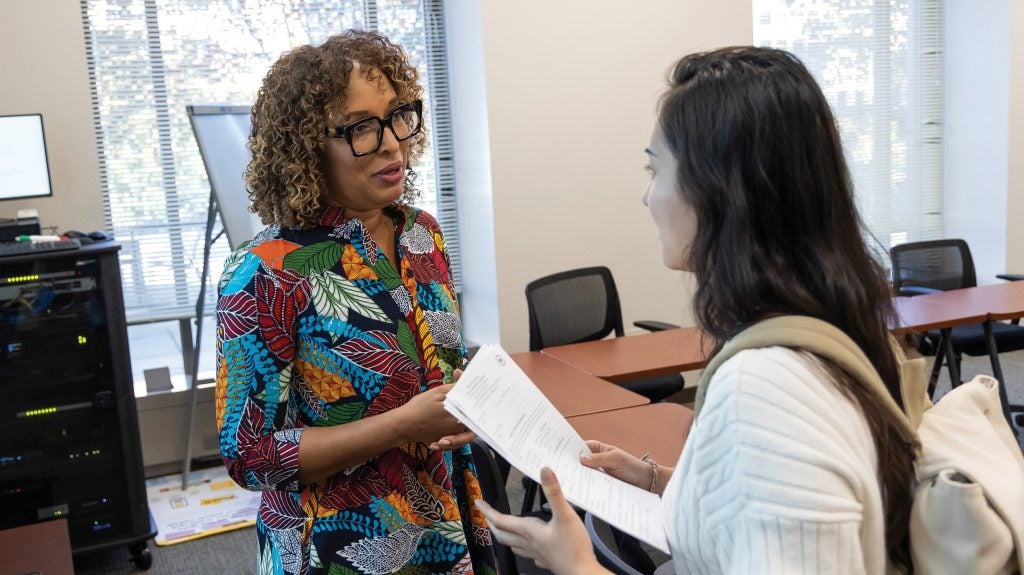
Prof. Llezlie Green speaking with a student
The clinic’s clients are typically low-wage earners such as domestic workers, construction workers, restaurant employees and home health aides who have experienced what Green calls “workplace indignities,” usually wage theft (an employer’s failure to pay wages or benefits to which a worker is legally entitled). This is a problem affecting millions of workers nationwide: A recent report by the Economic Policy Institute found that between 2021 and 2023, federal, state and local efforts to combat wage theft recovered more than $1.5 billion. The clinic also represents workers such as “John” who have been unfairly denied unemployment benefits and have the right to appeal.
Most students work on both kinds of cases during their time in the clinic, in large part because of the differing timelines for each. A typical wage theft case can take a year or more to complete because of the intense documentation required, the vagaries of court schedules and other factors. So the clinic’s wage theft cases are usually passed along between semesters, with each student pair advancing it as far as they can. On the other hand, resolving an unemployment benefits appeal can be done within weeks, so students are able to handle those from start to finish during their semester.
For those students who do get to see a wage theft client prevail, the results can be quite exciting, since Washington, D.C. awards plaintiffs four times their lost income, plus lawyers’ fees. The clinic’s biggest win to date involved a client who worked as a driver and whose employer treated him as a contractor, paying him “under the table” in cash. However, given his hours and the other conditions he worked under, the driver legally should have been classified as an employee, had missed out on years of overtime pay and had not even been paid the minimum wage. After more than a year of student-led effort, he was awarded a six-figure judgment. (Efforts to get all that money in the client’s bank account are still ongoing – but that’s another story, and another important lesson for students about real-life lawyering).
The Civil Justice Clinic’s arrival at Georgetown strengthens the clinical program’s efforts to serve and make a real difference for its neighbors. Other clinics that provide legal services to individual Washingtonians include the Domestic Violence Clinic, the Social Enterprise & Nonprofit Law Clinic and the Health Justice Alliance. “We are here in the nation’s capital, where you can engage with policymakers and Congress is two blocks away,” says Assistant Dean for Clinical Programs Patrick Griffith. “But D.C. is also a community, and we’re super committed to being a part of not only the national conversation, but the local conversation. Llezlie’s clinic is especially embedded in that local community in a way that I think is really exciting for students and for us as a program.”
While this particular clinic’s students will master the intricacies of the District’s wage and hour statutes and unemployment benefits law, Green ensures that students are also mastering the same skills that students across all Georgetown clinics are taught and that can be broadly applied to many fields of legal practice: the ability to interview and counsel a client, to develop a theory of a case, investigate, negotiate settlements and litigate before a judge or tribunal. The clinic includes a four-hour weekly seminar, where students learn about interviewing, narrative theory, case theory, fact investigation, counseling and negotiations. In case rounds each week, they present their cases and challenges to their classmates, crowdsourcing solutions and learning to collaborate as a larger group. “Law school tends to be a place where students don’t want to admit not knowing something,” Green says. “In clinic, it’s critically important that they’re honest about that so that we can work through this in the representation of their clients. We talk about creating ‘brave spaces’ instead of ‘safe spaces.’ Safe spaces tend to reinforce the idea that you should never be uncomfortable, but more learning happens when we lean into a bit of discomfort.”
Bennett Cho-Smith, L’24, and his clinic partner represented a bartender who didn’t receive all the tips he had earned. When he complained, the bar fired him. Describing how he and his classmates approached each case, Cho-Smith says, “We would meet with the client to try to understand their story and ask follow-up questions that would enable us to do some discovery on our end. We are trying to figure out: Who are these businesses that the client alleges have harmed them? Has the business been involved in litigation before?” Students develop rapport with their assigned clients, building toward sending demand letters to potential defendants. Some clients had had negative experiences with the judicial system, says Cho-Smith, and felt that they couldn’t trust it. “They had gone to people in positions of power and legal authority who wouldn’t give them the time of day,” he says.
Even when the process does not turn out well, crucial lessons are learned, says Bryce Kelety, L’24. “One case we worked on involved a genuinely inspirational, kind and hardworking client who had kept good records of their owed wages, but whom we were not able to help because the employer simply would not respond to our communications…Being unable to help despite our effort hurt.” (This client is now working with another set of clinic students – an example of how wage theft cases can take more than a semester or two to resolve.)
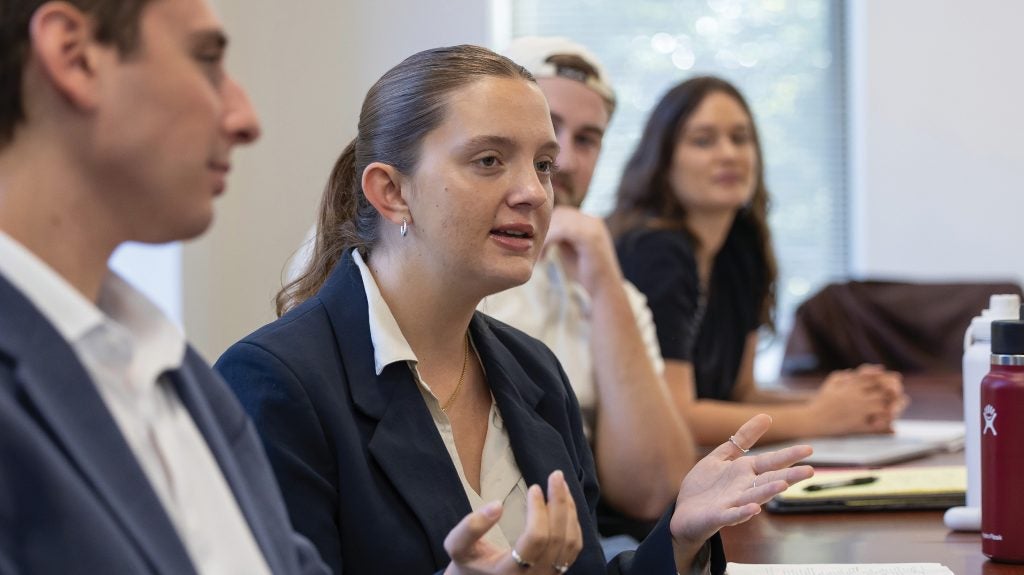
An important part of clinic work is weekly opportunities to discuss challenges and progress with classmates and professors.
Green agrees that students appreciate the gravity of their roles. “What is critically important and transformational about students’ clinic experiences is taking on the weight of what it means to be counsel,” says Green. “The students are the primary attorneys. They’re the ones who are ultimately guiding the clients through making decisions. And there is a certain weight that comes with that, particularly when you’re representing indigent clients or exploited workers.”
In the clinic, students are not only considering what kind of law to practice, but what kind of lawyer to be, says Green. They are thinking about whether they’re more comfortable in adversarial or more collaborative spaces. They also imagine their professional identity and an attorney’s obligations to think about justice. If they’re not already planning a career in public interest law, they might weigh engaging in pro bono work in the future. “I’m always in favor of the things that we do that position students to be happier lawyers. And it’s a privilege to guide them through making choices now that help them to find more fulfillment, satisfaction and joy in their work in the future,” says Green.
Beyond the technicalities of employment law, the Civil Justice Clinic’s students also gained a greater understanding of the challenges facing low wage workers and employment justice. “How are relationships between workers and employers affected by the absence of safety nets? What do workplaces actually look like when people are being paid under the table in cash?” says Green. “Most of us don’t take a lot of time to think about the bigger picture and what’s actually happening, the pervasiveness of wage theft in our communities.”
Green knows there will be a steady need for the program. “As vulnerable populations continue to experience challenges in society, we’ll see more opportunities or more interest from students also in becoming more engaged with that individual representation,” she says. “There really is dignity and value associated with what we do. Putting in a hard day’s work and being compensated for that work properly — when that doesn’t occur it is more than just an economic harm. These aren’t just broken contracts,” she says.
Takeaways for Students and Their Clients
Aubrey, who is now an antitrust associate at a law firm in Washington, D.C., appreciates the experience she gained from representing John in his unemployment appeal. “That was the experience that I was really looking for, because it’s very hard to get that in law school. Being able to say, ‘I have actually cross-examined a witness, and I have done a closing statement,’ speaks to your experience in being able to respond to dynamic situations. Being able to think on your feet – especially if you’re doing litigation – is one of the most important skills that you can develop.”
Additionally, students cite the human connection created in the clinic space. “In the U.S., work can feel like your identity. To the clients, it feels so personal and so big,” says Aubrey. “The folks who came to our clinic were so appreciative,” says Cho-Smith. “Even if we weren’t able to accomplish any concrete objectives for them, the exercise of reinforcing their faith in the system was powerful. That will always stick with me.”
Cho-Smith currently works in securities fraud litigation; a practice where direct client interaction is less common. But he says he’s looking for future pro bono opportunities, so that he can continue to have the one-on-one client interaction he experienced. “That really helped me understand the power of legal education, helping people have their stories heard and trying to get them some kind of legal recourse in a way that they absolutely deserve,” he says.
Kelety now works at the Office of the Attorney General for the District of Columbia in the Workers’ Rights and Antifraud Section, a job that “involves handling the same kind of wage theft cases I worked on at the Civil Justice Clinic, just on behalf of more workers and with more tools at our disposal to get workers relief and employers in compliance,” he says. “While I miss building the individual connections we had with our clients, each time I interview workers here I use the skills in interviewing and trust-building that I developed working for the clinic.”
Even though Kelety and his clinic partner weren’t able to resolve one client’s unemployment claim, they prevailed in another. “Our case ended up before an administrative law judge. We sat, nervously, waiting for the opposing party’s attorneys to appear. When the judge announced that they had not appeared, we walked the judge through a carefully-crafted oral argument and our client answered the judge’s factual questions. A few days later, we received a judgment in our favor — our client would receive the benefits they needed to get back on their feet and find their next job.”
Not long after that stressful conference call hearing, Aubrey found out that “John” had his unemployment benefits reinstated. “That was the best winter break gift I could have gotten. It was a great turnaround,” she says. “You put all this work in, and it worked.”
For the bartender, Cho-Smith and his partner conducted the initial investigation and drafted a demand letter. Later, students filed a complaint that is currently pending in D.C. Superior Court. But even without a clear win, he left the clinic with a greater understanding. As he says, “There’s nothing more central than getting paid for the work that you do.”
This article is the cover story for the Fall 2025 issue of Georgetown Law Magazine.
Author Eliza McGraw is a writer based in Washington, D.C. She has written five books, most recently Here Comes Exterminator!, about the 1918 Kentucky Derby winner. Her work has appeared in many publications, including the New York Times, Smithsonian.com, Atlas Obscura and the Washington Post.
For more on students’ experiences in Georgetown Law clinics, watch the video below and read other recent articles featuring clinics.