Youth Advocates, Legal Experts Call for Climate Justice at 2026 Samuel Dash Conference on Human Rights
April 7, 2026
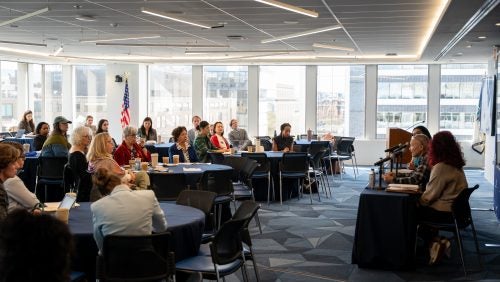
At the 2026 Samuel Dash Conference, both the panels and audience included climate advocates of all ages, coming together to discuss the future of environmental law and policy. Photo: Alijah Jones
With an eye toward identifying the advocates and strategies that will guide the next generation of climate justice work, on March 31, Georgetown Law’s Human Rights Institute (HRI) convened “Futures at Stake: Climate Change, Human Rights, and Youth Advocacy,” the 2026 Samuel Dash Conference on Human Rights.
Building on the 2025 advisory opinion of the International Court of Justice affirming that environmental protection is a precondition to the full enjoyment of human rights, the day-long convening included a series of panel discussions featuring Indigenous and youth activists who shared the impact of climate change on their communities, legal experts who examined recent landmark international advisory opinions and their significance for states’ human rights obligations, and advocates who outlined creative pathways for climate action in the United States.
“Climate change is intimately linked with human rights because of its effects on not just the environment, but on our well-being and ultimately our survival,” said HRI Executive Director Elisa Massimino in her opening remarks. “Young people everywhere are increasingly organized to lead the charge in challenging governments, corporations and all of us to reject complacency and build a brighter future.”
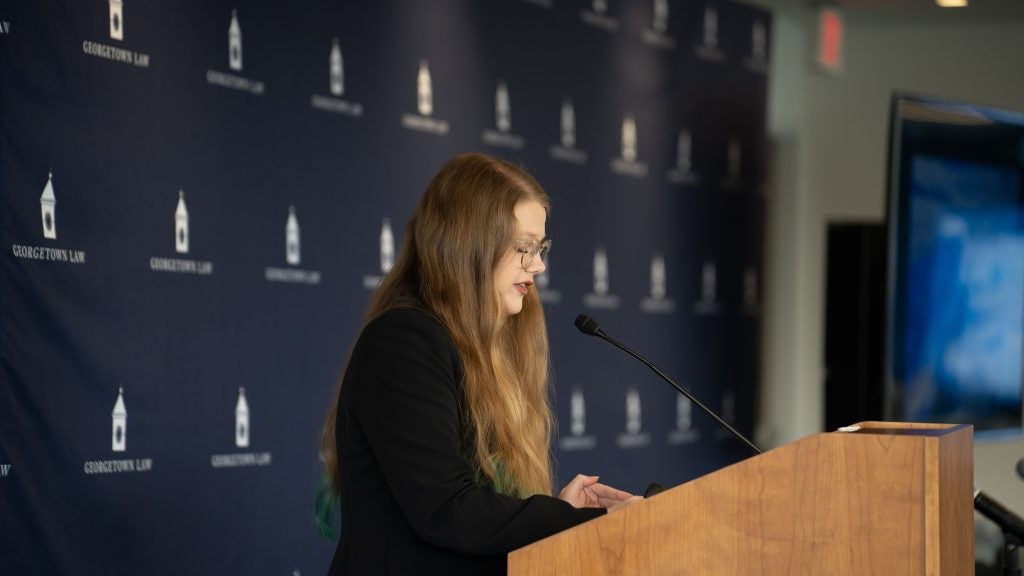
Delaney Reynolds, who has been an environmental activist since childhood and is now a lawyer and Ph.D. candidate, presented the day’s keynote address. Photo: Alijah Jones
Among the youth activists in attendance was keynote speaker Delaney Reynolds, a lawyer and Ph.D. candidate at the University of Miami whose environmental activism was sparked by her love of ecology (Reynolds wrote and illustrated three children’s books on environmental topics while in elementary and middle school) and witnessing climate change impacts such as sea level rise in her home state of Florida, which led her to found the nonprofit Sink or Swim Project as a teenager in 2014.
“We are inheriting a world shaped by decisions made long before we were old enough to vote, let alone hold office. But we are not powerless in the face of those decisions,” said Reynolds of herself and her fellow young climate activists in her remarks. “Through the courts and the law, we can and must challenge policies that jeopardize the future.”
One of 22 youth plaintiffs currently suing the Trump administration in Lighthiser v. Trump, which challenges three executive orders concerning fossil fuels, renewable energy and climate science, Reynolds underscored the role of the judiciary as a vehicle for change and the work of youth activists across the country in demanding climate justice in the courts and beyond.
“Despite the failure of our legislative and executive branches, the judicial branch thankfully affords us a way to demand accountability and to affirm that young people have rights that must be protected,” she said. “The very existence of our judiciary should give each of us hope.”
The event’s other speakers included Professor Emerita Edith Brown Weiss, a longtime leader in the field of environmental law, and Liberian climate advocate Alfred Brownell, who recently spent a year at Georgetown Law as the 2024-25 Drinan Chair in Human Rights.
The Samuel Dash Conference on Human Rights is convened annually by HRI in honor of former Law Center Professor Samuel Dash, a human rights champion who died in 2004. This year’s conference topic grew out of HRI’s 2025-26 Human Rights Advocacy in Action Practicum “Children’s Right to a Healthy Climate,” offered in partnership with nonprofit public interest law firm Our Children’s Trust.
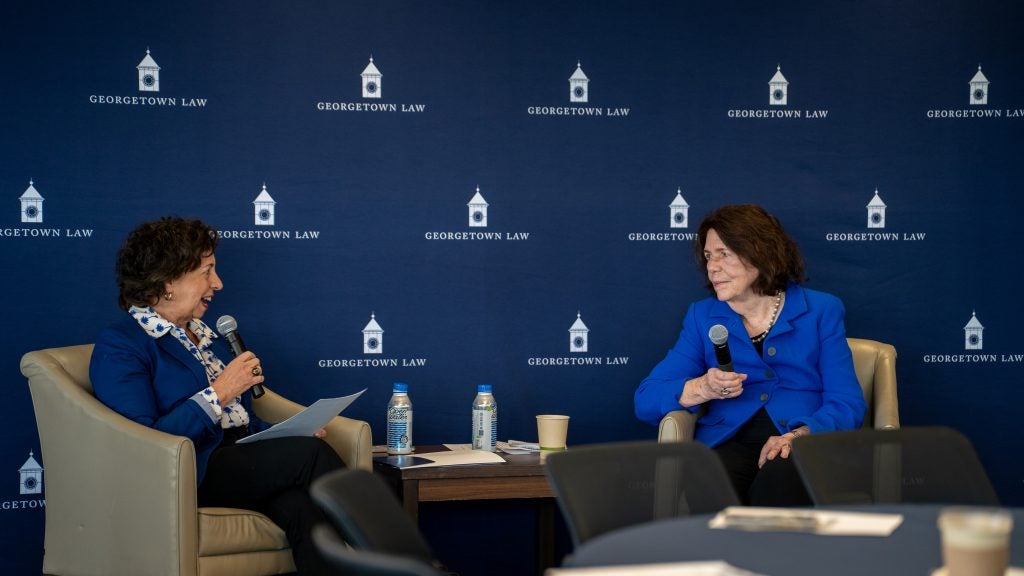
HRI Executive Director Elisa Massimino (left) and Georgetown Law Professor Emerita Edith Brown Weiss (right). Photo: Alijah Jones