Georgetown Law’s Juvenile Justice Clinic Celebrates 50th Anniversary
June 4, 2024
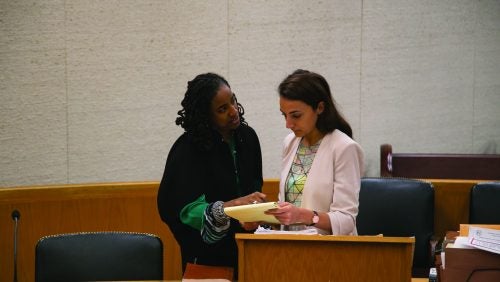
Juvenile Justice Clinic Director Professor Kristin Henning, L'87, advising student Deena Dulgerian, L'17, before a 2016 court hearing.
On June 1, Georgetown Law hosted a festive celebration honoring the 50th anniversary of its Juvenile Justice Clinic. The Clinic was not only one of the first at the Law Center, but has also been a pioneer in clinical legal education in the United States since its founding, and has continued to innovate and grow through the decades. This feature article from the latest issue of Georgetown Law Magazine tells the story of its founding and impact.
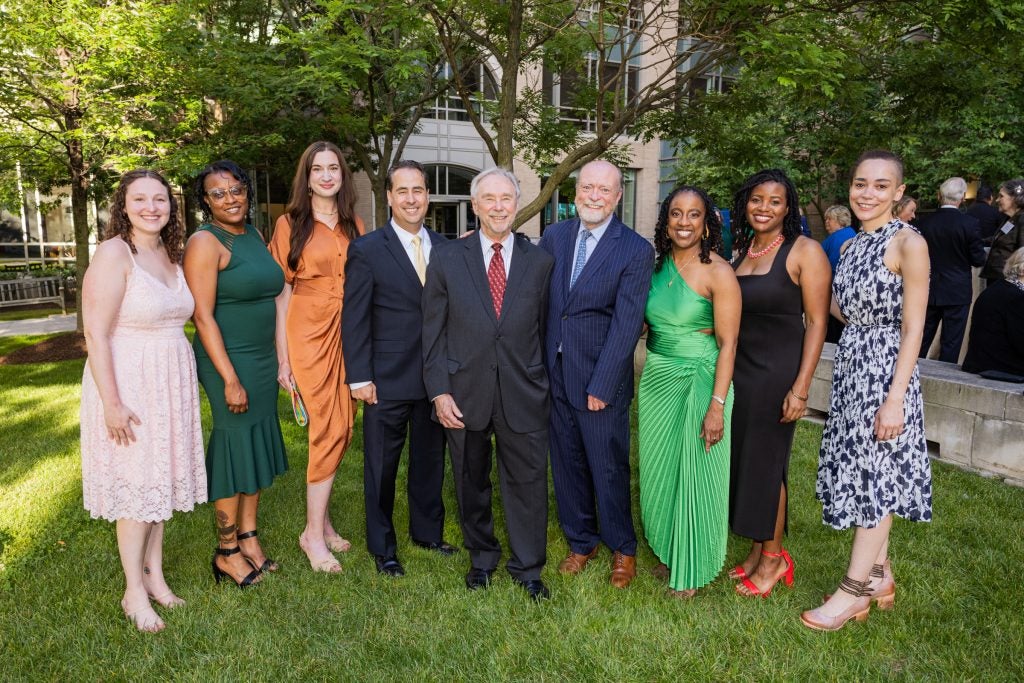
The current Juvenile Justice Clinic and Initiative team at the 50th anniversary celebration. L-R: Prettyman fellow Kelsey Robinson, Program Specialist Katrecia Banks, Senior Staff Attorney Rebba Omer, Policy Director Eduardo Ferrer, Senior Counsel Wallace Mlyniec, Dean William M. Treanor, Director Kristin Henning, Racial Justice & Youth Defense Fellow Alina Tulloch, Prettyman Fellow Eloisa Cleveland. Photo: Elman Studio
Even after all these years, Mary Lupo, L’74, still sounds astonished as she recalls her very first delinquency case as the very first student in Georgetown Law’s Juvenile Justice Clinic, back in 1973. “He was a little shrimp, about 11,” says Lupo. The boy was locked up when she met him, awaiting his turn before a judge, facing charges of trespassing. He had been caught sneaking into a local school where he wasn’t enrolled, hoping to get one of the free breakfasts they handed out. “I mean, this is a crime?” says Lupo.
“I convinced the judge he didn’t not need to be locked up for that ‘horrific crime’ while he was waiting for his trial,” Lupo says. The boy was released, and eventually the charges were dropped. Lupo went on to work in the Florida State Attorney’s Office juvenile division, where she helped set up programs to better serve abused and neglected kids and their parents, and later became the first female judge in Palm Beach County. “The training, the excitement, the energy and the care that I learned at the Clinic, I brought that to Florida with me,” says Lupo, who retired in 2004. “Putting my hard work aside, I give it all the credit for my career. How to prepare a case, massage the system, how to convince other people to work with me – I learned all of that from the Clinic.”
That shrimpy kid Lupo got freed is just one of thousands who have been helped by students in the Georgetown Law Juvenile Justice Clinic, which is now celebrating its 50th anniversary. Founded in 1973 by former Dean Judith Areen, who hired Lupo-Ricci Professor of Clinical Legal Studies Wallace J. Mlyniec, L’70, as its first director, the program still provides individual assistance to young people in all kinds of trouble across the District of Columbia. It has also expanded to take on cutting-edge policy and professional training work, becoming a force for legal reform and youth advocacy across the country.
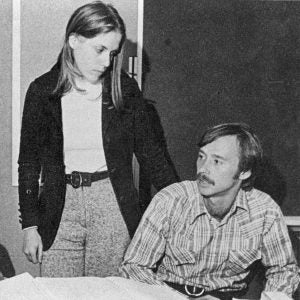
L: Dean Emerita Judith Areen and R: Prof. Wallace Mlyniec, L’70, in the Juvenile Justice Clinic’s early days.
The clinic was created in the wake of the Supreme Court’s 1967 decision in In re Gault, which established that juveniles charged with crimes had the same right to counsel as adults. Suddenly obligated to find lawyers for thousands of kids facing charges, the D.C. Superior Court put out a call for volunteers. One of those who signed up was an idealistic young Chicagoan named Wally Mlyniec, then a student at Georgetown Law. After graduating in 1970, he continued practicing in juvenile court, supported by grant funding. Meanwhile, clinic programs, in which law students got hands-on experience working on actual cases, were starting to pop up around the country, including at Georgetown. A D.C.-based group of volunteer lawyers for neglected and abused kids encouraged Areen, who was then teaching family law at Georgetown, to set up a clinic for juveniles – something that didn’t yet exist. Undeterred by half-joking colleagues who scoffed at the idea of a “kiddie clinic,” Areen pulled in some foundation funding and recruited Mlyniec to be the clinic’s founding director. “Wally was the first person I ever hired in my life,” says Areen. “And he’s still the best hire I’ve made in a long career.”
“I thought I’d do the job for two years and then move on to become a public defender,” says Mlyniec. “But the job just kept getting more interesting, more fun and better over the years.” He wound up staying with the Clinic for fifty solid years. Mlyniec handed over the director’s role to Blume Professor of Law Kristin Henning, L’97, in 2015, but stayed on in the role of “senior counsel.” (“They didn’t know what else to call me,” Mlyniec says.) In 2025, he plans to finally retire.
Over the decades, almost 900 students have enrolled in the Clinic. With faculty supervision, the lawyers-in-training defend youths charged with crimes, researching their backgrounds, cross-examining police officers and other witnesses, negotiating with prosecutors and litigating cases in court. Students also advocate for kids in school exclusion hearings, abuse and neglect proceedings, evictions from public housing and sometimes even in their relationships with their parents. “We’d talk to the kids, gain their trust and think outside the box,” says Lupo. “Child welfare workers might have 75 or 100 cases, all of them emergencies. The easiest thing for them to do is put a kid in foster care, so they can move on to the next one. They don’t have time to go out and find permanent or longer term placements. We would snoop out other relatives who could take those kids in, get them clothes from local charities, whatever was needed. Thanks to Wally and Judy, we learned to move through the system.” All told, clinic students, fellows and faculty have served more than 4,500 clients.
Many things have changed over that time, of course. “One of the biggest changes in my time here is the number of guns on the streets, and young people’s access to guns,” says Mlyniec. “Thanks to the Supreme Court, guns are now so abundant in cities all over America. Kids have seen so many shootings in their neighborhood they often carry guns just to protect themselves.” What hasn’t changed is the depressingly consistent profile of most of the Clinic’s clients: low-income, often survivors of brutal traumas, and overwhelmingly Black and brown children. “African-American kids always seem to get the raw end of the deal,” says Mlyniec.
That’s why Henning has expanded the program’s work beyond individual cases to push also for a broader notion of racial justice. “I’ve been representing kids in juvenile court in the District of Columbia for 26 years,” she says. “In all that time only four of them were white. Every other client that I had has been African-American.”
Henning was raised in Tennessee and North Carolina, in “a family of preachers and teachers, people who cared a lot about less fortunate kids,” she says. She was a freshman at Duke University when she got a life-changing jolt. “I was an apprentice at a local juvenile court in Durham. On my first day, I walked into the courthouse and saw a line of children all shackled together at their arms and legs,” she says. “I was just blown away. It was really that moment when I knew, ‘I really want to be a defense attorney.’”
Henning went on to Yale Law School, and came to Georgetown in 1995 as a Prettyman-Stiller fellow working in both the Criminal and Juvenile Justice Clinics. She went on to work for four years with the D.C. Public Defender Service, specializing in juvenile court. With Mlyniec’s encouragement, though, she came back to Georgetown, soon becoming a full professor. Dedicated as she was to her public defender job, she also loves to teach. “As a clinical professor, I get the great joy of both representing children accused of crime, and also teaching law students how to do this work and instilling in them a desire and a passion for serving young people,” she says.
Though she’d always known about racial disparities in the justice system (the subject of her 2021 book “The Rage of Innocence“), Henning says one particular case convinced her the Clinic needed to broaden its approach. She once represented a young black teenager named Eric who saw a Molotov cocktail in a movie and thought it looked cool. He found an empty bottle, filled it up with some liquids he found in the family’s kitchen, stuffed some toilet paper into the neck and closed the bottle cap. After playing with it, he tucked it into his book bag – and forgot it was there when he went back to school. The bag went through the school’s metal detector and a cop assigned to the school stopped the boy, who was then arrested and charged with attempted arson. Henning spent nine months litigating his case. Months later, after she told this story at a conference, a white woman came up to her and said her son had done the same thing – but instead of getting arrested, his curiosity and inventiveness got him moved into an advanced science class. “That was an a-ha moment,” she says. “I had thought Eric’s treatment was about our fears of school shootings, but I realized, no. It’s that we are afraid of Black children in particular. Particularly in the District of Columbia. I felt we had to be doing something about that.”
Under Henning’s leadership, the clinic has launched a number of offshoots aimed at promoting racial justice. In 2015, the Georgetown Juvenile Justice Initiative began advocating for policy changes at the national, regional and local level aimed at making the juvenile legal system “smaller, better and more just.” That includes pushing for more investment in schools, health care, restorative justice programs and other things that help keep youth from getting into trouble in the first place, and supporting them when they do. “It costs $621 a night to incarcerate a kid in D.C., but the maximum Temporary Aid to Needy Families benefit is $990 a month,” points out Professor Eduardo Ferrer, B’02, L’05, currently the policy director of what is now known as the Juvenile Justice Clinic & Initiative.
The Initiative also runs on-site trainings and webinars that have been attended by thousands of lawyers and other advocates, and offers a Racial Justice Toolkit of sample motions and pleadings, case law summaries and other resources. Henning and Ferrer often train attorneys across the country. Most recently, the Institute launched its Ambassadors for Racial Justice program, which has trained dozens of public defenders and other youth justice advocates committed to advancing racial equality.
Georgetown graduates who have gone through the Clinic or its sister programs say the experience affected the whole direction of their careers – and more. “It was life-changing,” says Ferrer, who was a student in the Clinic in 2004-2005. “Coming into the Clinic, I knew generally about the racial disparities that existed in terms of system involvement. But working directly with clients in D.C., I really came to understand the direct connection between these disparities, systemic racism and the legacies of slavery.” After graduating, he and other clinic alumni founded a youth justice nonprofit before he came back to teach in and work for the Clinic and eventually the Initiative.
“It was the hardest and the best thing I’ve ever done,” says Ebony Howard, L’07, who went through the Clinic in 2007. “It was the first time I felt so emotionally connected to the people I was representing.” The work often pushed her past what she thought she could do. She’d be toiling away on some kid’s court case, she says, and then suddenly learn the kid’s school was also threatening to expel them. “Kris (Henning) would say, ‘That’s your client. Go handle it.’ It really taught me what it means to be an advocate.” Like many other Clinic alumni, Howard is still in the juvenile justice arena. She’s now the deputy director of the Gault Center, a youth justice organization that partners with the Juvenile Justice Clinic & Initiative on several programs. “People in the Clinic, it’s like a fraternity, or a sorority, or whatever the gender neutral term is,” she says. “It’s a beautiful connection you don’t lose.”
Mlyniec isn’t giving up that connection – even if he is retiring soon. “I’ll be doing work in the archive,” he says. “After fifty years in the same chair you don’t just walk out the door.” There’s plenty of work still to be done, of course. “My biggest regret is that I hear my students still making the same arguments I did fifty years ago about the lack of rehabilitative services, or why some kid should not be locked up,” says Mlyniec.
On the other hand, there is also much to be proud of. “The fact that I’m getting invited to train judges and prosecutors shows we’re getting traction,” says Henning. “We’ve educated close to a thousand students and fellows. Even if they go off to big law firms, a huge number of them are still involved with public interest work. I’m confident they are doing good in the world,” says Mlyniec. “And we’ve prevented more kids than I can count from being harmed.”
One might count Parav Nanda’s clients among them. “The Juvenile Justice Clinic was the reason I applied to Georgetown,” says Nanda, L’23, a member of the clinic in 2022-23. One year after graduating, Nanda is now a public defender in Massachusetts, representing 40-plus young people at any given time. “Without the training and the knowledge base and the hands-on teaching that I received through the clinic,” he says, “I could not think about doing this job.”
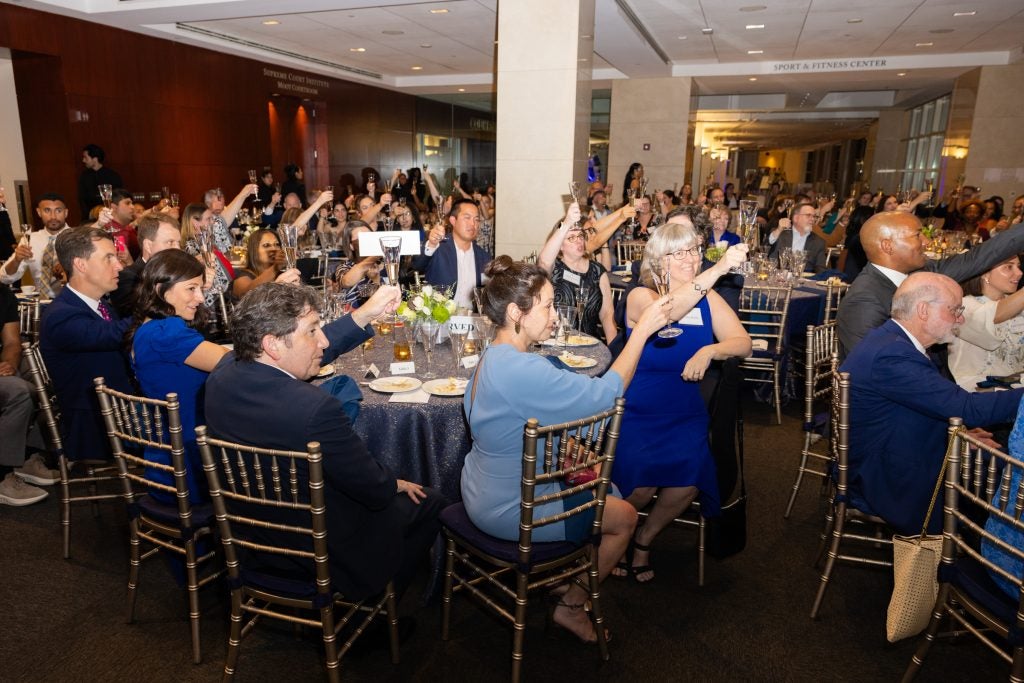
Clinic alumni and other supporters toasted the Clinic’s 50th anniversary. Photo: Elman Studio
Author Vince Beiser is a journalist based in Vancouver, Canada. He is the author of the books “The World in a Grain: The Story of Sand and How It Transformed Civilization” and the forthcoming “Power Metal.”