Georgetown Law Supreme Court Institute Previews October Term 2026
September 21, 2026
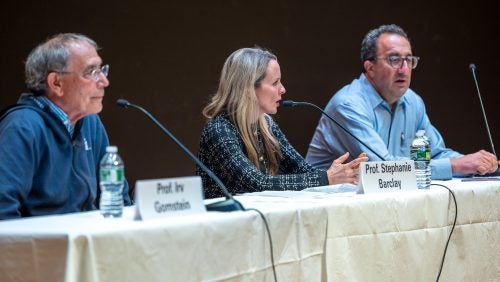
L-R: Prof. Irv Gornstein, Prof. Stephanie Barclay, Prof. Marty Lederman.
Some 200 students gathered to watch Georgetown Law faculty discuss the Supreme Court’s upcoming October 2026 term during a student preview panel hosted by the Supreme Court Institute (SCI) and the Georgetown Center for the Constitution on Sept. 16.
The event, which was co-sponsored by campus chapters of the American Constitution Society and the Federalist Society, was moderated by SCI Executive Director Professor Irv Gornstein and featured Professor Stephanie Barclay, faculty director of the Georgetown Center for the Constitution, in conversation with SCI Senior Fellow Professor Marty Lederman.
The panelists offered their assessments of the Court’s prior term and discussed several of the high-profile cases set to be heard by the nation’s highest court in the year ahead, including those concerning the Second Amendment, religious liberty and other consequential constitutional issues.
“These are really deep and hard questions,” said Lederman of the First Amendment test and religious exemption questions raised by St. Mary Catholic Parish v. Roy, which concerns public funding for religious preschools. “The Court’s grappling with them, and … it’s become much more complicated in recent years than it had been before,” he said, noting that individuals from across the political spectrum have increasingly brought religious exemption claims before the courts.
“For the last 10 or 15 years, this court has … carved out all sorts of contexts in which they will grant religious exemptions; the Court will recognize them to a far greater degree than we ever have in our nation’s history before,” he said.

Students in attendance received handouts detailing selected cases from the upcoming term. Each year, the Supreme Court Institute publishes a guide to noteworthy cases in the upcoming term.
The panelists also discussed Viramontes v. Cook County, which concerns the right to possess AR-15s and similar semiautomatic rifles. “Part of what is at issue in this case is will the government be able to show or make arguments about there being unusual dangerousness with respect to this type of gun that, as [Professor Gornstein] points out, is really commonly used,” said Barclay, noting the Court’s consideration of the historical reasons that made it permissible — or impermissible — to limit the right to bear arms in its reasoning on Second Amendment issues.
“You can’t pick a reason that could defeat the right in every single case, or that would make it irrelevant that we have the right to begin with,” she said. “You have to pick a right that’s historically grounded, and that’s only going to let the government limit the right in certain particular cases.”
The faculty discussion was followed by a question-and-answer session in which students posed questions about potential outcomes and legal reasoning related to upcoming cases.
The student preview was preceded by a preview panel for members of the press on September 15, which was moderated by Professor Gornstein and featured Supreme Court and appellate advocates Donald Verrilli, Jr., Deepak Gupta, L’02, Roman Martinez and Erin Murphy, L’06.
In addition to the annual preview events, the Supreme Court Institute (SCI) publishes a yearly guide summarizing the noteworthy cases scheduled to be heard in the new term and hosts moot courts that give Supreme Court advocates the chance to practice their oral arguments before a panel of experts.
This story will be updated shortly to include a captioned video recording of the press preview panel.